
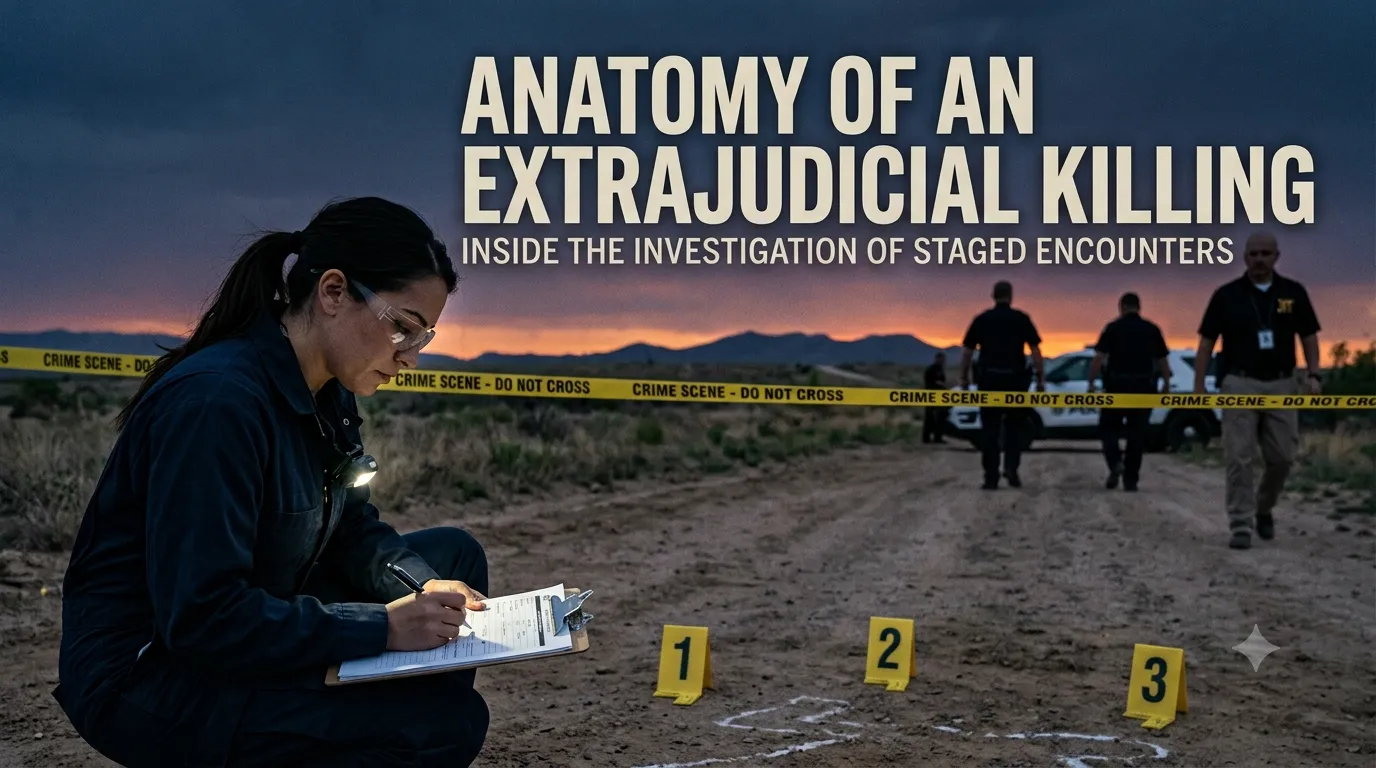
In early January 2018, Naqeebullah Mehsud—a 27-year-old textile worker and aspiring fashion model from South Waziristan—was picked up by plainclothes men from a local tea shop in Karachi. Ten days later, his body was laid out alongside three others on the dirt floor of a deserted farmhouse on the city’s outskirts.
The official police narrative was immediate, authoritative, and routine: Senior Superintendent of Police (SSP) Rao Anwar announced to the press that a joint tactical unit had successfully neutralized four hardened militants tied to outlawed terrorist outfits during a high-stakes, multi-directional firefight.
For decades, that standardized memo would have been where the story ended. Closed files, quiet burials, and zero institutional questions. However, Naqeebullah’s death ignited a widespread national human rights movement that demanded an independent, technical audit of the incident.
What followed became a landmark study in how digital forensics, forensic ballistics, and paper trails can systematically dismantle state-sanctioned extrajudicial violence.
The Structural Blueprint of Fake "Encounters"
Human rights bodies, including the Human Rights Commission of Pakistan (HRCP), have long documented the phenomenon of the "staged encounter." Far from an accidental breach of protocol, it functions as a deliberate extrajudicial shortcut utilized by law enforcement agencies under intense political pressure to maintain public order, bypass weak criminal justice systems, or execute targeted liquidations without judicial oversight.
The institutional mechanics follow a distinct, highly repeatable operational pattern:
Unrecorded Custody:
Targets are detained without formal judicial warrants, jail entries, or station records, creating an initial period of total legal non-existence.
Off-the-Grid Detention:
Victims are transferred to unlisted sub-jails, private safe houses, or unmonitored holding cells while families are intentionally kept in the dark.
Crime Scene Staging:
Detainees are transported to secluded rural or suburban locations, executed at point-blank range, and planted with unregistered weapons, dummy explosives, or fake tactical gear.
Standardized Reporting:
The department releases a pre-drafted press release claiming officers came under sudden fire while on routine patrol and returned fire in legitimate self-defense.
Digital Forensics vs. Official Fictions
What unspooled the official narrative in Naqeebullah’s case was a high-level Joint Investigation Team (JIT) that systematically prioritized hard technical data over police statements:
Call Data Records (CDRs) & Geo-Fencing:
Mobile network tower logs completely destroyed the officers' alibis. Geolocation data placed key police commanders at the murder site hours before the alleged "shootout" occurred, disproving official claims that senior staff arrived post-facto to manage an ongoing emergency.
Forensic Ballistics & Autopsies: Independent post-mortem examinations revealed that Naqeebullah was shot in the back at point-blank range—a downward trajectory that is physically impossible in an open-field, multi-directional firefight. Furthermore, no gunpowder residue was found on the victim's hands, proving he had never discharged a firearm.
Witness Reconstruction: Eyewitnesses who had been abducted alongside Naqeebullah and later released confirmed they had been held in illegal captivity together in a private facility, establishing a verified timeline of custody weeks prior to the alleged encounter date.
The Systemic Gap Between Investigation and Justice
The JIT investigation conclusively established that the encounter was entirely fabricated, proving that Naqeebullah had zero ties to militant networks. The case exposed the structural rot of extrajudicial practices and mobilized massive public protests demanding sweeping police reforms.
Yet, the ultimate judicial outcome highlights the steep challenge of convicting state actors through existing legal channels. In January 2023, an anti-terrorism court acquitted the primary police officials, citing prosecution loopholes, hostile witness turns, and evidentiary gaps.
The Naqeebullah Mehsud investigation remains a crucial case study in modern human rights work.
It demonstrates that while digital forensics and technical evidence can expose official fabrications to the public, dismantling systemic abuse requires persistent, long-term judicial and institutional reform.

Discussion