

Preface
Stop pretending AI is just cold code.
It’s 2026. I don’t “use” software anymore. I talk to it.
It’s 3AM. My laptop’s on. The fan is buzzing. Chai thandi ho chuki hai. This doesn’t feel like work. It feels like I’m in a band, trying to write a song before morning.
I used to sit here and stare. Blank screen. Cursor blinking. Like it was judging me. I’d type commands — “Write a blog post about X.” And it would throw junk back at me.
Then something changed. I stopped ordering. I started talking.
At 2:47AM one night, I typed, “This is stupid, but what if…”
And it replied — not with an answer, but with a question.
That’s when things shifted. My writing stopped sounding like a template. It started to sound like me.
I don’t write posts now. I don’t fill pages. I write stories — the kind I’d actually read.
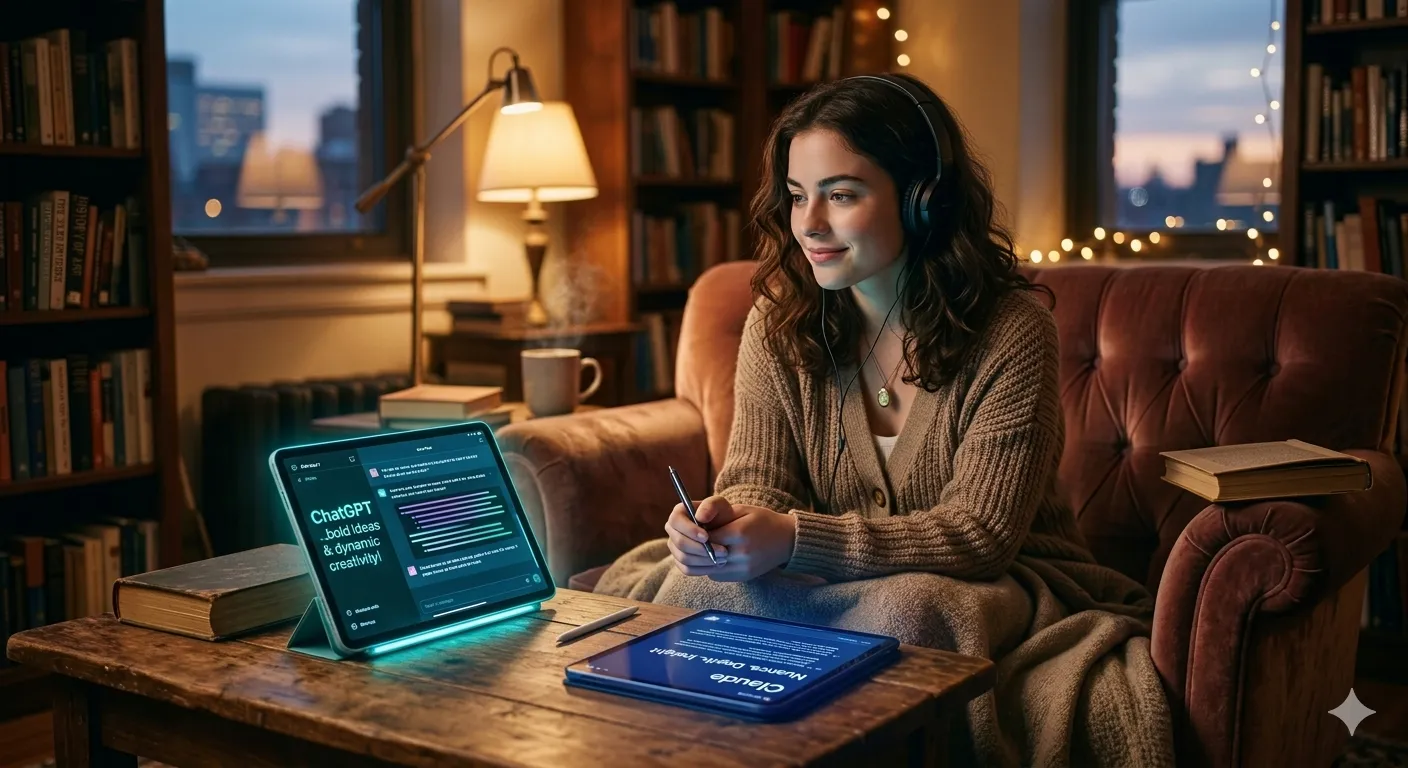
ChatGPT — The Spark
If my creative life was a film, ChatGPT would be the friend in the front row — the one yelling, “Do it. Worst case, you delete it.”
It doesn’t just throw data at me. It argues. It disagrees. It calls my first idea lazy. And honestly, it usually is.
Last week, I was stuck on a caption. I gave it three words: “AI, lonely, weird.” Ten seconds later, it gave me twenty angles. One of them made me swear out loud. That’s the one I went with.
The Vibe
When I’m stuck, I throw it half a thought, half a rant — sometimes just a messy voice note I transcribed badly. It takes that mess and turns it into something powerful.
This isn’t about “AI generating content.” That phrase makes me cringe. This is about the final draft sounding like I wrote it at 3AM — not like it was assembled in a lab.
For brainstorming, for breaking through blank-page fear, nothing beats it.
Claude — The Depth
ChatGPT brings the heat. Claude brings the quiet — the kind of quiet you feel at 4AM when the world is asleep.
It reads between my lines. It notices when I’m trying to sound smart instead of honest. It will say, “This feels off. What do you actually mean?”
Annoying. But right. Every time.
Last month, I was writing about burnout. ChatGPT gave me stats and “5 tips” lists — useful, but shallow. Claude asked me what burnout felt like on a Tuesday.
I told it about hiding in my car for ten minutes before a Zoom call. That became the article. And that one got real responses.
The Depth
When a story needs soul, I go to Claude. It understands my tone without me explaining twice. It remembers what I don’t like. It gets when I’m being sarcastic because I’m tired.
Working with it feels like a late-night conversation with a friend who doesn’t try to fix you — just listens until you figure things out yourself.
The results don’t just rank. They feel real.
What Actually Works in 2026
Google changed. Everyone felt it. Robotic writing stopped working.
You can’t trick it anymore. Stuffing keywords everywhere won’t get you to page one. If your article sounds like everyone else’s, you’re invisible.
What works now is what only you can write. Your messy drafts. Your opinions. Your weird 3AM ideas that somehow make sense in the morning.
I learned this the hard way. I published 30 “optimized” posts. Perfect SEO. Zero traffic.
Then I wrote one post about arguing with AI at night. That one worked.
I stopped treating AI like a vending machine — insert prompt, get 500 words, publish. I started treating it like a co-writer. A messy, brilliant, sometimes dumb co-writer.
Now I’m not copying the internet. I’m adding to it. One weird, specific, human story at a time.
People stay because they feel something. And yeah, Google notices that — time on page, comments, shares. You can’t fake it.
The Real Question
So are machines becoming human?
No. That’s not even the right question.
The real question is: are we using machines to become more human? To say things we were too tired or too scared to say alone?
I think so. I think that’s the point.
If you keep saying “write this for me,” everything you create will feel empty. Because you’re not really in it.
But when you say, “Let’s talk about this together,” something changes.
The work gets sharper. Brighter. It starts to sound like you — after two coffees, telling the truth.
FAQs
Is using AI for SEO safe in 2026?
Yes — but only if you treat it like a partner, not a tool. Google doesn’t care what you used. It cares whether you added something new. A story, a detail, a perspective that doesn’t already exist online.
ChatGPT or Claude — which is better?
It depends.
Need bold ideas fast? Use ChatGPT.
Need depth and emotional clarity? Use Claude.
Most days, I use both.
How do I sound human and not robotic?
Forget trying to “pass” anything.
Write for a real person. Talk to AI like you’d talk to a smart, slightly weird friend. Add real details from your life — chai, late nights, random thoughts.
If you do that, you don’t need to pass anything. You’ll naturally stand out.
Conclusion
The 2026 winners are not the most well-equipped.
They’re the ones who know how to use those tools without losing themselves.
Stop ordering. Start talking.
That’s where the real work begins.
That’s where it starts to feel real.


















Responses (0)
Sign in to share your thoughts.
Sign in