
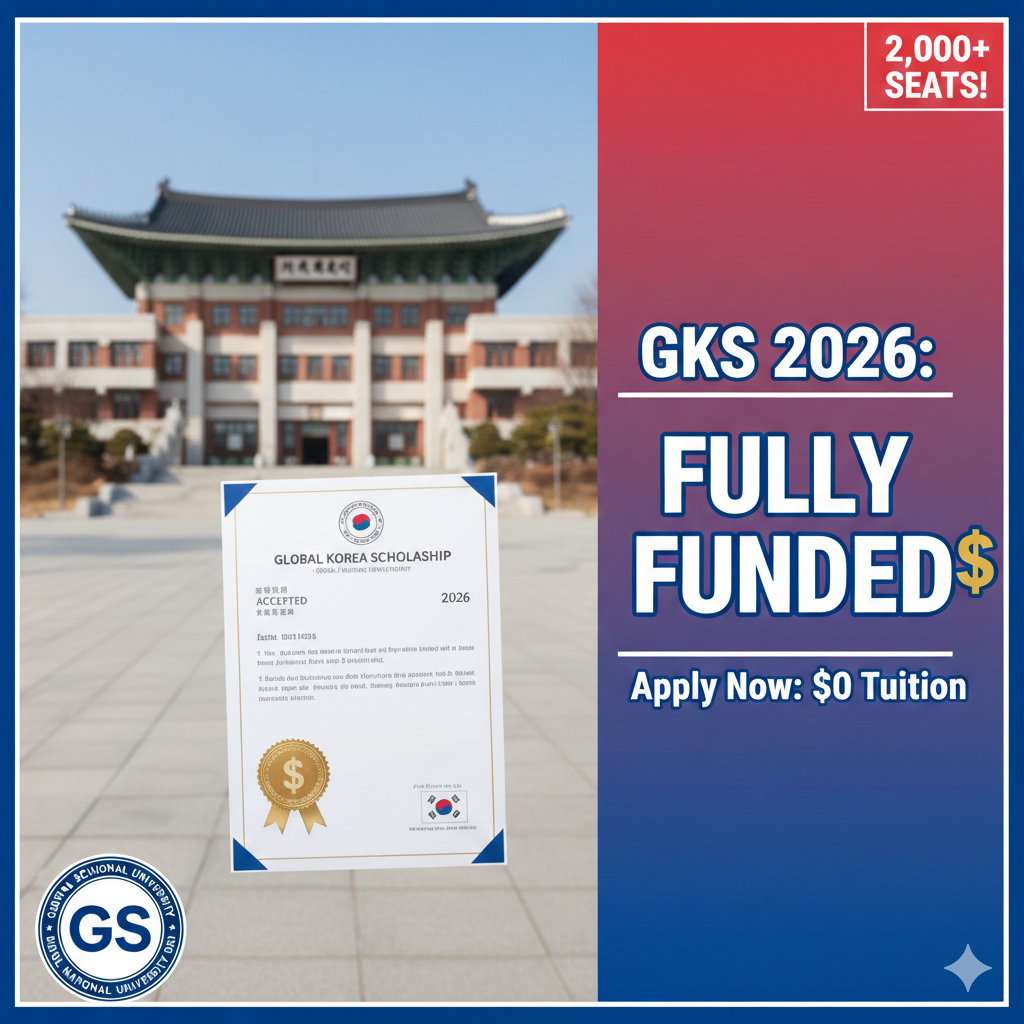
In the context of Korean scholarships for 2026, "Tags" usually refer to the application tracks or program categories you must select when filling out your forms. Choosing the right "tag" is critical because it determines your quota and competition pool.
Here are the primary tags and categories for the 2026 GKS (Global Korea Scholarship) and university applications:
1. Application Track Tags
When you apply, you must choose one of these tracks. You cannot apply to both.
* Embassy Track: Applications go through the Korean Embassy in your home country.
* Benefit: You can list up to 3 different universities.
* Tag Category: General, Overseas Korean, or Korean Language Teaching Professional.
* University Track: You apply directly to a single Korean university.
* Benefit: Often a faster selection process.
* Tag Category: General, Regional University (R-GKS), or Research.
2. Program Type Tags
Depending on your field of study, your application may fall under a specialized tag that has its own reserved seats:
* R-GKS (Regional University): Specifically for students applying to universities outside of the Seoul Metropolitan area. This is a "priority tag" to encourage students to study in provinces like Busan, Daegu, or Gwangju.
* R&D (Research & Development): A tag for STEM (Science, Technology, Engineering, Math) applicants applying to specific research-heavy departments. This tag often has a higher quota in 2026 to boost tech innovation.
* Global Network: A newer tag for future leaders in fields like Public Policy and International Relations.
* International Organization: For applicants recommended by specific global partners.
3. University "Type" Tags
In the official GKS guidelines, universities are tagged as Type A or Type B:
| Tag | Location | Examples |
|---|---|---|
| Type A | Seoul & Metro Area | SNU, Yonsei, Korea University, Hanyang |
| Type B | Regional/Provincial | Pusan National, Chonnam National, Kyungpook |
> Pro-Tip: If applying via the Embassy Track, you must choose at least one university tagged as Type B in your list of three choices.
>
4. Academic Requirement "Tags"
When evaluating your profile, the NIIED (National Institute for International Education) looks for these specific markers:
* GPA Score: Must be 80% or higher (or top 20% of your class).
* TOPIK Level: Level 3 or higher is a major advantage; Level 5 or 6 exempts you from the mandatory language year.
* English Proficiency: High scores in IELTS or TOEFL (usually 7.0+ or 90+) are highly valued for English-taught programs.
Would you like me to find the specific list of Type A and Type B universities for the 2026 cycle?























Responses (0)
Sign in to share your thoughts.
Sign in