
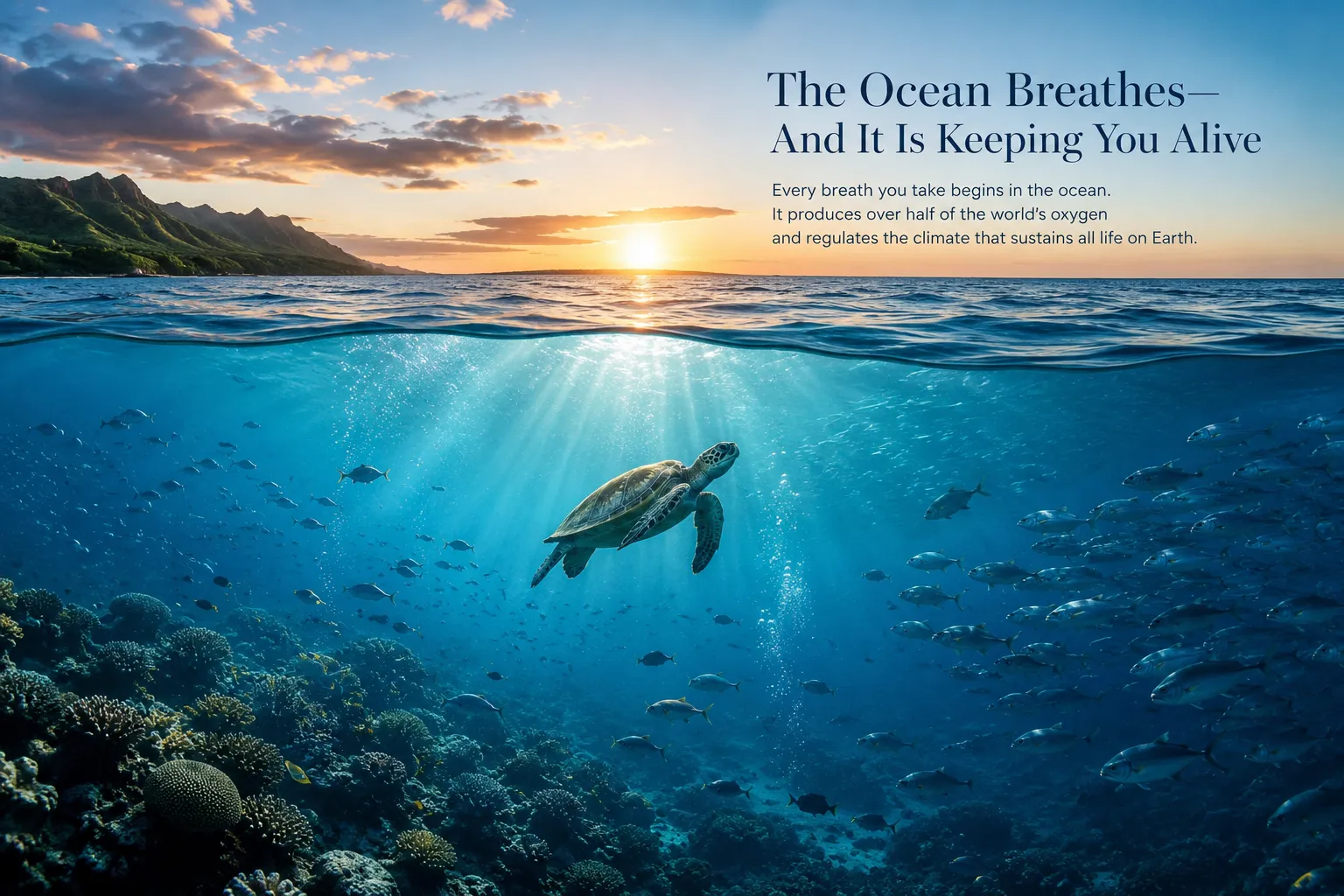
Stop for a moment and think about the breath you just took. Where did that oxygen actually come from? Most people would say trees, forests, or plants. And they would only be partly right. A significant portion of the air filling your lungs right now originated far from any forest — it came from the open ocean, produced by living things so small that billions of them could fit in a single drop of water.
This is not a minor scientific detail. It is one of the most important facts about life on Earth, and most of us were never taught it.
The Invisible Farmers of the Sea
Scattered across the sunlit upper layers of every ocean on Earth are countless microscopic organisms called phytoplankton. They belong to neither the plant nor the animal kingdom.They occupy an intermediate position: they are small, floating life forms that achieve something extraordinary. They capture sunlight, absorb carbon dioxide from the surrounding water, and convert it into energy.Oxygen is what they release in return.
The figures that support this strategy are quite impressive. These organisms collectively generate somewhere between half and four fifths of all the oxygen present in Earth's atmosphere. One particular species, Prochlorococcus — only identified by scientists in 1986 — is now believed to be among the most productive oxygen-generating life forms on the entire planet. The ocean, it turns out, is not just a body of water. It is the engine behind every breath we take.
Quietly Absorbing What We Produce
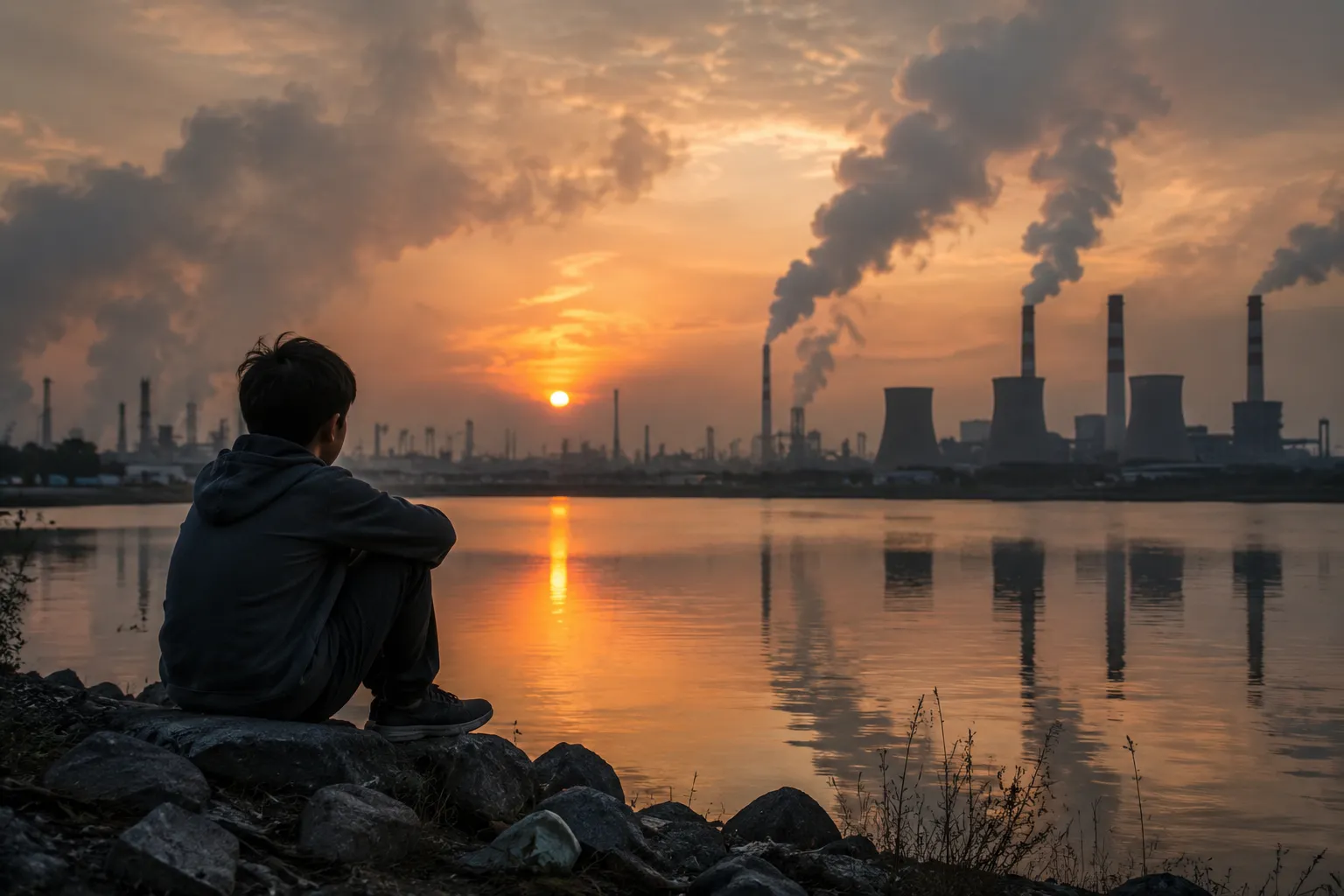
The ocean does something else that rarely gets the attention it deserves. Every single year, human industry, transport, and energy use pump tens of billions of tonnes of carbon dioxide into the atmosphere. The ocean quietly pulls around a quarter of that back out again.
Part of this happens through simple chemistry — cooler seawater draws in gas from the air above it, much like a chilled glass of soda holds its bubbles better than a warm one. The rest happens biologically. Phytoplankton consume carbon during their lifetimes, and when they die, they drift slowly downward, carrying that carbon toward the ocean floor where it remains locked away for extraordinarily long periods. Scientists call this the biological carbon pump, and without it functioning at full capacity, the rate of climate change on this planet would already be far worse than what we are currently experiencing.
I prefer oxygen

The ocean's role extends well beyond the air we breathe. It is the primary force shaping weather patterns and temperatures around the world. Large amounts of solar heat are absorbed by seawater and released gradually over time, moderating the extremes that coastal areas would otherwise experience in every season.
Deep beneath the surface, enormous currents move slowly around the planet like underwater rivers, carrying warmth from tropical regions toward colder latitudes and drawing cooler water back in return. These systems keep vast areas of the world genuinely liveable. One of the most significant — a circulation pattern running through the Atlantic Ocean — plays a major role in keeping Northern Europe considerably warmer than its geographic position would otherwise allow. There is growing scientific concern that the influx of cold freshwater from melting Arctic ice is beginning to interfere with this system, with potentially serious consequences for weather patterns across two continents.
A World Beneath That Remains Mostly Unknown
For all the scientific progress humanity has made, the deep ocean remains one of the least understood places on Earth. More than eighty percent of it has never been meaningfully explored. Below roughly two hundred metres, sunlight disappears entirely, pressure becomes immense, and temperatures hover just above freezing.
And yet life is everywhere down there. Species equipped with their own bioluminescence glow in the permanent darkness. Organisms cluster around hydrothermal vents where water temperatures are hot enough to melt lead. Entirely new creatures are found there every single year. Many marine scientists believe that the ocean floor contains more undiscovered biodiversity than any rainforest on land — most of it still completely unknown to science.
Under Serious Pressure
The same ocean that sustains us is being pushed toward its limits. Warming surface temperatures are altering the circulation patterns that regulate global weather. As more carbon dioxide dissolves into seawater, the water grows increasingly acidic — a gradual chemical shift that weakens the shells of molluscs and corals and disrupts the tiny the microscopic life forms found at the base of the food chain.
Coral reefs are particularly vulnerable. These structures occupy less than one percent of the ocean floor, yet they provide habitat and food for roughly a quarter of all marine species. They are now bleaching and collapsing at a rate that would have seemed impossible just a generation ago. Plastic dumping, overfishing and coastal construction have devastated ecosystems for millions of years.
Recovery Is Possible
Here is what makes this situation different from many environmental challenges — the ocean can recover, and it can do so relatively quickly when pressure is reduced. In areas where fishing and industrial activity have been restricted, fish populations have rebounded, coral has regrown, and biodiversity has returned within just a few years. Restored seagrass meadows and mangrove forests absorb carbon at rates that most land environments cannot match.
None of this requires technology that does not yet exist. Supporting marine protected areas, making thoughtful choices about seafood, and reducing single-use plastic are actions available to ordinary people right now, with outcomes that are measurable and real.
The ocean has kept this planet alive for billions of years. It produces the air we breathe, shapes the weather that grows our food, and absorbs the carbon that would otherwise accelerate the warming of our world. Taking care of it is not a task for specialists alone. It belongs to everyone who depends on it — which is every living thing on Earth.






















Responses (0)
Sign in to share your thoughts.
Sign in