
10 Incredible Volcano Facts Most People Have Never Heard Of

Category: Science & Nature | Reading Time: ~7 minutes
Volcanoes are among the most powerful and awe-inspiring geological features on Earth. They can remain dormant for thousands of years, then dramatically reshape entire landscapes in a matter of hours. Most people recognize famous peaks like Japan's Mount Fuji or Italy's Mount Vesuvius, but the world of volcanology is filled with surprising discoveries that go far beyond the textbook. From a volcano that sledders ride down to one that produces black lava unlike anything else on the planet, here are 10 incredible volcano facts that most people have never heard of.
FACT 1
You Can Actually Sled Down an Active Volcano in Nicaragua
Cerro Negro: The World's Only Volcano Boarding Destination

Located on Nicaragua's Pacific coast, Cerro Negro is a young and highly active stratovolcano whose slopes are blanketed in fine black volcanic sand. The volcano last erupted in 1999, and in the years since, an unusual tourism industry has taken root at its base — volcano boarding.
Visitors who are willing to hike roughly an hour to the summit are rewarded with a sweeping panoramic view, followed by an adrenaline-packed descent. Participants are outfitted with bright orange jumpsuits and protective goggles before sitting on a specially made wooden-and-metal board and launching themselves down the steep volcanic slope. Although it is sometimes compared to surfing, most people descend in a seated position rather than standing.
Key Stat: Riders can reach speeds of up to 40 miles per hour (64 km/h), and the entire descent from top to bottom takes less than 60 seconds.
The experience is unlike anything else on Earth. Being in close proximity to a real active volcano while hurtling downhill at high speed is a thrill that volcano boarding enthusiasts say simply cannot be replicated. Cerro Negro remains one of the most unique adventure tourism destinations in all of Central America.
FACT 2
Certain Rare Volcanoes Have Actually Erupted Diamonds
Kimberlite Eruptions: Nature's Diamond Delivery System

When most people picture a volcanic eruption, they imagine rivers of glowing orange lava, billowing ash clouds, and poisonous gases. But a rare category of volcano does something far more astonishing — it erupts diamonds to the surface.
Diamonds form under extraordinarily high pressure, roughly 93 miles (150 km) or more beneath Earth's surface. The only natural process capable of transporting them upward is a kimberlite eruption, in which fast-moving magma from deep in the mantle travels violently toward the surface, carrying diamonds and other minerals along with it.
Kimberlite volcanoes have a distinctive carrot-like shape — wide at the surface and narrowing significantly with depth. They tend to form in geologically ancient parts of Earth's crust, with the most famous examples found in South Africa, Brazil, and parts of Canada and Russia. These regions are among the world's leading diamond-producing areas precisely because of their kimberlite geology.
Surprising Fact: The last known kimberlite eruption is believed to have taken place more than 25 million years ago, meaning no human has ever witnessed a diamond-erupting volcano in action.
FACT 3
Hawaii's Mauna Kea Is Actually Taller Than Mount Everest
Why Sea Level Changes Everything About What "Tallest" Means

Mount Everest is universally known as the tallest mountain on Earth, standing at 29,032 feet (8,849 m) above sea level. But that title only holds true when height is measured from sea level. When measured from base to summit — the true definition of a mountain's total height — Everest is actually surpassed by Hawaii's Mauna Kea volcano.
Mauna Kea rises 33,497 feet (10,210 m) from its base on the Pacific Ocean floor to its peak. The catch is that the vast majority of this height — around 19,700 feet (6,000 m) — sits beneath the ocean's surface. Only 13,802 feet (4,207 m) of Mauna Kea is visible above the waterline, which is why it does not commonly appear on lists of the world's tallest mountains.
Despite being classified as dormant, Mauna Kea is a geological giant. Its last eruption is estimated to have occurred roughly 4,500 years ago. Scientists note that while the volcano is currently quiet, there remains a possibility that it could become active again in the distant future. Today, the summit of Mauna Kea is home to several world-class astronomical observatories, chosen for its high altitude, dry air, and minimal light pollution.
FACT 4
NASA Uses an Active Hawaiian Volcano to Train Future Mars Explorers
The HI-SEAS Program on Mauna Loa's Slopes

While Mauna Kea is dormant, its neighbor Mauna Loa is Earth's largest active volcano — and it happens to double as a training ground for future missions to Mars and the Moon. Since 2013, the Hawaii Space Exploration Analog and Simulation program, known as HI-SEAS, has operated a small habitat dome 8,200 feet (2,500 m) up on Mauna Loa's rugged lava-covered slopes.
Six crew members at a time live inside the dome for periods ranging from four months to an entire year. The environment is engineered to simulate the conditions of a long-duration space mission as closely as possible. Crew members experience a mandatory 20-minute communication delay — mirroring the actual signal delay between Earth and Mars — and must wear full spacesuits whenever they venture outside the dome.
What Researchers Are Learning from the Simulation
Beyond physical training, the program provides researchers with valuable psychological data. The volcanic landscape of Mauna Loa, with its barren terrain and isolation, closely resembles what scientists expect on the Martian surface, making it ideal for geological and astrobiological field exercises. Program investigators have noted that one of the most critical findings involves how small teams manage interpersonal conflict during extended periods of extreme isolation — information that will be vital for any real mission to Mars.
FACT 5
Antarctica Has an Active Volcano With a Permanent Lava Lake
Mount Erebus: Fire and Ice at the Bottom of the World

Antarctica is best known for its extreme cold — the lowest temperature ever reliably recorded on Earth's surface, approximately −137°F (−94°C), was measured on the Eastern Antarctic Plateau. Yet this frozen continent is also home to one of the world's most remarkable volcanic phenomena: a permanently active lava lake.
Mount Erebus, located on Ross Island, has maintained a persistent lava lake in its summit caldera since 1972. Persistent lava lakes are exceptionally rare globally, found in only a small handful of volcanoes worldwide. What makes Erebus particularly unusual is its chemical composition — unlike most volcanoes, which are rich in water vapor, Erebus is dominated by carbon dioxide. This difference in gas chemistry allows the magma to rise unusually close to the surface, sustaining the lava lake in a near-constant state of low-level activity.
Did You Know? Scientists are still working to fully understand what drives Mount Erebus's unique behavior. Its remote location on the Antarctic continent has historically made detailed research challenging.
FACT 6
Mount Paektu Produced One of History's Largest Eruptions — Far From Any Tectonic Plate Boundary
The Mystery Volcano on the Korea–China Border

Situated on the border between North Korea and China, Mount Paektu is responsible for one of the most powerful volcanic eruptions in recorded human history. Around 946 CE, the volcano released an estimated 45 megatons of sulfur into the atmosphere in what geologists have named the Millennium Eruption. To put that into perspective, when Indonesia's Mount Tambora erupted in 1815 — releasing roughly 28 megatons of sulfur — the event caused global temperatures to drop significantly, leading to widespread crop failures and famine across the Northern Hemisphere in what became known as the "Year Without a Summer."
Paektu's eruption was even larger than Tambora's by some measures, yet it did not produce comparable global climate effects — a discrepancy that volcanologists are still actively researching. The eruption did, however, carve out the massive crater at the volcano's summit, which today holds a lake known as Heaven Lake, nearly 3 miles (5 km) wide.
Why Paektu's Location Defies Geological Logic
Most volcanoes form at the boundaries between tectonic plates, where one plate subducts beneath another, generating the heat and pressure that produces magma. Mount Paektu, however, sits more than 600 miles (965 km) away from the nearest plate boundary, the Pacific Plate. This makes it a genuine geological anomaly. The reasons for its existence in this location are still not fully understood, though the mountain has recently been designated a UNESCO Global Geopark, which scientists hope will allow greater international research access.
FACT 7
Japan's Mount Unzen Was Once Used as an Execution Site for Christians
The Dark History Behind Japan's Deadliest Volcano

Mount Unzen, located on the island of Kyushu at Japan's southwestern tip, holds the grim distinction of being the most deadly volcano in Japanese history. In 1792, a massive eruption destabilized a portion of the volcano's flank, triggering a catastrophic landslide and tsunami that killed approximately 15,000 people — one of the deadliest volcanic disasters in Asian history.
But Unzen's association with death extends beyond natural disasters. During the 17th and 18th centuries, under Japan's Edo-period government, the volcano's boiling, highly acidic hot springs were used as an instrument of execution against Christians. The Edo government strictly prohibited the spread of Christianity, viewing the influence of European missionaries as a political and cultural threat.
Individuals caught practicing Christianity — whether foreign missionaries or Japanese converts — were first subjected to torture and given the opportunity to renounce their faith. Those who refused were executed by being thrown into Unzen's superheated volcanic springs. The combination of extreme heat and high acidity made death both certain and agonizing.
Historical Note: The use of Unzen as an execution site ended in the early 1800s, and the formal persecution of Christians in Japan officially concluded in 1856.
FACT 8
Sharks Have Been Found Living Inside an Active Underwater Volcano
The "Sharkcano" Discovery at Kavachi

The ocean floor hosts an estimated one million volcanoes, far outnumbering those on land. Among the most active of these submarine volcanoes is Kavachi, located in the warm waters just off the Solomon Islands in the South Pacific. Kavachi erupts frequently, expelling superheated water, ash, and toxic gases into the surrounding ocean. Scientists assumed that nothing beyond heat-resistant microbial bacteria could survive inside its crater.
That assumption was shattered in 2015 when a research team led by ocean engineer Brennan Phillips lowered an underwater camera into the crater, approximately 66 feet (20 m) below the surface. What the footage revealed was completely unexpected: large animals were actively swimming through the hot, acidic, ash-laden water inside the volcano. The team captured clear footage of silky sharks, scalloped hammerhead sharks, and sixgill stingrays moving through the volcanic plume as if the conditions were perfectly normal.
What Does This Mean for Marine Science?
The discovery raised a host of unanswered questions. How do these sharks tolerate the extreme chemical and thermal conditions inside an active volcanic crater? Do they sense impending eruptions and evacuate in time? Do they live permanently inside the volcano or simply pass through? Researchers have informally dubbed Kavachi the "sharkcano," and ongoing studies aim to better understand this bizarre and thriving ecosystem that exists in one of the most hostile environments on the planet.
FACT 9
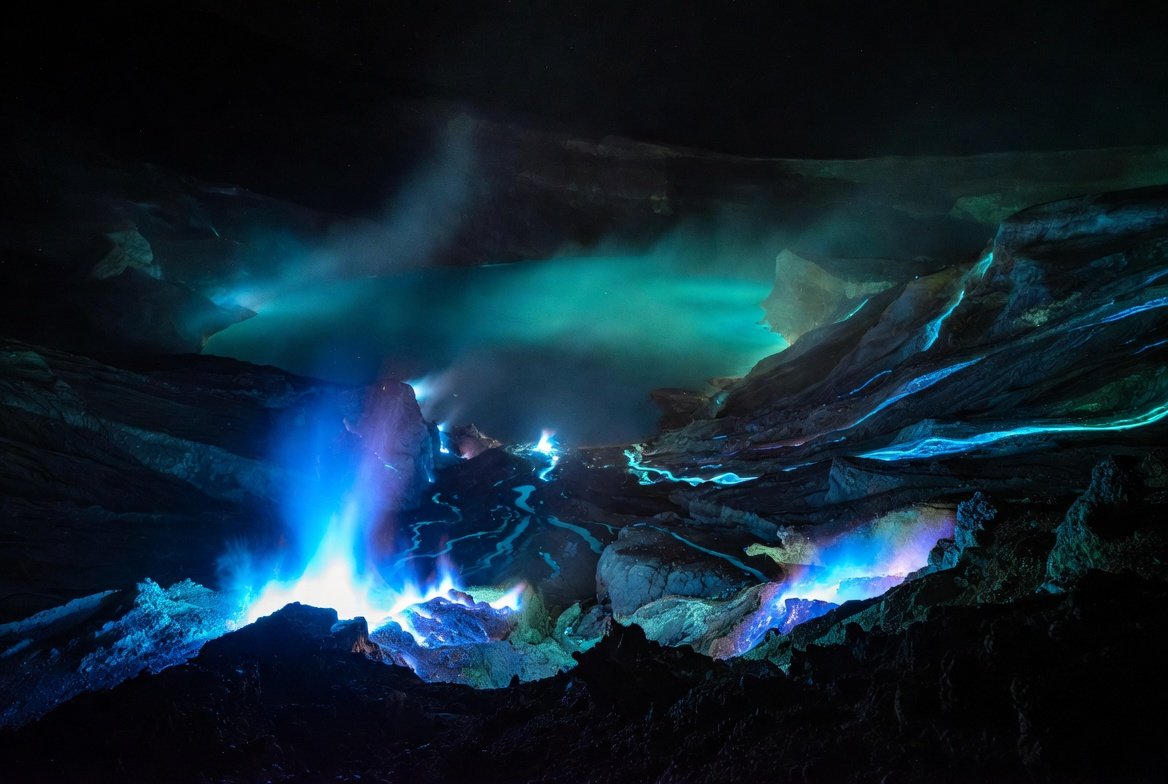
Indonesia's Kawah Ijen Burns With Brilliant Electric-Blue Fire
The Science Behind the World's Most Visually Stunning Volcano

Kawah Ijen, located in East Java, Indonesia, is often misrepresented online as having blue lava. The truth is actually more scientifically fascinating: the electric-blue glow that visitors witness is not lava at all, but burning sulfuric gas.
Highly concentrated sulfuric gases seep out of fissures and vents in the volcano at temperatures reaching up to 1,112°F (600°C). When these gases contact the cooler open air, they combust spontaneously, producing an intense blue flame. In some cases, the gases cool enough to condense into liquid sulfur before fully burning, creating the appearance of glowing blue liquid flowing down the slope — which is what photographers have often captured in viral images and mistaken for blue lava.
Visitor Note: The blue flames burn continuously, reaching heights of up to 16 feet (5 m), but are most visible after dark. Visitors must wear gas masks due to the highly toxic sulfur dioxide in the air.
In addition to the blue fire, Kawah Ijen's summit crater contains the world's largest naturally occurring acid lake — a body of turquoise water so corrosive that it can dissolve metal. Despite the hazardous conditions, local miners wade into the crater daily to extract solid sulfur, which is sold to sugar refineries and chemical manufacturers.
FACT 10
Tanzania's Ol Doinyo Lengai Is the Only Volcano on Earth That Erupts Black Lava
Carbonatite Lava: The Coldest and Most Unusual Lava on the Planet

In the remote highlands of northern Tanzania, within sight of the Serengeti, stands Ol Doinyo Lengai — a volcano unlike any other on Earth. It is the only active volcano in the world known to erupt carbonatite lava, a type of lava with a chemical composition so different from conventional lava that it behaves in ways that seem almost impossible.
Standard volcanic lava is silica-rich, which gives it its characteristically thick, viscous texture and bright orange-to-red glow. Ol Doinyo Lengai's lava, by contrast, is low in silica and high in sodium and calcium carbonate — the same compounds found in limestone and chalk. This unusual chemistry gives the lava its striking black color and makes it far more fluid than typical lava. Fresh carbonatite lava flows almost like water, spreading quickly across the crater floor before cooling.
The Coolest Lava on Earth — and Why It Matters for the Serengeti
The lava of Ol Doinyo Lengai erupts at approximately 932°F (500°C), which is roughly half the temperature of conventional lava. This is cool enough that field geologists can collect fresh samples using ordinary steel cups rather than specialized heat-resistant equipment. Once the black lava is exposed to air and moisture, it rapidly oxidizes and turns a pale silvery-white color, giving the volcano's interior a ghostly, alien appearance.
Beyond its geological oddity, Ol Doinyo Lengai plays a remarkable ecological role. The calcium-rich ash the volcano regularly deposits across the surrounding landscape significantly enriches the soil. This mineral input contributes directly to the fertility of the Serengeti grasslands and is one of the key factors that sustains the Great Wildebeest Migration — the annual movement of over one million wildebeest who depend on those calcium-enriched grasses to meet their nutritional needs.
Final Thoughts: Volcanoes Are Far More Surprising Than Most People Realize
From sharkanos in the Pacific Ocean to diamond-erupting kimberlites in South Africa, from NASA's Mars training facility on Hawaiian lava fields to Antarctica's improbable lava lake, volcanoes are among the most varied, powerful, and scientifically significant features on our planet. They are not merely geological hazards to be feared — they shape ecosystems, drive migrations, conceal entire mountain ranges beneath the sea, and continue to puzzle scientists with behaviors that no existing theory fully explains.
Understanding volcanoes is not just a matter of scientific curiosity. Active volcanoes around the world affect millions of people who live within their range, and improved research into volcanic behavior has real implications for disaster preparedness and public safety. The more we learn about these extraordinary natural structures, the better equipped we are to respect — and live alongside — the restless power beneath Earth's surface.





















Responses (0)
Sign in to share your thoughts.
Sign in