
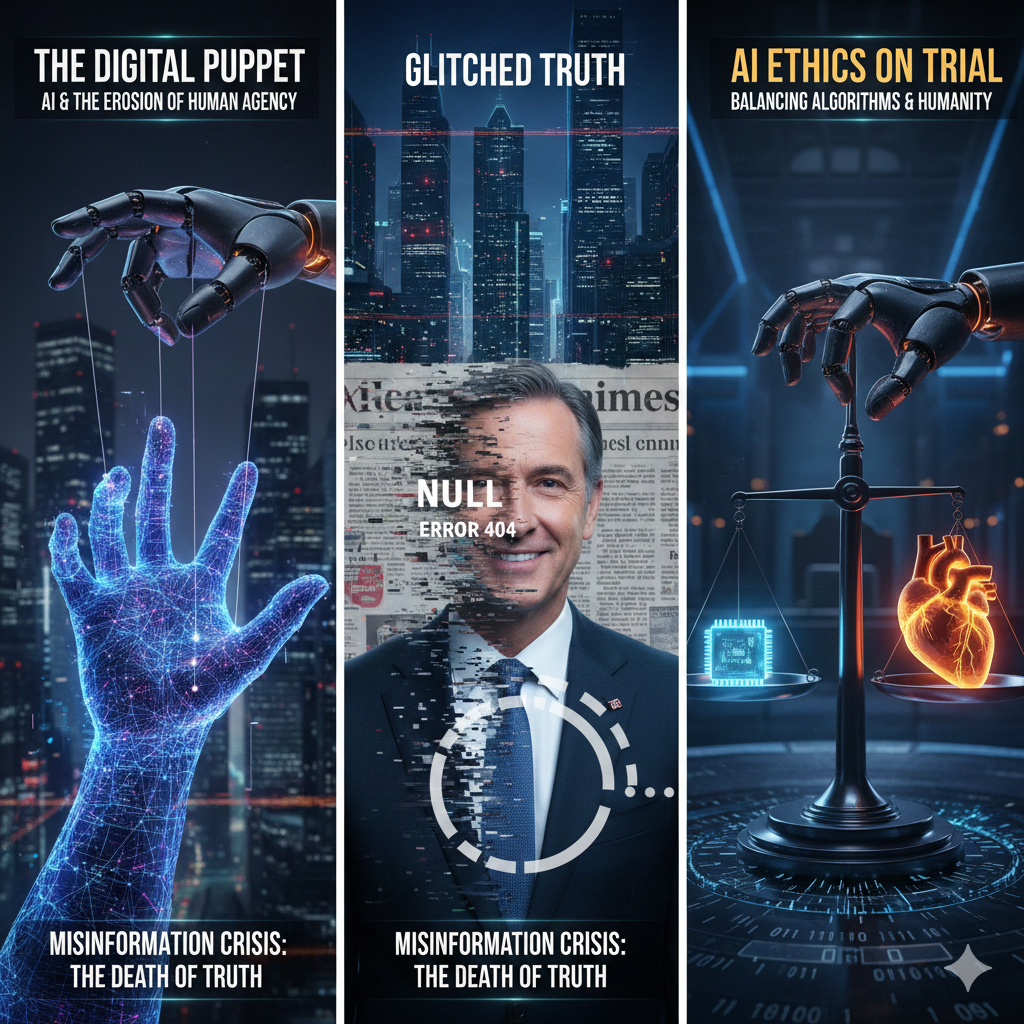
The Silent Architect: Navigating the Ethical Labyrinth of AI in 2026
Introduction
In 2026, Artificial Intelligence is no longer a futuristic concept; it is the invisible infrastructure of modern life. From the algorithms that decide who gets a mortgage to the generative models that produce our news, AI has moved from a "tool" to an "agent." However, as these systems become more autonomous, the ethical questions surrounding them have shifted from theoretical abstractions to urgent societal crises. To navigate this new era, we must address three critical pillars: algorithmic transparency, the preservation of human agency, and the global accountability of AI creators.
The Crisis of the "Black Box"
One of the most pressing ethical concerns is the "Black Box" problem. Modern AI models, particularly deep learning networks, are so complex that even their creators cannot fully explain why a specific output was generated. In sectors like criminal justice—where AI is used for recidivism prediction—or healthcare, where it diagnoses terminal illnesses, this lack of transparency is unacceptable.
* The Danger: If we cannot explain a decision, we cannot challenge it.
* The Trend: 2026 has seen a surge in "Explainable AI" (XAI) research, moving toward systems that prioritize "interpretability" alongside performance.
The Erosion of Human Agency and Creativity
As generative AI matures, the line between human and machine creation has blurred. In 2026, the internet is flooded with synthetic media, leading to what psychologists call "Reality Apathy"—a state where the public ceases to believe anything is real.
> "The greatest threat of AI is not that it will destroy us, but that it will make us indifferent to the truth."
>
The ethical debate now centers on Intellectual Property (IP). Should an AI be allowed to "learn" from millions of human artists without compensation? In 2026, this has led to landmark legal battles that are redefining the very definition of "originality."
Global Accountability and the Digital Divide
The benefits of AI are currently concentrated in a few "AI Superpowers." This creates a digital divide that risks leaving the Global South behind. Furthermore, the ethical burden of AI is often outsourced; thousands of workers in developing nations are paid pennies to label traumatic data to "train" the algorithms that serve the West.
* Climate Ethics: We must also account for the environmental cost. Training a single large language model in 2026 consumes as much electricity as thousands of households.
* The Solution: Global governance, similar to the IAEA for nuclear energy, is being proposed to ensure that AI development is sustainable and equitable.
Conclusion
The ethics of AI in 2026 is a mirror reflecting our own human values. If we build systems that prioritize profit and efficiency over fairness and truth, we risk creating a world that is technologically advanced but morally bankrupt. The path forward requires a "Human-in-the-Loop" philosophy—ensuring that for every autonomous decision made by a machine, there is a human held accountable for its consequences.























Responses (0)
Sign in to share your thoughts.
Sign in