
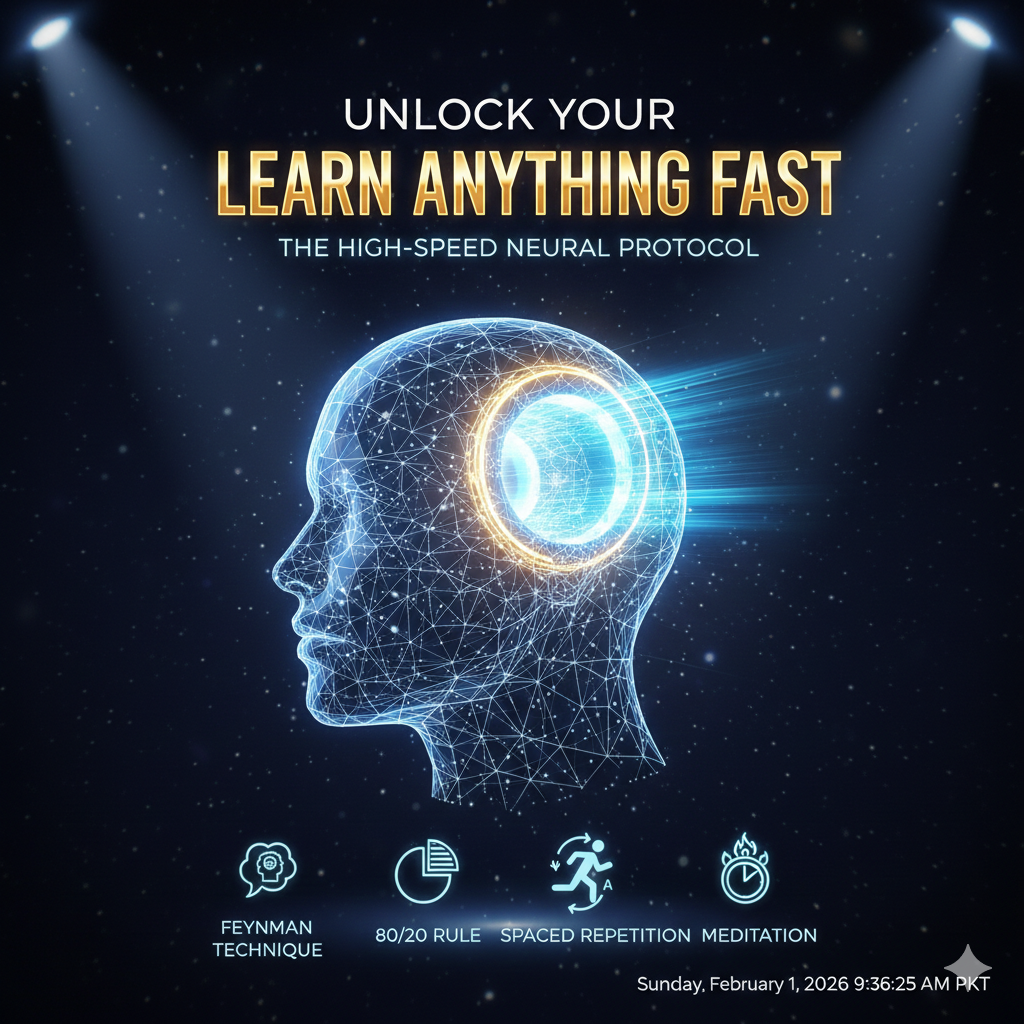
To learn anything fast, you have to move away from "passive" habits (like re-reading) and embrace active strain. Speed in learning comes from the quality of your focus and the speed of your feedback loops.
Here is the high-speed learning protocol:
1. The Feynman Technique (The "Simplicity" Test)
The best way to learn is to teach. If you can’t explain a concept to a 10-year-old, you don't understand it yet.
* Step 1: Write the name of the concept at the top of a blank page.
* Step 2: Explain it in plain English as if you are teaching someone else.
* Step 3: Identify your "blind spots" (where you got stuck) and go back to the source material.
* Step 4: Simplify your language even further using analogies.
2. Pareto’s 80/20 Rule
Don't try to learn everything. Most subjects have a "power law" where 20% of the information gives you 80% of the results.
* The Strategy: Identify the core "building blocks." If you're learning a language, focus on the 500 most common words first. If you're learning coding, focus on logic and loops before syntax.
* The Goal: Achieve "Minimum Viable Knowledge" so you can start practicing immediately.
3. Active Recall & Spaced Repetition
Most people forget 70% of what they learn within 24 hours. You combat this with the Forgetting Curve.
* Active Recall: Instead of highlighting text, close the book and ask yourself, "What did I just read?" Force your brain to retrieve the data.
* Spaced Repetition: Review the information at increasing intervals (1 day later, 3 days later, 1 week later). Use apps like Anki or Quizlet to automate this.
4. The "10-Minute Rule" for Flow
The hardest part of learning is the "cognitive friction" of starting.
* The Hack: Tell yourself you will only focus on the task for 10 minutes.
* The Science: Once you overcome the initial resistance, your brain enters a Flow State, where neurotransmitters like dopamine and norepinephrine make learning feel effortless and fast.
The Learning Hierarchy
| Method | Effectiveness | Why? |
|---|---|---|
| Teaching Others | 90% | High cognitive integration |
| Practice by Doing | 75% | Builds "muscle memory" in neurons |
| Discussion Groups | 50% | Exposes you to different perspectives |
| Reading/Lectures | 5-10% | Passive; high "illusion of competence" |
> Key Rule: Deconstruct before you construct. Break the skill down into the smallest possible parts, and master the most important part first.
>
Would you like me to deconstruct a specific skill for you (e.g., coding, a language, or an instrument) using this 80/20 framework?





















Responses (0)
Sign in to share your thoughts.
Sign in