
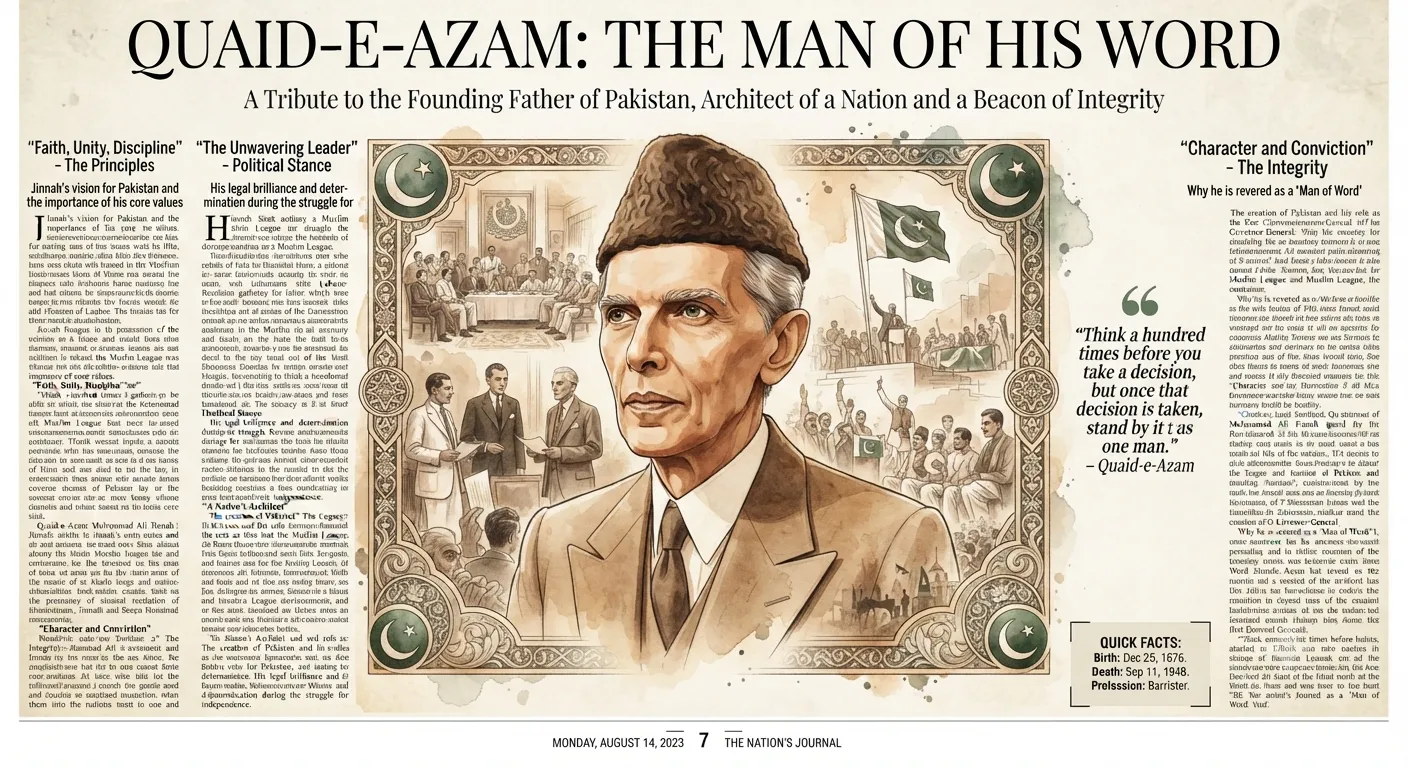
Below is the verified historical account of his life, career, and principles, free of folklore and myths.
1. Early Life and Education
Birth: Born on December 25, 1876, in Karachi (then part of British India, now Pakistan) into a prosperous merchant family. His ancestral roots traced back to Paneli village in Gujarat, India.
Education: He attended the Sindh Madressatul Islam and Christian Missionary Society High School in Karachi.
The Barister: At age 16, he moved to London and enrolled at Lincoln’s Inn. He chose law over business, becoming the youngest Indian at the time to be called to the Bar in 1896. During his time in London, he was profoundly influenced by 19th-century British liberalism and parliamentary systems.
2. The "Ambassador of Hindu-Muslim Unity"
Entry into Politics: Jinnah began his political career in 1906 by joining the Indian National Congress, which at the time advocated for self-governance within the British Empire.
The Title: For the first decade of his political life, Jinnah was a staunch nationalist who actively bridged gaps between communities. His efforts culminated in the Lucknow Pact of 1916, a historic agreement between the Congress and the All-India Muslim League. For his instrumental role, nationalist leader Sarojini Naidu dubbed him the "Ambassador of Hindu-Muslim Unity."
3. Shift to the Muslim League and the Two-Nation Theory
Disillusionment:
Jinnah initially opposed mass agitation politics (such as Gandhi's non-cooperation movements, preferring strict constitutional and legal frameworks). Over time, growing majoritarian politics within the Congress and the systematic marginalization of Muslim political rights led to a permanent parting of ways.
The Muslim League: He joined the All-India Muslim League (which he had helped influence earlier while maintaining dual membership) and restructured it into a mass-mobilization platform for South Asian Muslims.
The Lahore Resolution: On March 23, 1940, presiding over the Muslim League's annual session in Lahore, Jinnah formally championed the Two-Nation Theory, leading to the adoption of the Lahore Resolution demanding a separate sovereign state.
4. A Man of Strict Principles and Uncompromised Word
Jinnah's reputation as "a man of his word" is rooted in his rigid adherence to legal precision, punctuality, and moral code:
Integrity in Politics: Unlike many politicians of his era who used emotional rhetoric, Jinnah relied entirely on cold logic, constitutional arguments, and signed agreements. British leaders like Lord Mountbatten and political opponents alike noted that Jinnah's word was his bond—if he agreed to a clause, he stood by it completely; if he disagreed, he rejected it openly without deception.
Personal Honesty: He maintained absolute financial transparency. Throughout his massive legal and political career, his accounts were meticulously managed, and he never capitalized on his political power for personal or familial enrichment.
5. Creation of Pakistan and Final Days
Governor-General: Following intense negotiations (including the Cabinet Mission Plan and the 3rd June Plan), British India was partitioned, and Pakistan emerged on August 14, 1947. Jinnah took oath as Pakistan's first Governor-General on August 15, 1947.
Vision for the State: In his historic August 11, 1947 address to the Constituent Assembly, Jinnah laid out a pluralistic, inclusive vision for the country, famously stating: "You are free; you are free to go to your temples, you are free to go to your mosques or to any other place of worship in this State of Pakistan. You may belong to any religion or caste or creed—that has nothing to do with the business of the State."
Passing: Worn out by decades of relentless political struggle and suffering from advanced tuberculosis (which he kept hidden from the public and British authorities to prevent political vulnerability), Quaid-e-Azam passed away on September 11, 1948, in Karachi, just 13 months after witnessing the birth of Pakistan.

Discussion