
History of the Taj Mahal
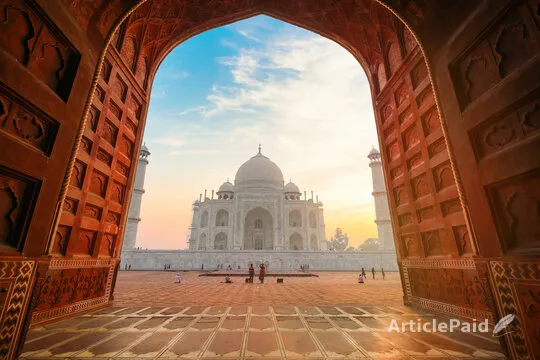
The Taj Mahal is one of the most famous monuments in the world and a magnificent symbol of love, architecture, and Mughal history. It is located on the southern bank of the Yamuna River in Agra, Uttar Pradesh, India. Built during the 17th century by the Mughal emperor Shah Jahan, the Taj Mahal was created as a mausoleum for his beloved wife Mumtaz Mahal. Today, it is recognized as a UNESCO World Heritage Site and attracts millions of visitors from around the world.
The Story Behind the Taj Mahal
The history of the Taj Mahal begins with Shah Jahan and Mumtaz Mahal. Shah Jahan was born Prince Khurram in 1592 and became the Mughal emperor in 1628. Mumtaz Mahal, whose original name was Arjumand Banu Begum, married Shah Jahan in 1612. She became his trusted companion and accompanied him on many journeys and military campaigns.
Mumtaz Mahal died in 1631 while giving birth to their fourteenth child in Burhanpur. Her death deeply affected Shah Jahan. According to historical accounts, he decided to build a magnificent mausoleum in her memory. Her body was initially buried in Burhanpur and was later transferred to Agra, where the Taj Mahal complex was constructed.
Construction of the Taj Mahal
Construction of the Taj Mahal began around 1632, during Shah Jahan's reign. The project involved thousands of craftsmen, architects, stonecutters, painters, calligraphers, and laborers. The main mausoleum was largely completed by about 1639–1643, while work on other parts of the complex continued for several more years.
The Taj Mahal was built primarily from white Makrana marble, which was transported from Rajasthan. Precious and semi-precious stones were used for decorative work. Stones such as jasper, jade, crystal, turquoise, lapis lazuli, and carnelian were incorporated into the marble using a decorative technique known as pietra dura.
The design of the Taj Mahal reflects a combination of Persian, Islamic, Indian, and Central Asian architectural traditions. The complex includes the main mausoleum, a large gateway, a mosque, a corresponding guest building, gardens, and other structures.
Architecture
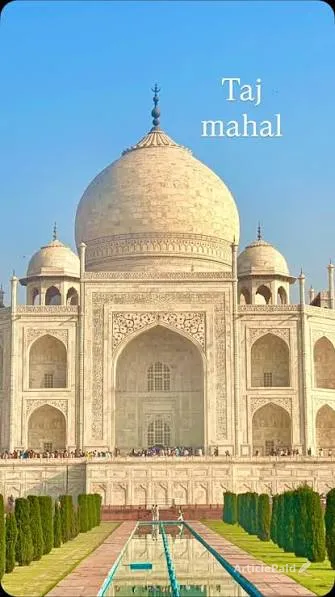
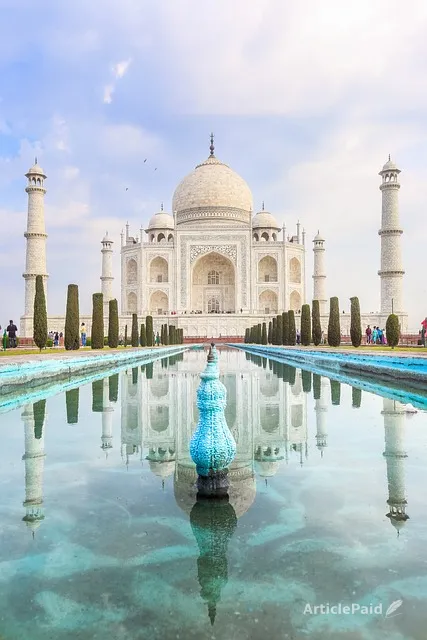
The central feature of the Taj Mahal is its enormous white marble mausoleum. It stands on a raised platform and is surrounded by four tall minarets. The central building has a large dome surrounded by smaller domed structures called chhatris.
The main dome is one of the most recognizable features of the monument. Its elegant shape gives the building a sense of balance and symmetry. The four minarets were positioned around the platform, contributing to the overall design.
Inside the mausoleum are the cenotaphs, or decorative memorial tombs, of Mumtaz Mahal and Shah Jahan. The actual graves are located in a lower chamber. The interior walls contain intricate marble screens, carved designs, and precious-stone decorations.
The Taj Mahal is also famous for its beautiful gardens. The garden follows the traditional charbagh design, which divides the garden into four sections. Water channels and reflecting pools create a symmetrical view toward the mausoleum.
Calligraphy and Decoration
Another remarkable feature of the Taj Mahal is its calligraphy. Verses from the Quran were beautifully written on the walls and entrance structures. The calligraphy was created by the Persian calligrapher Amanat Khan Shirazi, whose name is associated with some of the inscriptions.
The decorative artwork includes floral patterns, geometric designs, and detailed carvings. The artists carefully combined different colored stones with white marble to create elaborate patterns. The craftsmanship demonstrates the high level of artistic skill available during the Mughal period.
Shah Jahan and the Taj Mahal
Shah Jahan ruled the Mughal Empire during a period when architecture and art flourished. He commissioned several important buildings, including the Red Fort in Delhi and parts of the Jama Masjid. The Taj Mahal, however, became his most famous architectural achievement.
According to historical records, Shah Jahan was later imprisoned by his son Aurangzeb, who became emperor after a struggle for succession. Shah Jahan spent the final years of his life in Agra Fort. Tradition says that he could see the Taj Mahal from his place of confinement.
Shah Jahan died in 1666. He was buried beside Mumtaz Mahal inside the Taj Mahal. The placement of his tomb slightly breaks the otherwise perfect symmetry of the interior, because the original design had been centered around Mumtaz Mahal's tomb.
The Taj Mahal During British Rule
Over the centuries, the Taj Mahal experienced periods of neglect and damage. During British rule in India, some parts of the monument and its gardens were altered. There were concerns about the preservation of the building, especially as the surrounding environment and urban development changed.
In the late 19th and early 20th centuries, conservation efforts became more important. Lord Curzon, the British Viceroy of India, supported restoration work at the Taj Mahal. Many damaged areas were repaired, and improvements were made to the surrounding gardens.
After India gained independence in 1947, responsibility for protecting the monument passed to the Indian government and archaeological authorities.
UNESCO World Heritage Site
The Taj Mahal was designated a UNESCO World Heritage Site in 1983. UNESCO recognizes it as an outstanding example of Mughal architecture and describes it as a masterpiece of architectural achievement.
The monument is also one of India's most important cultural landmarks. It represents the artistic and architectural achievements of the Mughal period and has become an internationally recognized symbol of India.
Conservation of the Taj Mahal
The Taj Mahal requires continuous protection because marble can be affected by pollution, weather, insects, and environmental changes. Authorities have introduced various measures to protect the monument and regulate activities around it.
Vehicles are restricted near the monument, and visitors are required to follow rules designed to protect the marble and interior decorations. Conservation specialists regularly monitor the structure and carry out restoration work when necessary.
Environmental pollution has been a particular concern because pollutants can contribute to discoloration of the marble. Efforts have therefore been made to control industrial and vehicular pollution in the surrounding region.
The Taj Mahal Today
Today, the Taj Mahal is one of India's most visited historical monuments. People from many countries travel to Agra to see its architecture, gardens, marble decoration, and famous reflection in the surrounding pools.
The monument looks different throughout the day. In the morning, the marble can appear bright and cool in color. During sunset, it can take on warmer shades. Moonlight also creates a distinctive appearance, although access during nighttime is subject to official regulations.
The Taj Mahal is not simply a monument built for one historical figure. It represents a significant period in Indian history, particularly the cultural and architectural achievements of the Mughal Empire.
Conclusion
The history of the Taj Mahal combines love, loss, architecture, art, and history. Shah Jahan built it in memory of Mumtaz Mahal after her death in 1631. Constructed mainly from white marble and decorated with intricate carvings, calligraphy, and precious stones, the monument reflects the remarkable craftsmanship of the Mughal period.
More than three centuries after its construction, the Taj Mahal remains one of the world's most recognizable monuments. Its symmetrical architecture, magnificent dome, peaceful gardens, and detailed decoration continue to attract visitors and historians. As a UNESCO World Heritage Site and an important part of India's cultural heritage, the Taj Mahal remains a lasting monument to the artistic achievements of the Mughal era and to the memory of Mumtaz Mahal.






















Responses (0)
Sign in to share your thoughts.
Sign in