
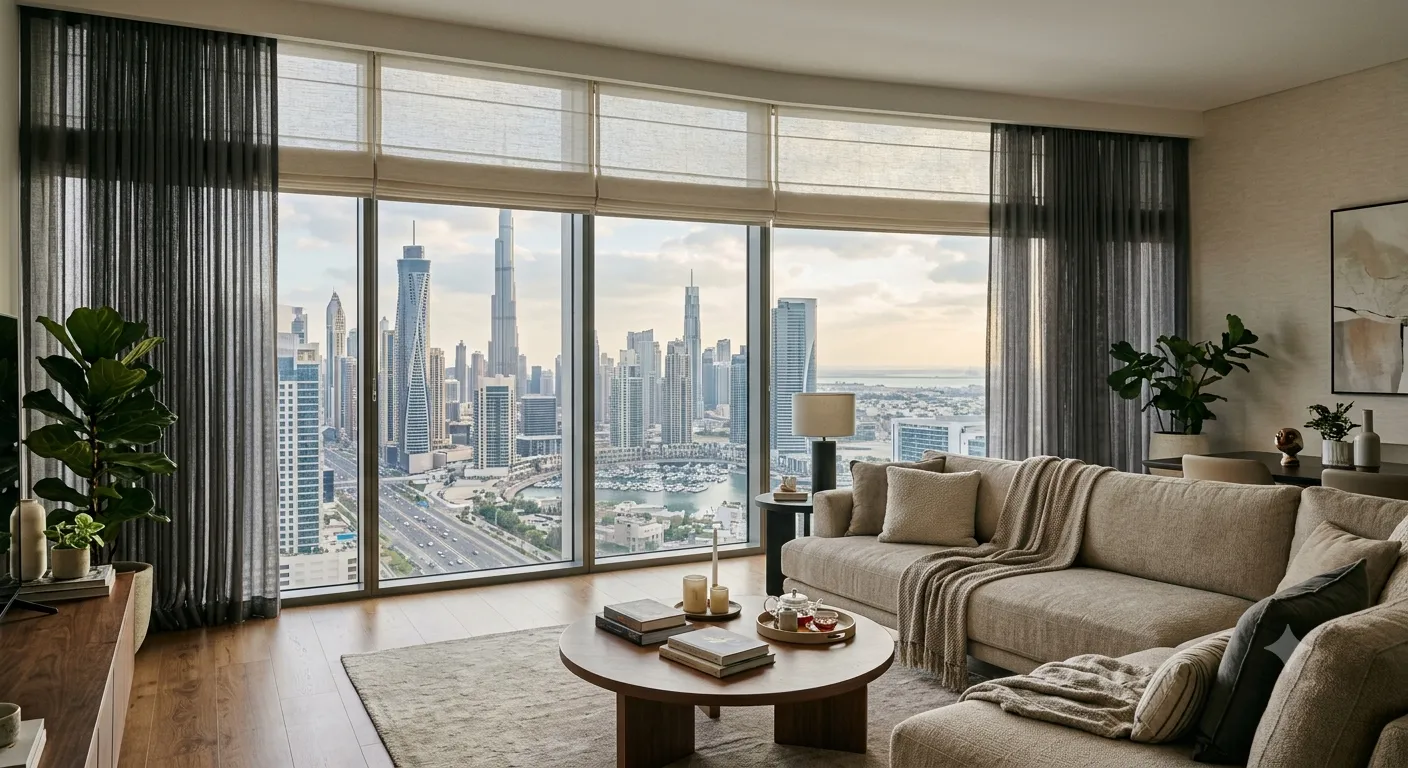
Dubai's a weird city to design for, honestly. A Marina apartment on the 30th floor has nothing in common with a villa in Damac Hills when it comes to light and privacy, and a townhouse in JVC is its own different animal again. Standard, off-the-shelf curtains just don't survive contact with that kind of variety. Which probably explains why a business built entirely around custom fitting has managed to stick around and grow here.
More Options Than You'd Guess
Go through their catalog and you'll notice they've actually thought about how people use these rooms, not just listed fabric types for the sake of it. Blackout curtains are the obvious starting point bedrooms, home theaters, anywhere that needs proper darkness, and let's be honest, that matters a lot once Dubai summer hits and the sun stops being polite. Sheer curtains do the opposite job, letting soft daylight into a living room while still keeping things private, and it's one of those choices people don't think much about until they've lived with the wrong one for a year straight.
Then there's the stuff that's more about finish than function. Eyelet curtains if you want something clean and modern. Wave curtains for that smooth, continuous fold look. Loop curtains for a more relaxed, everyday feel. Pinch pleat curtains if you're leaning traditional or formal. On paper these all sound similar, but hang two nearly identical fabrics with different pleat styles side by side and you'll see how much the finish actually changes a room's whole personality.
Blinds get just as much attention. Roller blinds are the practical default bedroom, office, doesn't matter, they just work. Roman blinds bring in a softer, richer look thanks to the extra fabric folding, so they tend to suit living rooms or spaces that want a bit more texture. Vertical blinds are still the reliable pick for big sliding doors, especially in offices where practicality wins over style points. And if you just want total darkness without dealing with curtain fabric at all, there's a blackout blinds option too.
Why Going Custom Actually Matters Here
Anyone who's spent real time living in Dubai knows the windows here rarely behave normally. Floor-to-ceiling glass, awkward bay shapes, giant sliding balcony doors it's basically the default now in newer buildings. Standard curtain sizes just don't fit, which is honestly the whole case for custom fitting in one sentence.
The process itself is pretty simple in practice. Someone visits your home first, for free, and brings actual fabric samples so you can see how they look under your own lighting instead of guessing from a photo online. After that comes proper measuring even a couple of centimeters off can throw an entire window's look out of balance, so this step matters more than people assume. Installation usually wraps up within 48 hours once everything's confirmed, which is a solid turnaround given that nothing's coming off a warehouse shelf.
Motorized Blinds Have Stopped Being a Novelty
This part's worth a mention because it's easy to write off as an unnecessary upgrade until you've actually lived with it. Smart homes are more or less the standard now across a lot of Dubai communities, and window treatments have finally caught up. Controlling blinds through Alexa or Google Home sounds minor on paper, but for a busy household or office, it turns into something you actually rely on blinds quietly adjusting as the sun shifts, without anyone getting up to deal with it. Most people who try it don't go back to doing it manually.
It's Not Just Homes
The marketing naturally leans residential, which makes sense, but the commercial side is just as built out. Offices, hotels, restaurants, schools all of these come with different demands than a private villa. Durability has to hold up under much heavier daily use, consistency across dozens of matching units matters more, and everything still needs to fit whatever brand or interior concept the business is going for. Running both residential and commercial work under one roof isn't simple, and it usually means the team's had to build more flexibility than a smaller, home-only outfit would ever need.
Local Knowledge Isn't Just a Marketing Line
One thing that stood out is the focus on specific neighborhoods rather than the usual "we cover all of Dubai" claim every company makes. Paying particular attention to areas like JVC, Damac Hills, and Dubai Marina says something about actual familiarity how light hits a Marina-facing balcony differently than a quiet JVC street, or how privacy needs shift between stacked apartments and standalone villas. That kind of local detail tends to show up as better recommendations on-site, instead of the same generic pitch repeated for every customer regardless of where they live.
Balancing Quality Against Price
The window treatment market in Dubai is crowded, and prices swing wildly depending on fabric grade, mechanism type, and how carefully the installation is actually done. What comes through here is a genuine attempt to balance both sides decent fabrics and mechanisms, without pricing out people on tighter budgets. That balance is hard to hold consistently, and honestly it's not something you can judge from a website alone. You'd want to see the samples in person, which is probably the entire reason the free consultation exists in the first place.
Why Any of This Matters
Curtains and blinds aren't really "install once and forget" items. You touch them daily opening them in the morning, closing them at night, adjusting them when the afternoon sun gets harsh. Getting them right changes how a room feels far more than people expect walking in, and getting them wrong is the kind of thing you don't really notice until you're already stuck living with it.
For anyone in Dubai thinking about upgrading their windows, whether that's one bedroom needing proper blackout curtains or a full commercial fit-out needing dozens of matching blinds, having a team that handles consultation, measuring, and installation within a couple of days cuts out a lot of the usual back-and-forth. Add in the smart motorization option and a product range that covers most fabric and style preferences, and it makes sense why a custom-focused window treatment service has built a solid reputation in a city with famously high interior standards.
If your windows have been sitting bare for months, or your current curtains just don't match the room anymore, it's probably worth booking that free consultation and seeing the fabric samples in person. Sometimes the smallest change swapping old blinds for something actually fitted to your window ends up making the biggest difference in how the whole space feels to live and work in.
Frequently Asked Questions
Do I need to know my window measurements before booking a consultation?
Not really, no. That's the whole point of the free home visit someone comes out, looks at your actual windows, and measures them properly. Trying to measure odd-shaped or floor-to-ceiling windows yourself usually ends badly anyway, so it's best left to someone who does it all day.
How long does installation take once I've picked a fabric?
Once everything's locked in fabric, style, measurements installation is usually done within 48 hours. Not instant, since it's all custom-made for your windows, but still a quick turnaround for something that isn't off a shelf.
What's the actual difference between blinds and curtains for a home like mine?
Comes down to how much softness versus practicality you want. Curtains add warmth and texture and suit bedrooms and living rooms well. Blinds are cleaner and more practical, especially in kitchens or offices with a lot of direct sun. Plenty of people just use both in different rooms rather than picking one for the whole house.
Are motorized blinds actually worth the extra money?
Depends on how you use the space, but most people who try it end up keeping it. Controlling blinds through Alexa or Google Home, or having them respond to sunlight automatically, saves more daily hassle than you'd expect before actually trying it.
Can blackout curtains and blinds really handle Dubai's summer sun?
Yes, that's essentially their whole job. They're built specifically to keep heat and light out completely, which matters a lot during summer, especially in bedrooms or media rooms where you want real darkness regardless of the time of day.























Responses (0)
Sign in to share your thoughts.
Sign in