
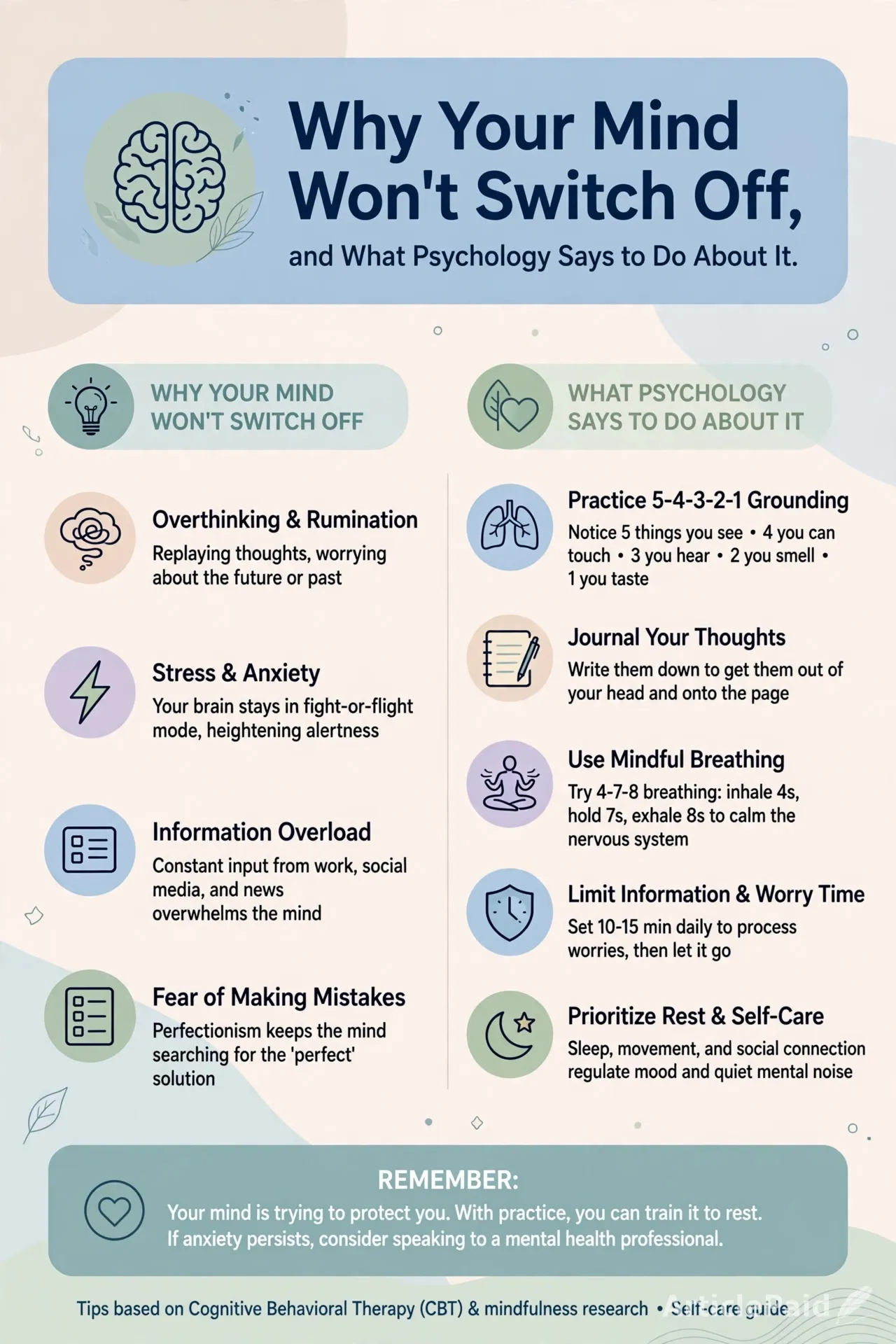
Last month's embarrassing text. Tomorrow's presentation. A decision you've already made but keep re-examining like it's evidence in a trial. Your brain loops through all of it, and somehow the more you think, the less you know.
This pattern has a name in research: rumination. A widely cited 2008 review in Perspectives on Psychological Science concluded that it can deepen a low mood, strengthen negative thinking, and weaken our ability to solve problems. It was also linked to anxiety, not just depression. In short, replaying a worry is not the same as working on it.
The good news is that you can train yourself out of the habit. Here are seven approaches worth trying.
1. Question: Thinking or looping?
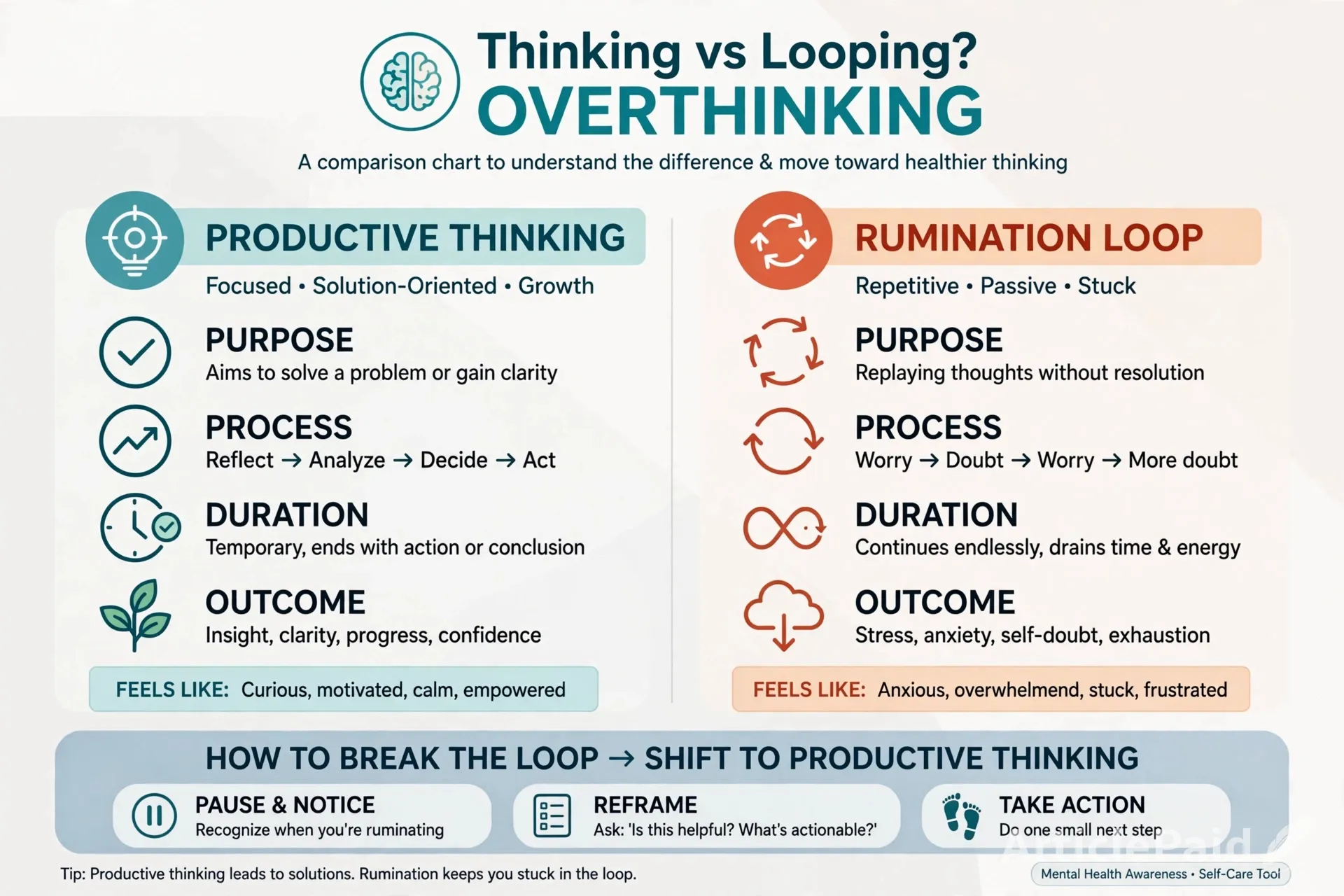
Productive thinking ends somewhere, with a decision, a plan, or a clear next step. Circling just returns to the starting point. Next time you're deep in thought, check which one you're doing. If you've covered the same ground three times, you're circling.
2. Park your worries until a set time
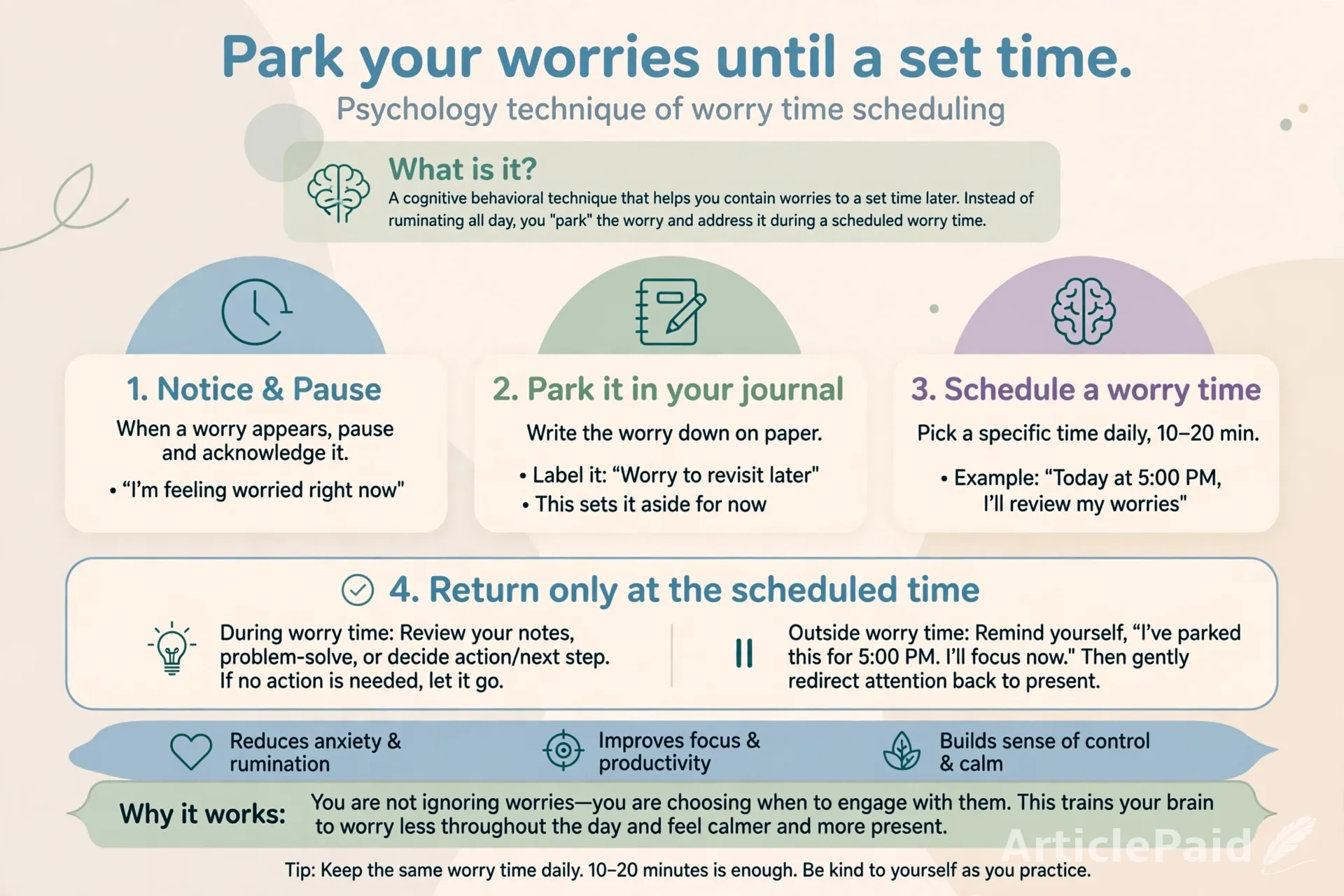
Give yourself a fifteen-minute slot later in the day for fretting, and nothing more. If a worry barges in at lunch, jot a two-word note and tell it to come back at the appointed hour. Many people find that by then half of their worries have lost their sting.
3. Use your name, not just "I"
Try replacing "I'm going to fail" with "Amna, what's actually going on here?" This isn't a gimmick. In a series of studies led by Ethan Kross, people who referred to themselves by name or with "you" while reflecting on a stressful moment felt less distressed and came across as more composed than people who used "I." Even participants prone to social anxiety benefited. Stepping outside your own voice lets you advise yourself the way you'd advise a friend.
4. Change the scenery
A mind that keeps spinning in one room often calms down in another. Step outside, run an errand, water the plants, or call someone cheerful. Experimental research has repeatedly found that pleasant distractions can improve a low mood. You're not dodging the problem, you're giving your brain a breather so you can return to it with fresher eyes.
5. Empty your head onto paper
Spend five minutes writing whatever is looping through your mind, messy and unfiltered. Then underline just one line and ask, "What's one small step I could take on this today?" Write the step down if there is one. If there isn't, note "nothing to do yet" and move on. It sorts what's in your control from what isn't.
6. Make the pile smaller
Overwhelm tricks you into thinking everything is due right now. Write the whole list down, choose the quickest task on it, and finish that one. Completing even a tiny thing rebuilds a sense of control, and control is exactly what an overthinking mind is hunting for.
7. Bring in a professional when it lingers
When constant worry stretches over several weeks and starts hurting your sleep, work, or relationships, it's time to speak with a doctor or therapist. Approaches such as cognitive behavioral therapy target exactly these thought patterns, and asking for help is a practical decision, not a sign of weakness.
Start small
Nobody retrains their mind in a weekend. Choose one technique, use it for a week, and see what shifts. Little habits, repeated, tend to outlast big promises you make to yourself on a Sunday night.
Frequently Asked Questions
Why do racing thoughts get worse after I go to bed?
Once the day's tasks and noise are gone, nothing competes for your attention. Writing your thoughts down earlier in the evening can give them somewhere else to go.
Is overthinking the same as anxiety?
Not exactly. They overlap, and research ties rumination to anxiety, but overthinking is a thinking habit while anxiety is a broader condition. If worry feels constant, it's worth getting checked.
How long before these techniques start working?
It differs for everyone. A few weeks of regular practice is a reasonable window to notice small changes.
Does telling myself to stay positive help?
Rarely. Pushing away worry with forced cheerfulness can backfire. Shifting your viewpoint, as with self-distancing, tends to work better.
References
This article draws on two peer-reviewed sources. The 2008 review "Rethinking Rumination" by Nolen-Hoeksema, Wisco and Lyubomirsky appeared in Perspectives on Psychological Science, volume 3, issue 5, pages 400–424 (DOI: 10.1111/j.1745-6924.2008.00088.x). The self-talk research is Kross and colleagues' 2014 paper "Self-Talk as a Regulatory Mechanism: How You Do It Matters" in the Journal of Personality and Social Psychology, volume 106, issue 2, pages 304–324 (DOI: 10.1037/a0035173).






















Responses (0)
Sign in to share your thoughts.
Sign in