
Your smartphone is no longer just a smart device. In 2026, it has become something closer to a personal brain that lives in your pocket.
For years, artificial intelligence lived in the cloud. Every question, photo edit, or translation request left your phone and traveled to distant servers.
That model is fading fast. Today, a growing share of AI runs directly on the device itself — private, instant, and available even in airplane mode.
This shift is called on-device AI.
Instead of shipping your data outward, the phone processes it locally using specialized neural processing units (NPUs) built into modern chips.
Apple’s latest foundation models, Google’s Gemini Nano 4, and Qualcomm’s Snapdragon 8 Elite Gen 5 are leading the charge.
These systems can handle language understanding, image analysis, real-time translation, and even basic reasoning without an internet connection.
The advantages are immediate. Privacy improves dramatically because sensitive information — your messages, photos, voice notes, and personal context — never has to leave the phone.
Responses arrive faster because there is no network round-trip. Battery life benefits too, as efficient on-device models consume far less power than constant cloud calls.
And when you lose signal in a subway, on a plane, or in a remote area, the AI keeps working.
Real examples are already everywhere.
Apple Intelligence, updated heavily in 2026 with iOS 27, runs many everyday tasks fully on-device and only escalates complex requests to its Private Cloud Compute system.
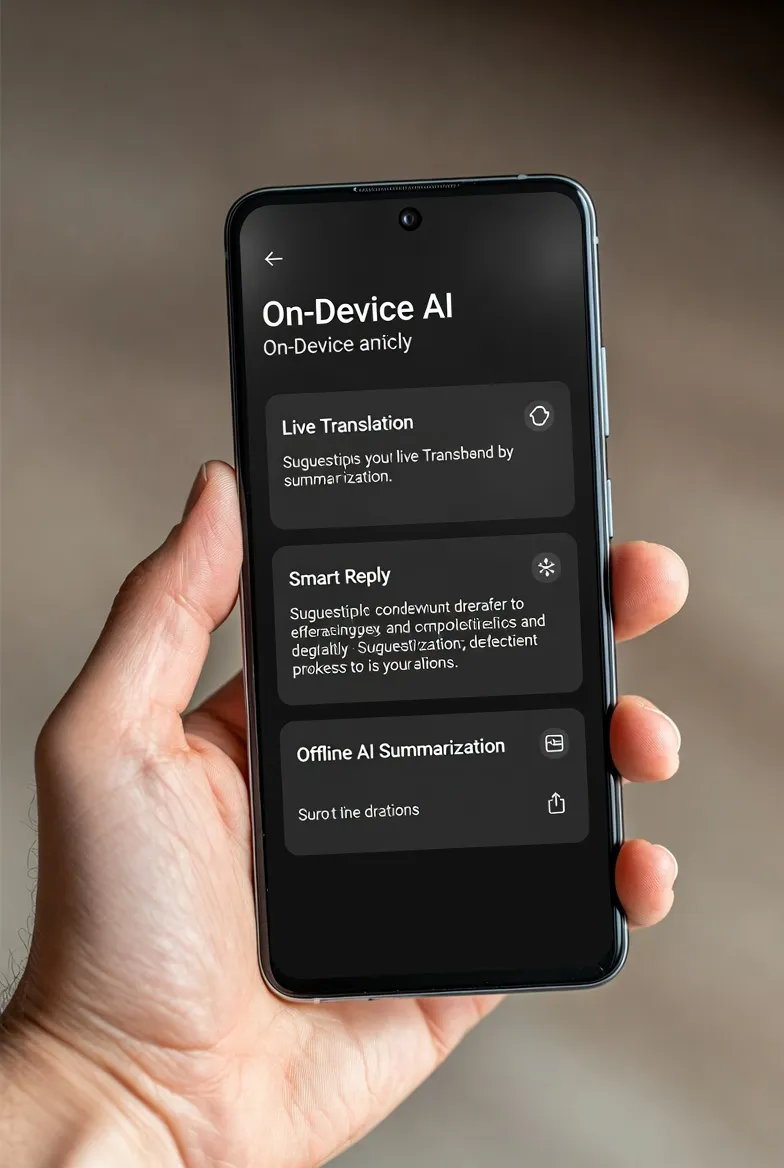
Google’s Gemini Nano 4, now shipping on devices like the Galaxy Z Fold 8 series, supports over 140 languages and powers offline summarization, smart replies, and even simple task automation.
Qualcomm’s latest chips push the hardware further, delivering higher token speeds and the ability to run surprisingly capable models locally.
The technology is not perfect yet. The biggest models still need the cloud for deep reasoning or massive knowledge.
Most systems use a hybrid approach: simple and private tasks stay on the phone, while heavier work moves to secure servers. Hardware requirements also matter — stronger NPUs and more RAM deliver better results.
Still, the direction is clear. Counterpoint Research projects that GenAI-capable smartphones will account for roughly 45 percent of global shipments in 2026.
What began as a premium feature is rapidly becoming standard.
The phone in your hand is evolving from a communication tool into a quiet, always-available intelligence that knows your context without broadcasting it to the world. It works offline.
It protects your data. And it responds at the speed of thought.
Your phone just got a brain of its own. And it is only getting smarter.





















Responses (0)
Sign in to share your thoughts.
Sign in