

Artificial intelligence has quietly become part of everyday life. While headlines often focus on futuristic robots or dramatic predictions about machines replacing people, the reality is much more practical. AI is already helping millions of people complete ordinary tasks that would otherwise take more time, require more effort, or involve repetitive work.
That doesn't mean AI is universally better than humans. It excels in situations where speed, pattern recognition, and processing large amounts of information matter. On the other hand, it still struggles with judgment, empathy, creativity in unfamiliar situations, and understanding the full context behind human decisions.
The most useful way to think about AI is as a tool. Like a calculator didn't replace mathematicians, AI isn't replacing human intelligence. Instead, it handles specific jobs efficiently, allowing people to focus on tasks that require experience, communication, and critical thinking.
Below are fifteen everyday tasks where artificial intelligence is already making a noticeable difference.
Finding information quickly
Searching through thousands or even millions of documents is something AI can accomplish in seconds. Instead of manually opening websites, comparing articles, or reading lengthy reports, AI systems can summarize relevant information almost instantly.
For example, someone researching vacation destinations might ask an AI assistant to compare flight times, weather conditions, average hotel prices, and popular attractions. Rather than spending an hour collecting information from multiple sources, they receive an organized overview within moments.
The biggest advantage is speed. AI can scan enormous volumes of text much faster than any person could.
However, this convenience comes with an important limitation. AI-generated summaries are only as reliable as the information they draw from. Facts still need verification, particularly when decisions involve health, finances, or legal matters.
Organizing email inboxes
Most people receive dozens or even hundreds of emails every week. AI now sorts incoming messages into categories, identifies spam, highlights important conversations, and even suggests replies.
Imagine receiving invoices, newsletters, work updates, appointment reminders, and promotional offers all in one morning. AI can separate these automatically before you even begin reading.
This reduces time spent managing an inbox and lowers the chance of missing something important.
Still, AI occasionally misclassifies messages. A legitimate email may end up in the spam folder, while promotional content sometimes reaches the primary inbox. Human review remains necessary.
Language translation has improved dramatically with modern AI systems.
Someone traveling abroad can point their phone at a restaurant menu, street sign, or product label and receive an almost immediate translation. Businesses also use AI to communicate with international customers without hiring translators for every routine interaction.
For everyday conversations, AI performs remarkably well.
The limitation appears when language becomes more nuanced. Humor, cultural references, sarcasm, and emotional expressions can still confuse automated translation systems. Professional translators remain essential for legal documents, literature, and sensitive communications.
Filtering unwanted spam
Every day, billions of spam emails are blocked before reaching users.
AI examines patterns, sender reputation, writing style, suspicious links, and unusual behavior to identify unwanted messages much faster than human reviewers ever could.
Without these automated systems, inboxes would be overwhelmed with phishing attempts, scams, and advertising.
Even so, spam detection isn't perfect. Criminals constantly adapt their techniques, forcing AI models to learn continuously. Some malicious emails still slip through, making user awareness just as important as automated protection.
Recommending movies, music, and products
Streaming services and online stores rely heavily on AI recommendation systems.
Instead of showing identical suggestions to everyone, AI studies viewing habits, listening preferences, purchases, and browsing history to predict what users may enjoy next.
Someone who regularly watches cooking shows may receive recommendations for recipe documentaries, kitchen gadgets, or food-related podcasts.
These personalized suggestions save time and help users discover content they might otherwise overlook.
The downside is that recommendation systems can create narrow experiences. People may repeatedly see similar content while missing opportunities to explore different interests.
Detecting credit card fraud
Banks process millions of transactions every day. Humans simply couldn't review them individually.
AI identifies unusual spending behavior almost immediately.
If a customer usually shops locally but suddenly a large purchase appears from another country minutes later, AI may temporarily block the transaction or request verification.
This rapid response helps reduce financial losses and protects consumers from fraud.
However, false alarms do happen. Legitimate purchases are sometimes declined until the customer confirms their identity, which can be inconvenient during travel.
Navigating traffic efficiently
Navigation apps rely on AI to analyze traffic conditions in real time.
Instead of following the shortest distance, they often recommend the fastest route based on congestion, accidents, road closures, and estimated travel times.
For commuters, this means spending less time sitting in traffic.
Delivery companies also benefit by planning routes that reduce fuel consumption and improve efficiency.
Despite these advantages, navigation systems aren't flawless. Unexpected road conditions, temporary construction, or inaccurate traffic reports occasionally lead drivers onto slower routes.
Enhancing smartphone photography
Modern smartphone cameras use AI every time users take pictures, often without realizing it.
The software automatically adjusts brightness, sharpness, color balance, focus, and noise reduction in fractions of a second.
Portrait mode, night photography, and scene recognition all rely on artificial intelligence.
Instead of requiring photography expertise, users can capture impressive images with a single tap.
Yet AI editing sometimes goes too far. Images may appear overly smooth, colors may look unrealistic, or facial features may be altered more than intended.
Converting speech into text
Voice recognition has become part of daily life through smartphones, computers, and smart speakers.
AI can transcribe meetings, dictate messages, generate captions, and convert spoken language into searchable documents.
Journalists, students, and business professionals save considerable time by speaking naturally instead of typing everything manually.
Accuracy has improved significantly, especially in quiet environments.
Challenges remain when multiple people speak simultaneously, heavy accents are involved, or background noise interferes with audio quality.
Predicting equipment maintenance
Many household appliances, vehicles, and industrial machines now use AI to monitor performance.
Instead of waiting until something breaks, AI analyzes temperature, vibration, energy consumption, or unusual operating patterns to predict when maintenance may be needed.
For example, a manufacturing company can repair equipment before an unexpected breakdown interrupts production.
Car owners may also receive alerts when certain components begin showing signs of wear.
Predictions are useful but not guaranteed. Unexpected failures can still occur despite continuous monitoring.
Assisting customer support
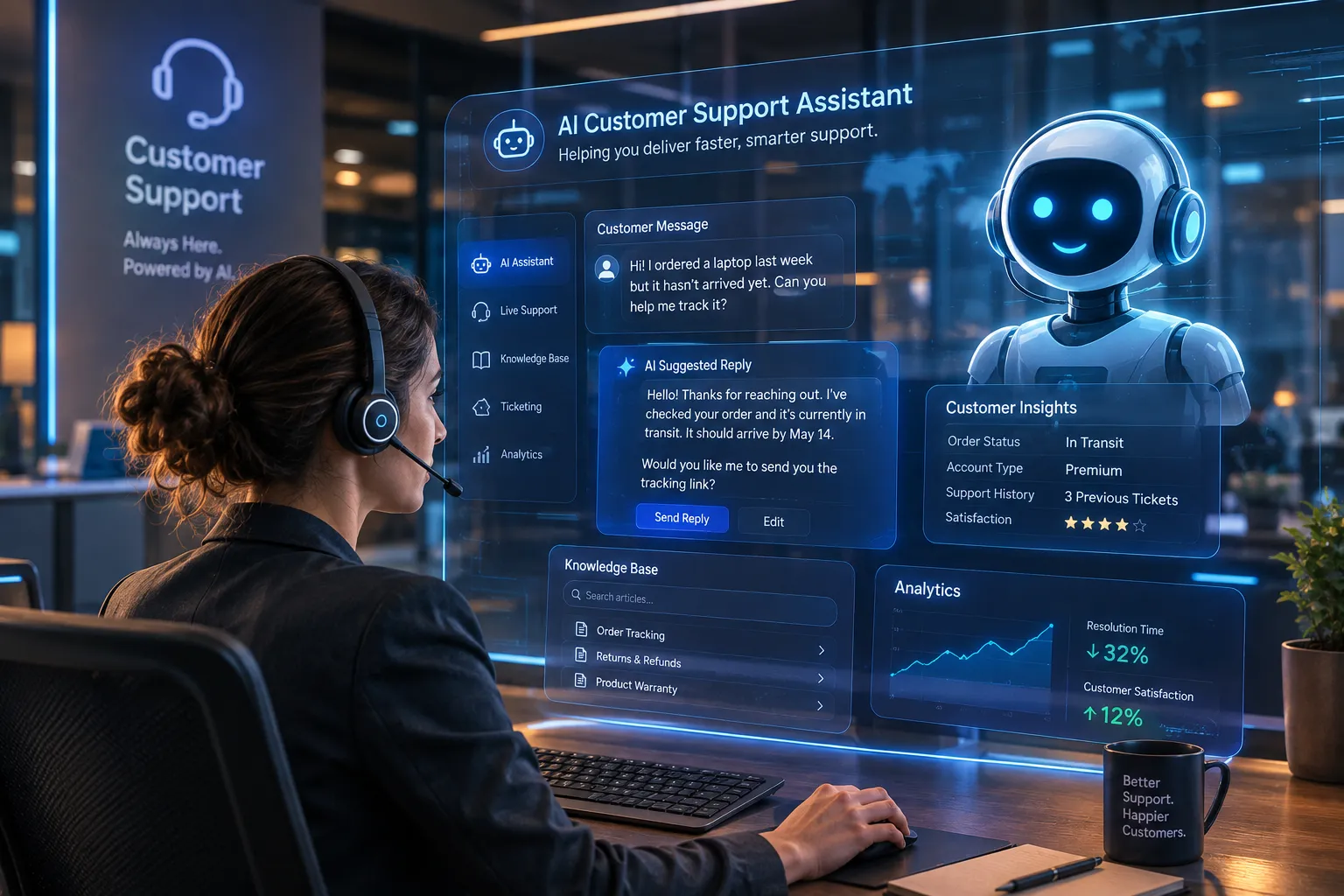
Many businesses now use AI chatbots to answer routine customer questions.
Checking delivery status, resetting passwords, updating account information, or finding store hours can often be completed without waiting for a human representative.
This provides faster service around the clock.
Human agents then have more time to handle complicated situations requiring negotiation, empathy, or problem-solving.
Customers sometimes become frustrated when chatbots misunderstand unusual requests or repeatedly provide irrelevant answers. Easy access to human support remains important.
Correcting spelling and grammar
Writing assistants now identify spelling mistakes, grammatical errors, awkward phrasing, and punctuation issues while people type.
Students, professionals, and content creators use these tools daily to improve clarity before sending emails or publishing documents.
AI catches many errors almost instantly, making writing more polished with minimal effort.
Still, language is highly contextual. AI occasionally recommends changes that alter meaning, ignore stylistic choices, or misunderstand specialized terminology. Final proofreading by a human remains valuable.
Managing smart home devices
AI helps coordinate connected home technology.
Lights can turn off automatically when rooms become empty. Thermostats learn household routines. Robotic vacuum cleaners navigate around furniture without constant supervision.
These small conveniences reduce repetitive chores and improve energy efficiency.
However, connected devices depend on reliable internet connections, compatible hardware, and proper configuration. When systems fail, manual control is still necessary.
Identifying objects in images
Image recognition has become surprisingly common.
People use AI to identify plants during hikes, recognize landmarks while traveling, organize family photo collections, or search for products by uploading a picture instead of typing keywords.
Retailers also use image recognition to simplify inventory management.
Although AI performs impressively on familiar objects, unusual angles, poor lighting, or rare items can reduce accuracy considerably.
Scheduling and calendar management
Scheduling meetings often involves comparing multiple calendars, finding available time slots, sending invitations, and adjusting appointments.
AI assistants increasingly automate much of this process.
Professionals can ask for a meeting next week, and AI identifies suitable times, avoids conflicts, and distributes invitations automatically.
Families also benefit by coordinating school events, medical appointments, and personal commitments in one place.
Even so, AI cannot always understand priorities between competing obligations. Important decisions about work-life balance or personal commitments still require human judgment.
Why people remain essential
Looking across these everyday examples, a clear pattern emerges. Artificial intelligence performs best when the work involves repetition, speed, data analysis, or recognizing patterns that computers can process consistently.
Humans remain better at interpreting emotions, understanding complex situations, making ethical decisions, negotiating compromises, and responding creatively when something unexpected happens.
The strongest results usually come from collaboration rather than competition. AI handles routine tasks, while people provide experience, common sense, and accountability.
As AI continues improving, more everyday activities will likely become partially automated. That evolution should be viewed as an opportunity to reduce tedious work rather than as a reason to underestimate the value of human skills.
Technology changes quickly, but qualities such as curiosity, empathy, adaptability, and sound judgment remain difficult to automate. Those human strengths will continue to matter, even as AI becomes an increasingly capable assistant in daily life.




















Responses (1)
Sign in to share your thoughts.
Sign in