

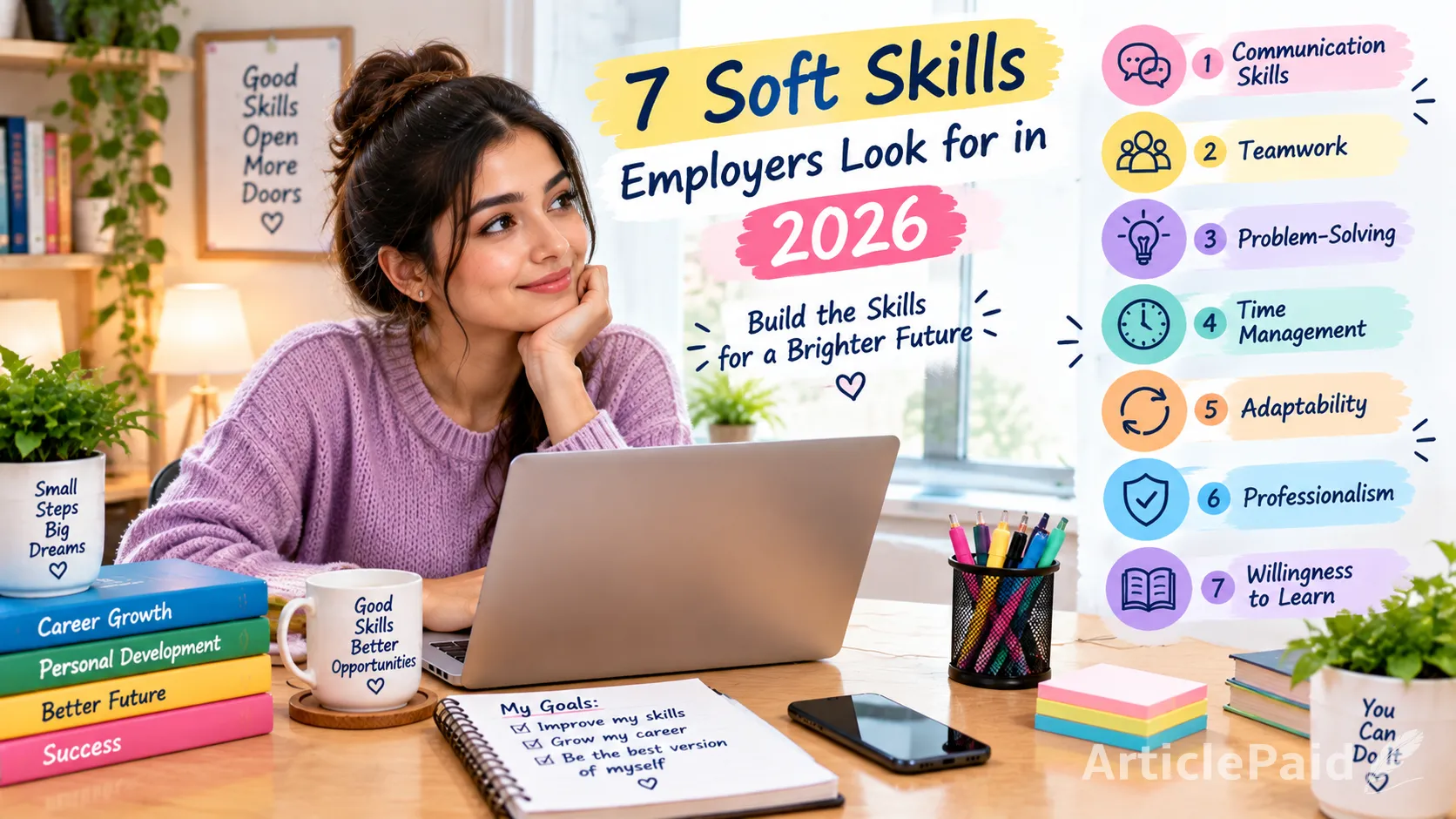
7 Soft Skills Employers Look for in 2026
Landing a job is not just about demonstrating expertise in a particular area of operation. Beyond hard skills, most employers value individuals who demonstrate excellent communication, problem-solving abilities, interpersonal connection, and flexibility.
They are generally regarded as soft skills, and they significantly enhance a worker’s capacity to succeed in an office environment.
Here are 7 most sought-after skills to develop in 2026.
1. Communication
Most of your interactions at the workplace will involve communication. It is, therefore, integral to invest some time to develop the abilities to communicate your ideas effectively and listen to your colleagues. Additionally, proper grammatical structures should be used when sending and receiving emails or message exchanges.
Communication skills training involves;
Practicing written expression
Active listening techniques
Becoming proficient at explaining
Thoughtful speaking
2. Teamwork
Almost every organization operates through teamwork, and you should practice how best it is done in your field. Teamwork entails sharing your ideas with others, being accommodating and respectful to each individual’s opinion, and doing your part of the work without needing someone to remind you.
Although compromise should normally be the order of the day in teamwork, it is sometimes useful never to budge on certain aspects.
How to build teamwork skills:
Group projects
Volunteering
Community projects
Collaborating online
3. Problem-Solving
Most employers seek individuals who are not prone to quitting at the first onset of a challenge. Instead, they must be able to recognize a problem, identify its origin and think of creative ways to address a situation. Your ability to remain composed under pressure will play a significant role in problem-solving. Although challenges are inevitable in each field of work, a positive attitude can support a positive outcome.
Here are a few ways to develop skills in this aspect:
Determine the nature of the problem
Collect additional information about it
List ways the problem might be solved
Weigh the likely outcomes of each procedure
Decide the next course of action
4. Time Management
Time management involves making conscious decisions with regard to how to use one’s time. For example, time management is needed when balancing a range of activities and responsibilities.
One effective strategy that works in many cases is to create a to-do list of daily activities and prioritize them based on level of importance and estimated time required to complete them.
It is essential to try focus more on achieving individual goals instead of switching from one activity to another.
This will undoubtedly be helpful when juggling multiple tasks at once.
5. Adaptable/versatile
Employers nowadays always seek versatile individuals who are willing to advance their careers. While experience matters, most companies would rather hire an enthusiastic employee with lesser skills than a more experienced but arrogant colleague.
Adaptability entails; learning new concepts, becoming familiar with new technologies and approaches, and mastering new skills.
A competent employee should always ask questions, analyze errors, and be willing to acquire new competencies to become more productive. Most organizations operate using different software, so it is essential to gain a wide range of technological proficiencies.
6. Professionalism
It is necessary for every employee to have good professional skills because it determines the manner in which a person will behave as well as their ability to meet professional obligations at work. Some practical applications include arriving at work on time and completing tasks responsibly within the closing period.
Moreover, one is expected to uphold moral principles and proper etiquette while in the office or when dealing with colleagues as well as company stakeholders.
Developing professional etiquette should be considered of paramount importance.
7. Willingness to Learn
Regardless of the skills one possesses, adaptability and willingness to learn are always valued. You are likely to face the need to increase your knowledge base throughout the working years.
A person may advance his or her capabilities and acquire new skills in several ways including: reading and accessing information, attending workshops and seminars, observing other workers and engaging in trial and error methods.
Learning how to learn is vital since it offers the option to grow professionally.
Feedback from other individuals will often be needed and should be used constructively and not dismissed outright.
How to Develop Soft Skills
It should be understood that developing all soft skills may not be possible. However, there is an option of choosing an area to concentrate on for at least one month. For instance, poor communication can easily become mastery of the English language that aids in creating stronger bonds with other people.
It is also possible to create an achievement journal to monitor your success with regard to mastering soft skills, and it acts as a motivator to further improvement. These skills may never go out of style within the span of one year!
Final Thoughts
Hard skills only take an individual so far, which is why many employers are always looking to hire staff with excellent soft skills set. Although every company is different, teamwork, communication, problem-solving, time management, adaptability, professionalism and willingness to learn are all necessary skills to have in 2026. Choose one skill, and begin to develop it, and then proceed to the next. Even a single step closer to mastering each of these competencies contributes considerably to your professional growth trajectory.




















Responses (0)
Sign in to share your thoughts.
Sign in