AI: Cause & Cure of Global Inflation and Rising Living Costs
Study-Supported Research | May 2026 Source: Goldman Sachs · Federal Reserve · BIS · LSE · CEPR Reading time: 6 minutes | ∼1100 words No ...
Source: Goldman Sachs · Federal Reserve · BIS · LSE · CEPR
Reading time: 6 minutes | ∼1100 words
No one understood you properly. Not the tech companies. Not the politicians. Not the news. So here it is, straight from the research: Artificial Intelligence is right now making your life more expensive — and it also holds the most documented solution to the inflation crisis that governments have failed to solve for five straight years. Both things are true simultaneously. Understanding why requires looking at actual numbers, not promises.
Key Facts Before We Begin
6.9% — US electricity price rise in 2025, driven by AI data centers consuming 40% of new demand (Goldman Sachs, Feb 2026)_
$736 Billion — Spent on AI infrastructure in 2025 with zero measurable US GDP growth returned _(Goldman Sachs, May 2026)_
38% — Reduction in supply chain costs when AI demand forecasting is fully applied (McKinsey / Chain Store Age)_
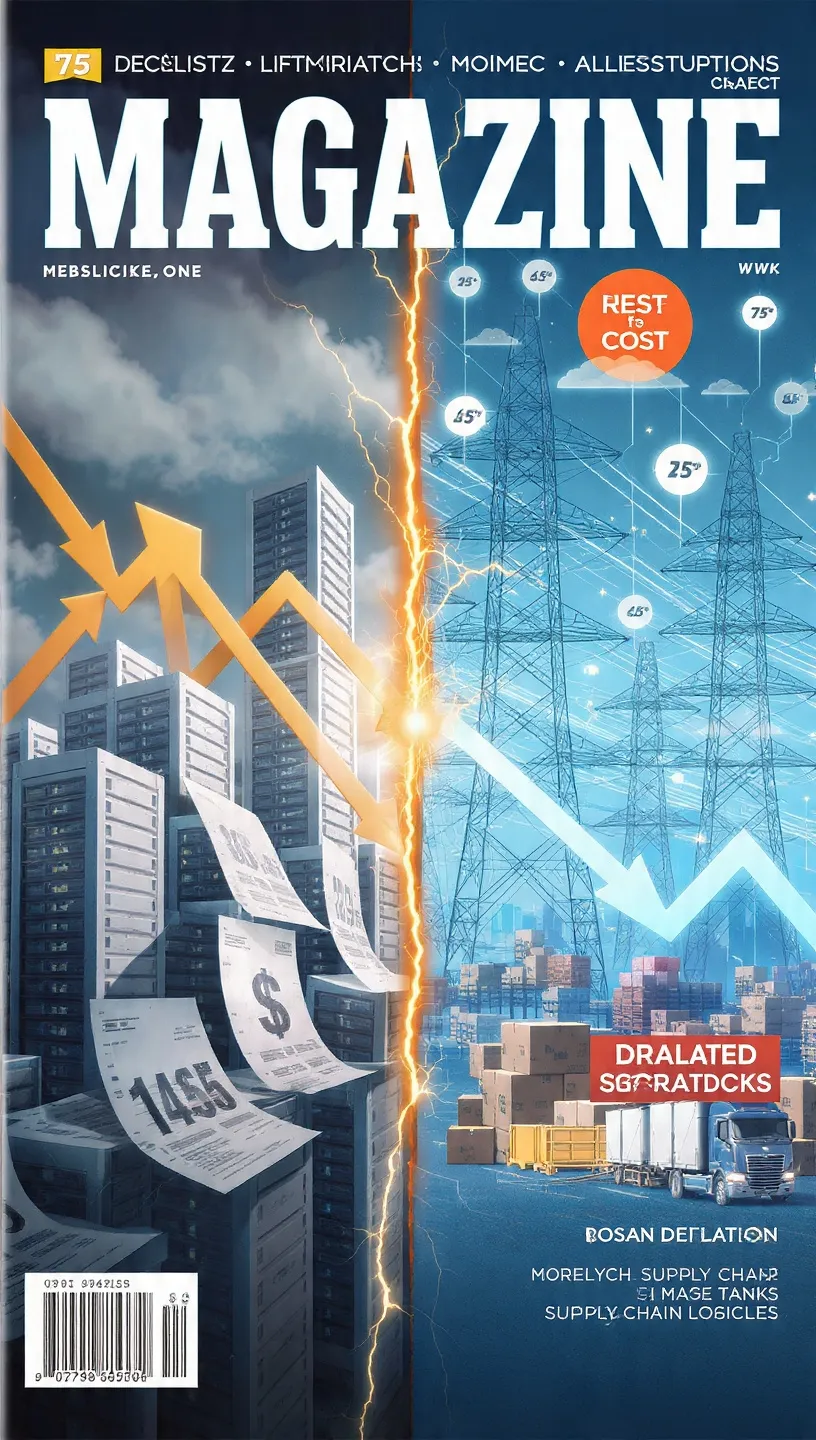
The most direct harm is visible in your electricity bill. Goldman Sachs reported in February 2026 that electricity prices rose 6.9% in 2025 more than double the 2.9% headline inflation rate. AI data centers are responsible for 40% of all new electricity demand growth in the United States. That translated to an added 0.1 to 0.2 percentage points of inflation landing directly on household budgets — not on technical company balance sheets.
Research reference — Goldman Sachs, February 2026:
Electricity prices will increase by 6.9% annually by 2025. Data centers make up 40% of new electricity demand growth. Goldman projects consumer electricity inflation stays near 6% through 2026–2027 before decelerating to 3.5% by 2028 as supply catches up.
Then there is the investment paradox. In 2025 alone, the five largest US technology firms spent $736 billion on AI data center expansion. Goldman Sachs found this investment contributed essentially zero to economy-wide productivity. What it did contribute to was a spike in construction costs, semiconductor prices, and specialized labor wages all of which rippled outward, raising costs for every business and every consumer who never chose to participate in the AI boom at all.
The London School of Economics named a third problem in October 2025: AI-propagated supply shocks. When AI disrupts one sector rapidly — semiconductors, logistics it destabilizes cost structures across every connected industry, faster than any interest rate tool can address. Central banks, built for a different era, are simply not equipped for this new type of disruption.
Advertisement
"In the AI era, there is an inflation problem, there is a reliability problem, and there is a growing constituency that is not willing to wait."
Fortune, May 2026 --- Part 2: The Real Answer: How to Cut Costs
Federal Reserve Bank of St. Louis published research in Q4 2024 showing that AI large language models produce inflation forecasts with lower error rates than the Survey of Professional Forecasters the gold standard of economic prediction for five decades. Better forecasts mean smarter interest rate decisions. Smarter decisions mean fewer cases where central banks over-correct and accidentally deepen the very problem they are trying to solve.
Research Reference — Federal Reserve Bank of St. Louis, Q4 2024:
AI large language models outperformed the Survey of Professional Forecasters in inflation forecasting accuracy across 2019–2023, generating lower mean-squared errors in most years and at almost all time horizons tested.
In food supply chains — where inflation hurts the poorest households most — AI is already delivering real results. The Food Institute reported in August 2025 that food manufacturers using AI quality control achieve 15 to 30 percent fewer defects. Plants using AI predictive maintenance reduce unplanned downtime by 20 to 40 percent. Full AI demand forecasting reduces overall supply chain costs by up to 38%. China has already deployed AI price monitoring across major city vegetable markets to detect and prevent artificial price spikes before they spread.
And on the very problem AI created — energy costs — AI is also the strongest solution available. AI-optimized power grid management and renewable energy scheduling tools are already in deployment. Goldman Sachs itself projects electricity inflation decelerates from 6.9% to 3.5% by 2028 — precisely because AI-driven efficiency and new supply will catch up to demand.
Part 3 — Honest Scorecard: Benefits vs Harms
Benefits — Research Backed
Energy long-term: Electricity inflation falls to 3.5% by 2028 as AI grid optimization scales — Goldman Sachs
Food prices: AI cuts supply chain costs 38%, defect rates 15–30% — Food Institute 2025
Central banks:AI outforecasts human expert panels on inflation accuracy — Federal Reserve Q4 2024
Advertisement
Serious & Respectful Matchmaking
Your Journey to Marriage Begins at NikahNoor
Connect with single Muslims who share your values, culture, and intentions for a lifelong partnership.
Price gouging: Real-time AI monitoring detects hoarding before it spreads — already live in China
Manufacturing: AI predictive maintenance cuts downtime 20–40%, directly lowering production costs
Long-term growth: AI productivity structurally lowers prices across economies — exactly as computing did after 1995
Harms — Happening Right Now
Electricity: 6.9% price rise in 2025 directly from AI data center demand — Goldman Sachs, Feb 2026
Wasted capital: $736 billion AI investment in 2025 with zero GDP growth — Goldman Sachs, May 2026
Construction inflation: Data center buildout inflating material and labor costs across the entire economy
Inequality: Rich nations gain the benefits while developing economies bear the energy costs without productivity access
Monopoly risk: AI market concentration could create new price-setting power in critical industries
Water Costs: Data center water consumption adds hidden resource cost pressures to already water stressed areas
Conclusion — The Numbers Side by Side
Here is what the research actually says when the facts are placed together honestly:
Advertisement
AI added 0.3 percentage points to US core inflation in the past year — Goldman Sachs, May 2026
US electricity rose 6.9% in 2025 — more than double headline inflation — Goldman Sachs, Feb 2026
$736 billion invested in AI in 2025 produced zero measurable GDP growth — Goldman Sachs
AI forecasting already outperforms human expert panels on inflation accuracy — Federal Reserve, Q4 2024
AI supply chain tools reduce costs by up to 38% — savings that flow directly to consumer prices
Food manufacturers using AI report 15–30% fewer defects and 20–40% less downtime — Food Institute, 2025
Electricity inflation decelerates to 3.5% by 2028 as AI-driven efficiency and supply scale — Goldman Sachs
These numbers tell one coherent story. AI is charging the world a short-term price — in electricity bills, infrastructure inflation, and disrupted labor markets — before delivering the long-term gains it has promised. This pattern is not new. The railroad boom of the 1800s caused land inflation for decades before it made trade cheaper for everyone. Electrification raised costs through the 1910s before transforming productivity in the 1920s.
What is different this time is that we have the research data in real time. We do not need to wait 30 years to see what is failing and what is working. The numbers are already telling us: deploy AI in food supply chains where 38% cost reductions are proven. Give AI forecasting tools to every central bank where accuracy is already demonstrated. Regulate data center energy consumption before electricity inflation compounds further. And open AI tools to small farmers and developing governments — not only to corporations that are already profitable.
The technology is not the problem. The decisions about where and how to deploy it are. And decisions, unlike physics, can be changed the moment the will exists to change them.
Research Sources: Goldman Sachs (February & May 2026) · Federal Reserve Bank of St. Louis (Q4 2024) · Bank for International Settlements Working Paper 1179 · LSE Business Review (October 2025) · CEPR Discussion Paper 19604 · The Food Institute (August 2025) · Fortune (May 2026)_

 Electricity prices will increase by 6.9% annually by 2025. Data centers make up 40% of new electricity demand growth. Goldman projects consumer electricity inflation stays near 6% through 2026–2027 before decelerating to 3.5% by 2028 as supply catches up.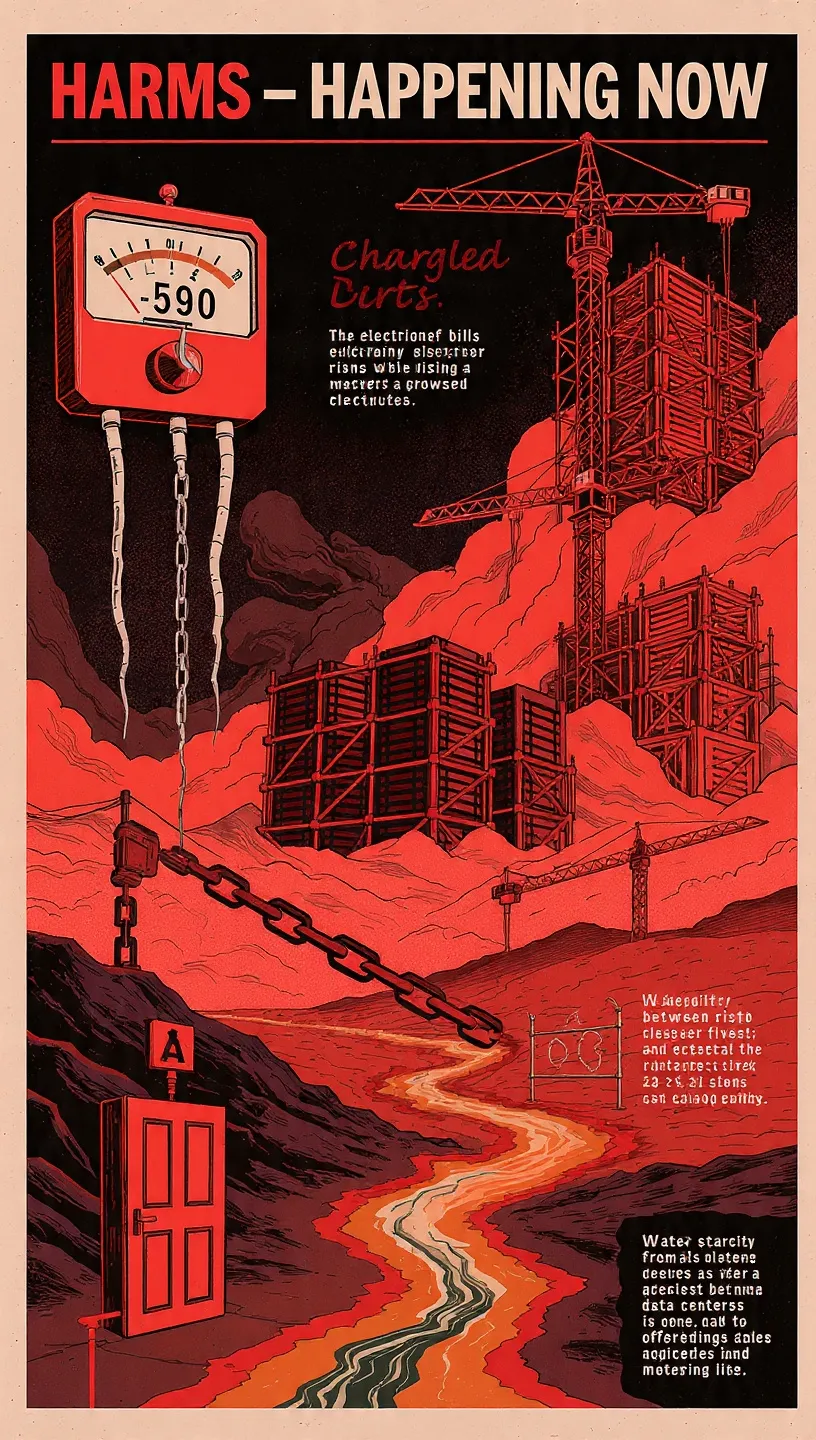




















Responses (0)
Sign in to share your thoughts.
Sign in