
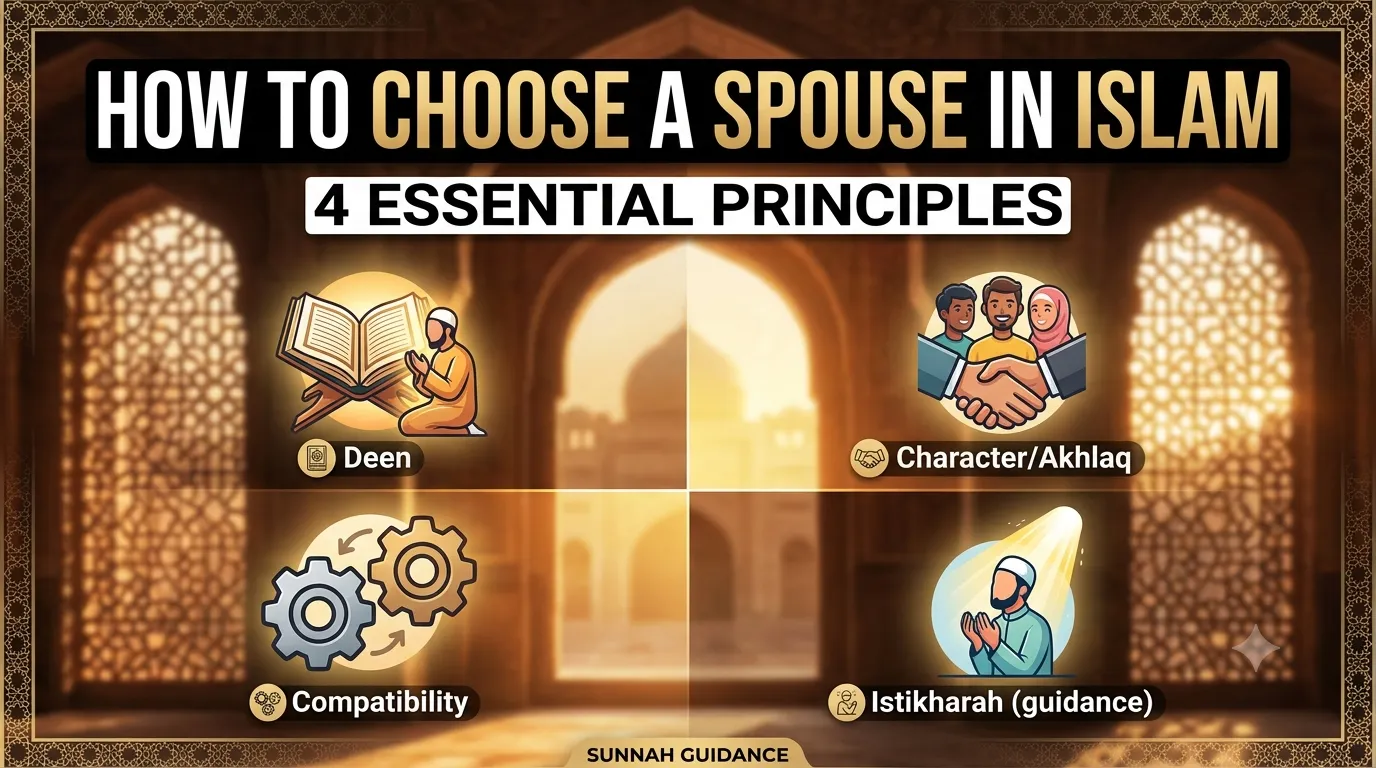
In Islam, choosing a life partner is considered one of the most important decisions you will make, as marriage (Nikah) is described as completing half of one's faith (Deen). The Prophet Muhammad ﷺ provided clear, practical principles to guide this decision.
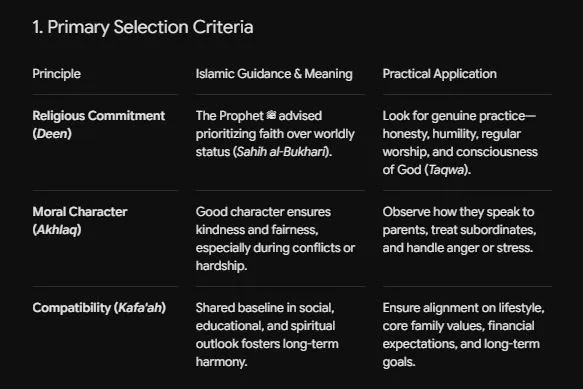
Key Islamic Principles for Choosing a Spouse
1. Prioritize Character and Religious Commitment (Deen & Akhlaq)
The primary criterion highlighted in Islamic teachings is religious commitment and moral character.
The Prophet Muhammad ﷺ said:
"A woman is married for four things: her wealth, her family status, her beauty, and her religion. So choose the one who is religious, may your hands be rubbed with dust (i.e., may you prosper)."
— Sahih al-Bukhari & Sahih Muslim
Similarly, regarding choosing a husband:
"If there comes to you one with whose character and religious commitment you are pleased, then marry (your daughter to) him."
— Sunan al-Tirmidhi
A person with genuine Deen and Akhlaq (good character) will treat you with respect, honor, and kindness—fulfilling their marital rights according to Islamic standards even during disagreements.
2. Compatibility (Kafa'ah)
Islam emphasizes compatibility between spouses to ensure long-term harmony. Kafa'ah involves evaluating alignment in key areas:
Values and Life Goals: Shared vision for raising a family, career expectations, and religious practice.
Maturity and Temperament: Emotional readiness for responsibility and mutual respect.
Social and Cultural Background: While not a strict barrier, shared or compatible cultural backgrounds often make family integration smoother.
3. Mutual Attraction and Consent
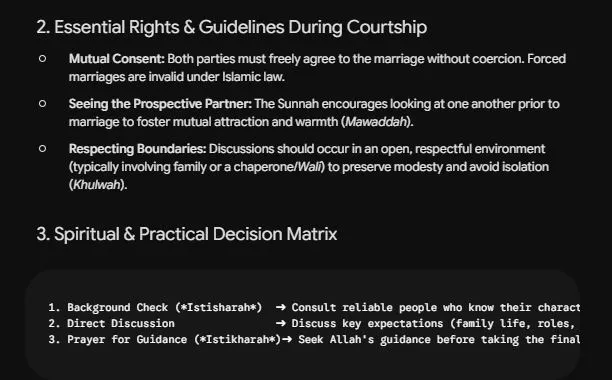
Islam does not advocate blind arrangements. Both prospective spouses have the right to see, talk to, and assess one another in a permissible (halal) environment to establish mutual attraction and consent.
Looking at the Prospective Partner: The Prophet ﷺ encouraged seeing a potential spouse before deciding, as it fosters love and affection between the two.
Free Consent: A marriage contracted without the genuine, free consent of both the bride and the groom is invalid in Islamic law.
4. Practical Steps in the Decision Process
Conduct Due Diligence (Istisharah): Seek honest feedback from trustworthy people who know the candidate well regarding their character, temper, financial habits, and interactions with others.
Keep Boundaries Respectful: Interactions during the courtship or proposal phase should remain within Islamic guidelines (e.g., involving family or a guardian/Wali, avoiding solitude/Khulwah).
Pray Salat al-Istikharah: Once you have done your research, evaluated compatibility, and formed an inclination, perform the prayer of guidance (Istikharah). Ask Allah to facilitate the path if it is good for your faith, life, and hereafter, or to turn it away if it is not.
More from ArticlePaid
Why Are Adult Friendships So Hard to Navigate? Tips to Deal With Such Situations
Friendship Does Not Develop the Same Way AnymoreWhen you were in school, all you had to do to gain a friend was sit at a desk next...

How to make My partner Happy learn Love Language. Be active in response
Making a partner happy isn’t about grand, cinematic gestures; it’s about the consistent, daily choices that show them they are see...

Why Do We Romanticize the Past, Even When It Wasn’t Perfect?
There is something strange about the past. Years can pass, people can change, places can disappear, and yet a single song, smell, ...

Solastalgia: The Silent Grief for Places We Left Behind—Without Ever Moving Away
Solastalgia: The Silent Grief for Places We Left Behind—Without Ever Moving AwayHave you ever returned to your childhood neighborh...

The Burden Of Memories Mind Refuses to Bear
Have you ever wondered why some memories stuck in our mind, an empty smile, an unforgotten goodbye, an incomplete conversation or ...

what's the real problem, Labels or expectations ?
Labels don't ruin relationships—our expectations do. When love turns into a checklist of roles and rules, we lose the freedom and joy that brought us close in the first place. Let connection be real, not controlled.

A“True Love Knows No Time: Heartbreaking Story That Became Legends”
Long ago, in the beautiful city of Verona, Italy, two powerful families, the Montagues and the Capulets, were bitter enemies....

What Attracts Russian and Ukrainian Men to American Women?
Presented here is an in-depth, question-and-answer styled article that examines the aspects Russian and Ukrainian men often find appealing in American women, from cultural, social, and psychological viewpoints. This article aspires to maintain respect, balance, and insight, steering clear of stereotypes while highlighting common patterns and observations.

Healthy Habits, Happy Life: Tips for Women's Wellness
Healthy Practices for a Satisfying Life Put self-care first, fuel your body, keep moving, handle stress, and cultivate significant relationships. Minor actions result in enduring health, joy, and energy.
Weekly Top Articles

Best AI Tools in 2026: 10 Tools That Make Everyday Work Easier
Artificial intelligence has become a practical part of everyday work in 2026. From writing and research to graphic design, coding,...

10 Future-Ready Courses Writers Should Consider in 2027
The Concept of Writing Skills Has Changed The role of a great writer is no longer about putting words together to form a good...

Money and Peace Together: 5 Hobbies That Can Earn You Extra Income Today
IntroductionIt is no secret that a person’s leisure time is often limited due to the ongoing hustle for money. However, in some ca...

Creamy Garlic Butter Chicken: A Weeknight Dinner Worth Repeating
Every so often, a dish takes over your social feed and you wonder if it's really that good. This one is. Tender chicken sits in a ...

Top 10 Online Courses to Learn in 2026 for a Successful Future Career
IntroductionThe online courses market is on the rise in 2026, and there are plenty of options suitable for students, job seekers. ...

7 AI Skills Paying $100 Daily In 2026 (No Degree Required)
IntroductionThe world of Artificial Intelligence is booming, offering unprecedented opportunities to make a living and build a sus...








Responses (0)
Sign in to share your thoughts.
Sign in