Introduction
The universe has always fascinated humankind with its infinite wonders, but few discoveries capture the imagination like NASA’s recent observation of a cosmic phenomenon nicknamed the “Hand of God.” Resembling a giant celestial hand stretching across the void, this nebula continues to challenge scientists and inspire awe around the globe.
What Is the ‘Hand of God’?
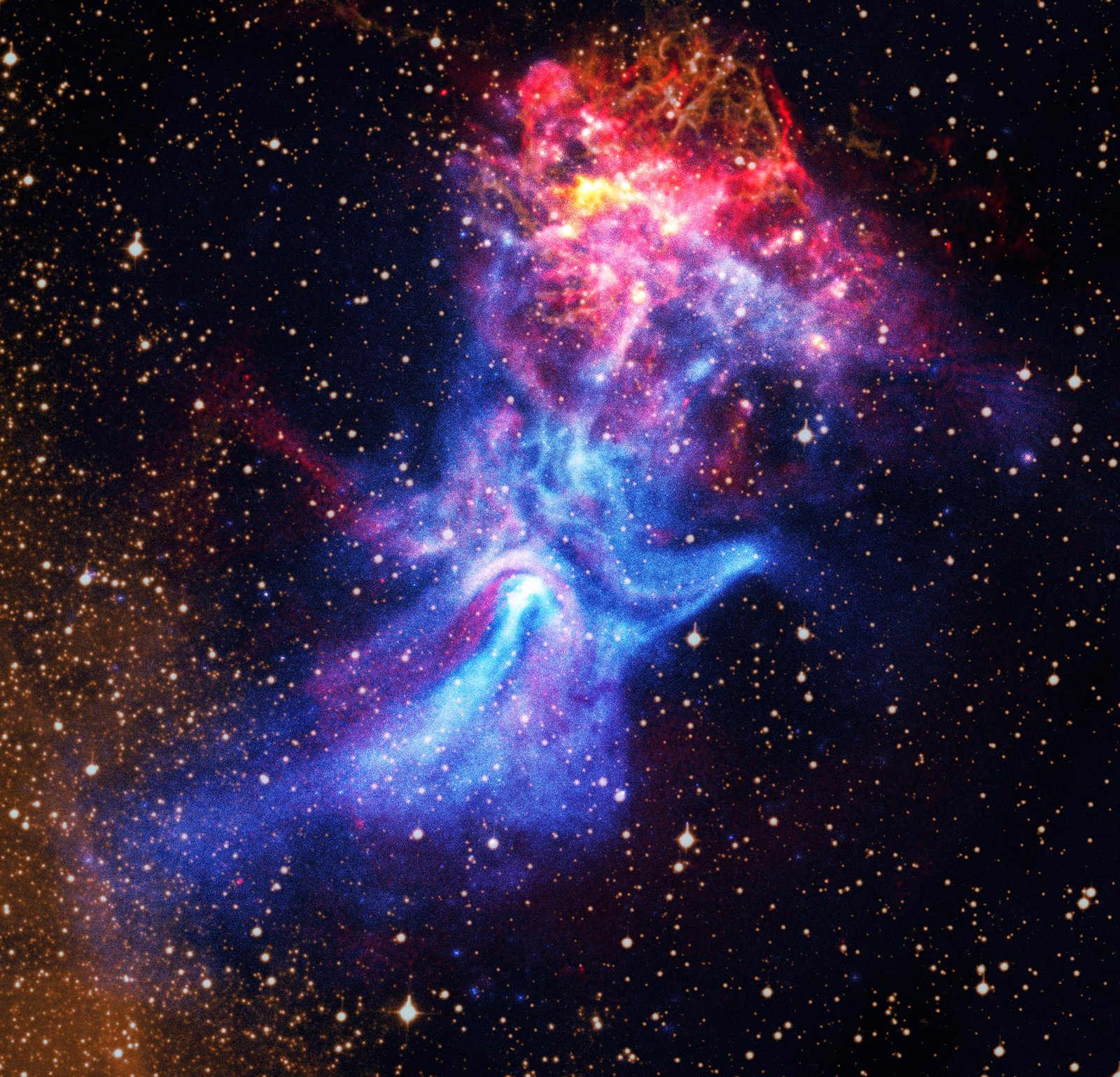
The image, captured by NASA’s Chandra X-ray Observatory, reveals a pulsar wind nebula — the aftermath of a star that exploded in a supernova. At its heart lies a dense, rapidly spinning neutron star (or pulsar) that emits powerful jets of matter and energy.
As the pulsar spews particles into the surrounding gas cloud, the interaction produces an eerie formation shaped like a giant hand, complete with what appear to be fingers stretching into space.
Why Is It Mysterious?
Scientists are puzzled because the nebula seems to exhibit unusual behavior that doesn’t fully align with current astrophysical models. Some mysteries include:
- Unusual Shape: The hand-like formation seems too structured to be random, raising questions about particle movement and magnetic fields.
- Energy Distribution: The way the X-rays spread through the gas appears inconsistent with what’s expected from pulsar winds.
- Size and Scale: Stretching nearly 150 light-years across, the nebula is larger and more defined than many others observed before.
The Science Behind the Beauty
- Pulsar Power: The neutron star at the center spins several times per second, releasing energy thousands of times more powerful than our Sun.
- Light & X-rays: The “glow” captured in X-ray imaging comes from particles accelerated to near-light speed, colliding with magnetic fields.
- Cosmic Timeline: Scientists believe the pulsar formed about 1,700 years ago, making this a relatively young remnant in astronomical terms.
What Does It Mean for Astronomy?
The “Hand of God” isn’t just visually striking — it’s scientifically valuable. Studying its structure helps researchers:
- Understand supernova remnants and their impact on the galaxy.
- Learn how pulsars interact with their environments.
- Gain insights into magnetic field dynamics on a massive cosmic scale.
Public Fascination
Nicknamed for its unmistakable resemblance, the nebula has quickly become a viral image across the internet. Some see it as proof of divine symbolism, while others view it as yet another reminder of the universe’s randomness and beauty.
Regardless of interpretation, it serves one truth: the cosmos has a way of humbling humanity.
Final Thought
NASA’s “Hand of God” Nebula reminds us of how much there still is to learn about the universe. Whether it’s a cosmic coincidence or a deeper astronomical clue, this mysterious structure continues to stretch human curiosity—much like its fingers reaching across the stars.





















Responses (0)
Sign in to share your thoughts.
Sign in