
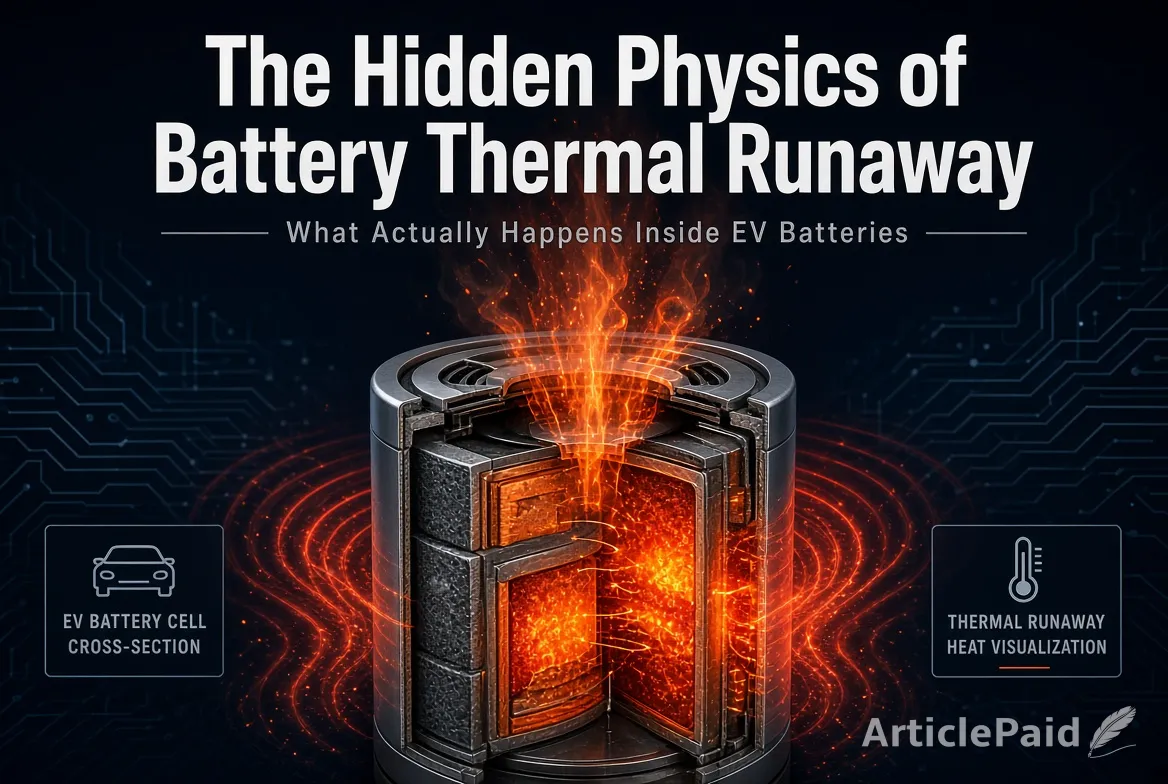
Physics of Battery Thermal Runaway: What Actually Happens Inside EV Batteries
Electric vehicles have transformed transportation, yet one persistent risk continues to capture headlines and engineering attention: battery thermal runaway. This is not simply “the battery catches fire.” It is a rapid, self-accelerating sequence of chemical and physical events that can turn a stable lithium-ion cell into a source of intense heat, gas, and flame within seconds. Understanding the hidden physics behind it is essential for safer battery design and more informed public discussion.
Thermal runaway begins when a lithium-ion cell is pushed beyond its safe operating window. Triggers include external heat, mechanical crush, internal short circuits from manufacturing defects, or overcharging.
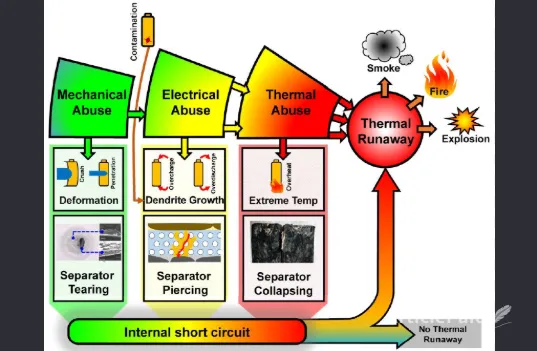
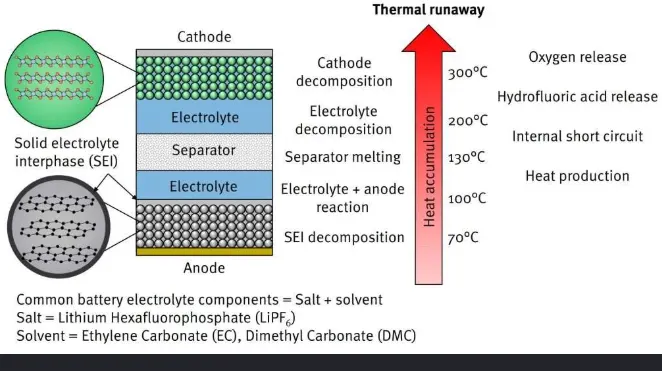
Once the temperature inside the cell reaches roughly 80–120 °C, the solid-electrolyte interphase (SEI) layer on the anode starts to decompose. The SEI is a thin protective film that normally prevents the electrolyte from reacting continuously with the anode.
When it breaks down, the electrolyte contacts the lithiated graphite and begins to react exothermically. Heat is released, temperature rises further, and the reaction rate accelerates according to Arrhenius kinetics—roughly doubling for every 10 °C increase.
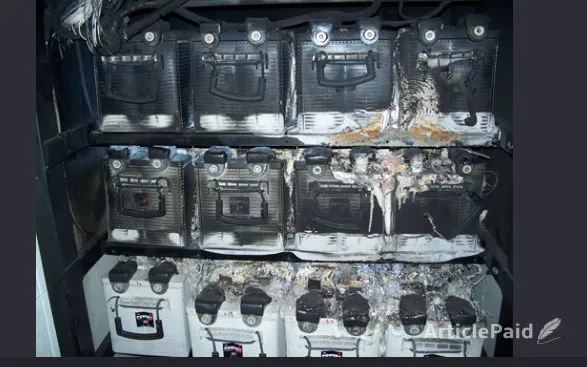
As temperature climbs past 130–150 °C, the polyethylene or polypropylene separator melts or shrinks. This thin polymer membrane is the only barrier keeping the anode and cathode from touching.
Once it fails, a large internal short circuit forms. Electrons flow freely between electrodes, generating ohmic heat at a dramatic rate. Simultaneously, the cathode materials (commonly NMC or NCA chemistries) begin to release oxygen through lattice collapse.
That oxygen reacts with the organic electrolyte solvents, producing additional heat and flammable gases such as carbon monoxide, carbon dioxide, methane, and hydrogen.
The process is now self-sustaining. Heat generated in one region conducts to neighboring material, triggering the same cascade. In a multi-cell pack the failure can propagate from cell to cell in a chain reaction.
Internal pressure builds rapidly as gases are generated; the cell casing eventually vents or ruptures, releasing a jet of hot, combustible vapor that can ignite on contact with air.
Peak temperatures inside a runaway cell routinely exceed 600–800 °C, and the energy release can be violent enough to eject molten metal and burning electrolyte.
From a physics standpoint, three factors dominate severity:
the energy density of the cell (higher energy means more chemical potential available), the thermal conductivity and heat capacity of the surrounding materials, and the kinetics of the decomposition reactions.
Modern cells pack more energy into less volume, which improves range but reduces the thermal mass available to absorb heat spikes. That is why engineers now focus intensely on cell chemistry (shifting toward higher-nickel or LFP formulations), improved separators with ceramic coatings, and sophisticated battery-management systems that detect early voltage or temperature anomalies.
Cooling systems, whether liquid channels or advanced phase-change materials, attempt to extract heat faster than the runaway reactions can generate it. Structural design—cell-to-cell spacing, fire barriers, and directed venting—aims to slow or contain propagation.
Yet the fundamental physics remains: once the cascade of SEI breakdown, separator failure, and oxygen release is underway, the energy already stored in the cell will be released, often with dramatic consequences.
Thermal runaway is therefore not a mysterious failure mode. It is the predictable result of highly energetic materials operating near the edge of thermodynamic stability.
The engineering challenge is to keep those materials within safe bounds under every real-world condition an electric vehicle will encounter.






















Responses (0)
Sign in to share your thoughts.
Sign in