A Mystery That Has Defied Six Centuries
Imagine walking into an ancient library and discovering a weathered book unlike anything you've ever seen. Its pages are covered with elegant handwriting in a language that doesn't belong to any known civilization. Strange plants with impossible roots grow across its pages. Women bathe in mysterious green pools connected by twisting pipes, while stars, moons, and zodiac symbols fill elaborate circular diagrams. Despite centuries of study by historians, linguists, codebreakers, and even artificial intelligence, no one has been able to say with certainty what the book actually says.
This is the story of the Voynich Manuscript, often called the world's most mysterious book.
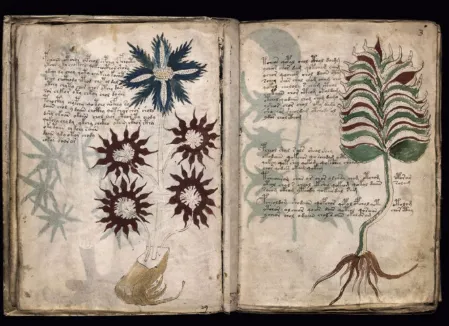
For more than 600 years, it has challenged some of the brightest minds in history. Every new discovery seems to create even more questions. Is it an encrypted scientific text? A forgotten language? A medieval medical guide? Or one of history's greatest hoaxes? Even today, the truth remains hidden within its mysterious pages.
What Is the Voynich Manuscript?
The Voynich Manuscript is a beautifully illustrated handwritten book believed to have been created in the early 15th century. It is named after Wilfrid Voynich, a Polish book dealer who purchased the manuscript in 1912 from a Jesuit college near Rome. Although the book became famous after he found it, it had already existed for centuries before entering the modern world.
Scientists used radiocarbon dating to examine the parchment, and the results showed that it was made between 1404 and 1438. This means the manuscript is genuinely medieval and not a modern forgery. The ink, handwriting style, and materials also match what experts would expect from a book produced during that period.
Today, the manuscript is preserved at Yale University's Beinecke Rare Book & Manuscript Library, where researchers from around the world continue to study it.
A Book Written in an Unknown Language
The first thing people notice is its writing.
The manuscript contains over 200 pages, although historians believe several pages are missing. Every page is filled with neat, flowing characters that resemble a real language, yet they don't match Latin, Arabic, Greek, Hebrew, or any other known writing system.
Researchers have named this mysterious script "Voynichese."
What makes the mystery even deeper is that the writing doesn't appear random. Certain words repeat frequently, sentences follow recognizable patterns, and statistical analysis suggests the text behaves much like natural human languages.
This has puzzled experts for decades.
If the writing is meaningless, why does it follow the complex structure of real language? But if it is meaningful, why has nobody managed to read it?
The Impossible Plants
Perhaps the manuscript's strangest feature is its collection of botanical illustrations.
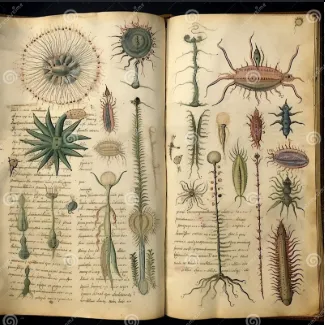
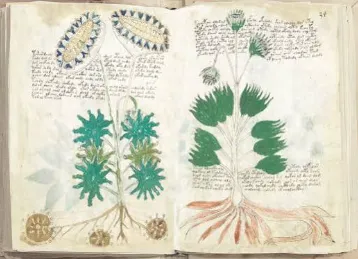
Nearly half the book contains detailed drawings of plants. At first glance, they resemble medieval herbal guides used by physicians. However, a closer look reveals something astonishing.
Many of the plants don't exist.
Some combine leaves from one species with flowers from another. Others have roots shaped like human figures or branches unlike anything found in nature. Researchers have attempted to identify hundreds of these illustrations, but no complete agreement has ever been reached.
Some historians believe they may represent extinct plants or artistic combinations created for medicinal purposes. Others suggest they are entirely imaginary.
Whatever the truth, the plants remain one of the manuscript's greatest mysteries.
Strange Women and Green Pools
If the plants weren't unusual enough, another section of the manuscript is even more bizarre.
It contains illustrations of dozens of naked women standing or bathing inside green pools connected by an elaborate network of tubes and channels. Some appear to be holding stars or strange objects, while others interact with unusual structures that resemble early plumbing systems.
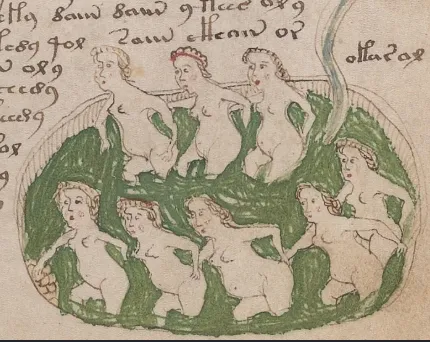
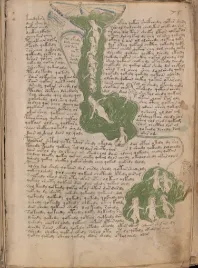
No one knows exactly what these scenes represent.
Some researchers believe they illustrate medieval ideas about medicine, fertility, or the human body. Others think they may symbolize natural springs, healing baths, or even philosophical concepts rather than real places.
Because there is no readable text to explain the pictures, every interpretation remains uncertain.
A Sky Filled with Symbols
Another fascinating section explores the heavens.
Large circular diagrams contain stars, moons, suns, and zodiac symbols including Aries, Taurus, Gemini, and other familiar constellations. Around these illustrations are rings of mysterious writing and groups of small female figures.
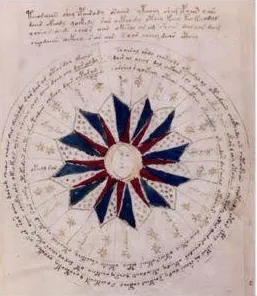
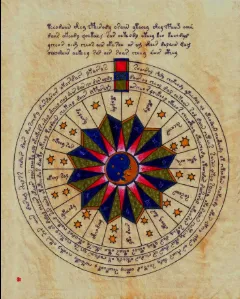
During the Middle Ages, astronomy and astrology were closely connected. Physicians often consulted the stars before treating patients, believing celestial movements influenced human health.
This has led some historians to believe that at least part of the manuscript may relate to astrology or medieval medicine.
Yet once again, without understanding the text, no one can be certain.
Why Has Nobody Solved It?
Since the manuscript became famous in the early twentieth century, countless experts have tried to unlock its secrets.
Linguists searched for hidden grammar.
Historians compared it with medieval books.
Mathematicians analyzed patterns.
Professional cryptographers looked for secret codes.
Even some of the brilliant codebreakers who helped decipher enemy communications during the Second World War examined the manuscript. Despite their remarkable success with military ciphers, they could not confidently decode the mysterious writing.
Every few years, someone claims to have solved the puzzle. Newspapers report a breakthrough, excitement spreads across the internet, and then other experts carefully examine the evidence.
So far, every claimed solution has failed to convince the scholarly community.
The Greatest Minds vs. the Greatest Mystery
The Voynich Manuscript has attracted historians, linguists, mathematicians, cryptographers, and computer scientists from around the world. Many believed they would be the first to unlock its secret. Yet, after more than a century of modern research, no explanation has gained widespread acceptance.
During the Second World War, some of the world's finest codebreakers—people who successfully deciphered complex military codes—studied the manuscript. If anyone could solve it, many believed they could. Yet even these experts failed to reveal a clear meaning.
In recent years, artificial intelligence has joined the search. Machine-learning systems have compared the manuscript with hundreds of ancient languages, searched for hidden patterns, and analyzed the frequency of words and symbols. While AI has discovered interesting statistical relationships, it has not translated the manuscript. The mystery remains unsolved.
Theories That Could Explain the Manuscript
Over the centuries, researchers have proposed countless explanations. Some are supported by historical evidence, while others are purely speculative.
1. A Secret Code
One of the oldest theories is that the manuscript is written in an elaborate cipher.
During the Middle Ages, kings, diplomats, and scholars often hid sensitive information using secret codes. Some believe the Voynich Manuscript contains medical knowledge, scientific discoveries, or alchemical recipes that its author wanted to protect.
However, if it is a cipher, it is unlike any other known medieval code. Despite decades of analysis, experts have not identified a convincing encryption method.
2. A Lost Language
Another possibility is that the manuscript is written in a real language that has disappeared over time.
History contains many forgotten languages and writing systems. Some have survived only in fragments, while others remain undeciphered. Perhaps the Voynich Manuscript preserves the language of a small community that no longer exists.
The challenge is that no other known document uses the same script, leaving researchers with nothing to compare it to.
3. A Medieval Medical Guide
Many historians believe this is one of the most realistic explanations.
The manuscript contains hundreds of plant illustrations, diagrams of the human body, bathing scenes, and astronomical symbols. During the Middle Ages, medicine often combined herbal remedies, astrology, and natural philosophy.
If this theory is correct, the strange plants may represent medicinal herbs, while the unusual bathing scenes could symbolize health treatments rather than literal events.
4. An Alchemist's Book
Alchemy fascinated medieval Europe.
Alchemists searched for ways to transform ordinary metals into gold and hoped to discover the legendary Philosopher's Stone—a substance believed to grant extraordinary powers or even immortality.
Some researchers think the mysterious symbols and illustrations may represent alchemical knowledge hidden behind coded language.
Although this idea is intriguing, no direct evidence proves the manuscript belonged to an alchemist.
5. An Elaborate Hoax
Perhaps the most controversial theory is that the manuscript is simply a clever fake.
Supporters argue that someone created meaningless text designed to look like a real language in order to impress wealthy collectors.
However, this theory also faces problems.
Creating over 200 pages of carefully structured writing, complete with consistent word patterns and hundreds of detailed illustrations, would have required an enormous amount of time and skill. Few historians believe someone would devote years to producing such an elaborate hoax without clear evidence of profit or purpose.
Facts vs. Fiction
The mystery surrounding the Voynich Manuscript has inspired countless documentaries, novels, and internet stories. Some claim it contains messages from extraterrestrials. Others say it predicts the future or hides magical spells.
There is no reliable evidence supporting these claims.
Here are the facts historians agree on:
The parchment dates to the early 15th century.
The manuscript is authentic and genuinely medieval.
Its writing system has not been conclusively deciphered.
No one knows who wrote it.
No one knows exactly what its illustrations mean.
No accepted translation exists today.
Separating evidence from speculation is important because the real mystery is already extraordinary without adding fictional stories.
Why Does the Manuscript Fascinate Us?
Humans are naturally curious. Psychologists have long observed that unanswered questions capture our attention more than solved ones. This is sometimes called the information gap—when we know just enough about something to realize how much we don't know.
The Voynich Manuscript perfectly fits this pattern.
It looks meaningful.
Its writing follows the structure of real language.
Its illustrations appear carefully planned.
Everything about it suggests purpose, yet its message remains hidden.
This combination of mystery and evidence keeps people returning to it generation after generation.
Could It Ever Be Solved?
Many experts believe the answer is yes—but perhaps not soon.
Future discoveries could reveal another document written in the same script. Advances in artificial intelligence may identify patterns that humans have overlooked. New historical records might uncover the identity of its author or explain why it was created.
History has surprised us before.
Ancient Egyptian hieroglyphs remained unreadable until the discovery of the Rosetta Stone. The ancient Linear B script also puzzled scholars until it was finally deciphered in the twentieth century.
The Voynich Manuscript may one day experience a similar breakthrough.
Or it may continue guarding its secrets for centuries to come.
Final Thoughts
The Voynich Manuscript is far more than an old book. It is one of history's greatest intellectual puzzles—a rare object that has resisted centuries of investigation by brilliant minds.
Its pages contain elegant writing that no one can confidently read, illustrations that seem both familiar and impossible, and clues that continue to challenge historians, scientists, and cryptographers alike.
Whether it is a forgotten language, a coded scientific text, a medieval medical handbook, or something entirely unexpected, the manuscript reminds us that our understanding of history is still incomplete.
In an age when almost every question can be answered with a quick internet search, the Voynich Manuscript stands as a powerful reminder that some mysteries remain unsolved.
And perhaps that is exactly what makes it so unforgettable.
Frequently Asked Questions (FAQs)
1. Has anyone successfully translated the Voynich Manuscript?
No. Many people have claimed to decipher it, but none of these translations have been accepted by the scholarly community.
2. Where is the Voynich Manuscript today?
It is preserved in the Beinecke Rare Book & Manuscript Library at Yale University, where it is carefully protected and studied by researchers.
3. Why is the Voynich Manuscript so famous?
It is famous because it combines authentic medieval history with an unknown writing system, mysterious illustrations, and more than six centuries of unanswered questions, making it one of the world's greatest unsolved historical mysteries.











Responses (0)
Sign in to share your thoughts.
Sign in