
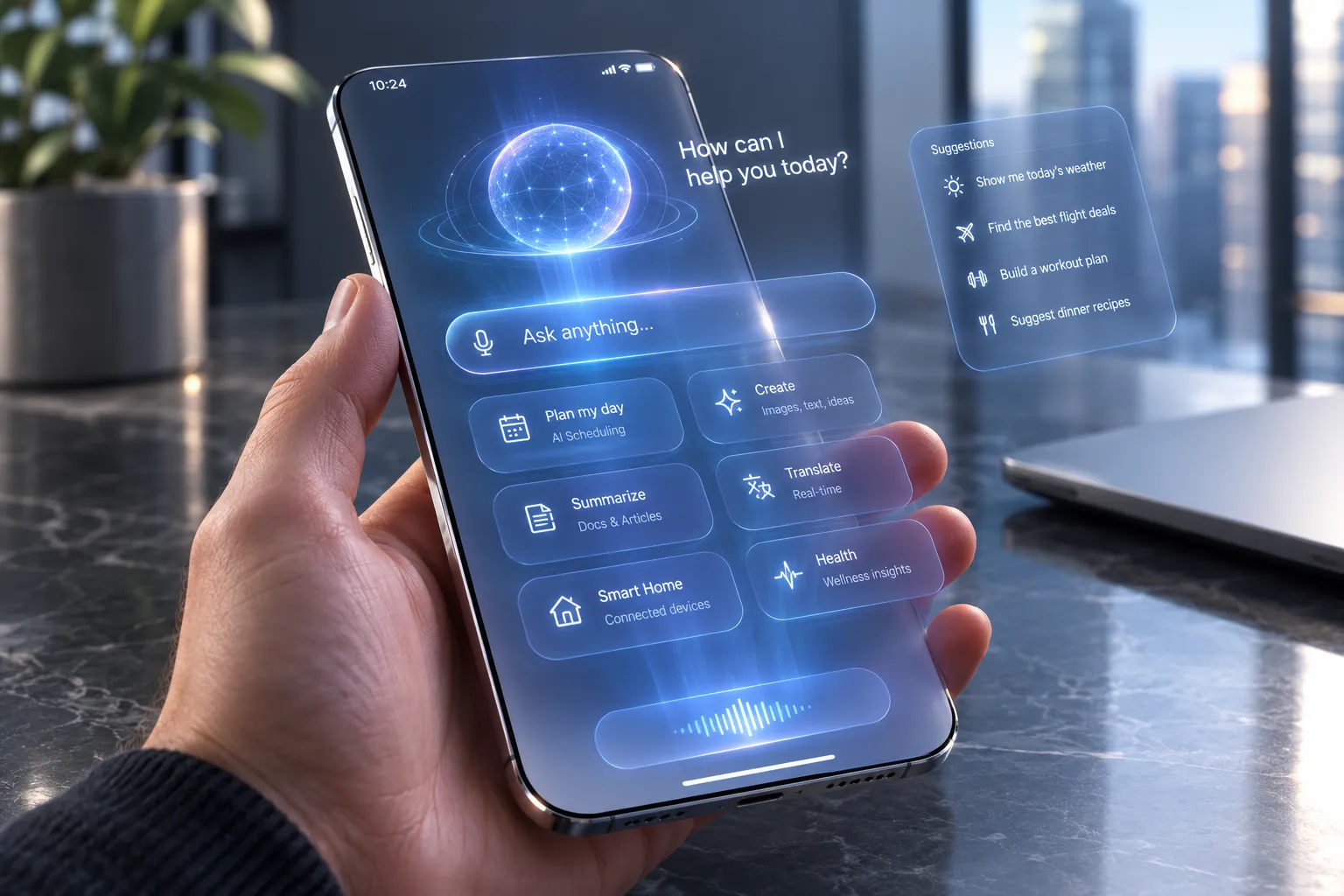
Smartphones have become the primary gateway to digital services, with millions of mobile applications competing for users' attention. From banking and shopping to entertainment and productivity, apps have shaped how people interact with technology for more than a decade. However, the rapid evolution of artificial intelligence is raising an increasingly important question: will traditional mobile apps remain the dominant interface, or are AI-powered assistants and conversational systems poised to replace them?
The answer is more complex than a simple yes or no. Artificial intelligence is transforming how users access information, complete tasks, and interact with digital services. Instead of opening multiple applications, many people are beginning to rely on AI assistants capable of understanding natural language, coordinating between services, and performing actions on their behalf. At the same time, traditional apps continue to provide reliability, specialized functionality, and carefully designed user experiences that AI alone cannot always replicate.
Rather than signaling the immediate end of mobile applications, AI is reshaping the entire software ecosystem. The coming years are likely to see a blend of conversational interfaces, intelligent automation, and conventional applications working together in new ways. Understanding these developments helps businesses, developers, and users prepare for a digital landscape that looks significantly different from today's app-centric world.
The evolution of mobile interfaces
The history of mobile computing has largely been defined by changing interfaces. Early smartphones relied on physical keyboards and simple menus before touchscreens introduced a more intuitive way to interact with software. The launch of app stores transformed mobile devices into platforms where users could download applications for virtually any purpose.
For years, the dominant model remained unchanged. If someone wanted to order food, they opened a delivery app. If they wanted to book a hotel, they used a travel app. Managing finances required opening a banking application, while communication happened through messaging platforms or social media apps. Every task involved finding, launching, and navigating a separate application.
Artificial intelligence is introducing an entirely different interaction model. Instead of navigating menus, users increasingly express intentions through natural language. Rather than searching through icons, they ask an assistant to accomplish a goal.
This shift reduces friction. A user no longer needs to remember which application performs a particular task if an intelligent assistant can identify the appropriate service automatically. For example, instead of opening several travel apps to compare prices, a user may simply ask an AI system to find the best flight within a specified budget and schedule.
The transition resembles earlier technological changes. Just as graphical interfaces simplified command-line computing, conversational AI aims to simplify today's complex collection of applications. However, simplicity also introduces new technical challenges, including accuracy, security, and trust.
The evolution of interfaces suggests that future software will focus less on navigating digital environments and more on communicating intentions, allowing AI to translate human requests into completed actions.
The rise of AI-powered assistants and conversational experiences
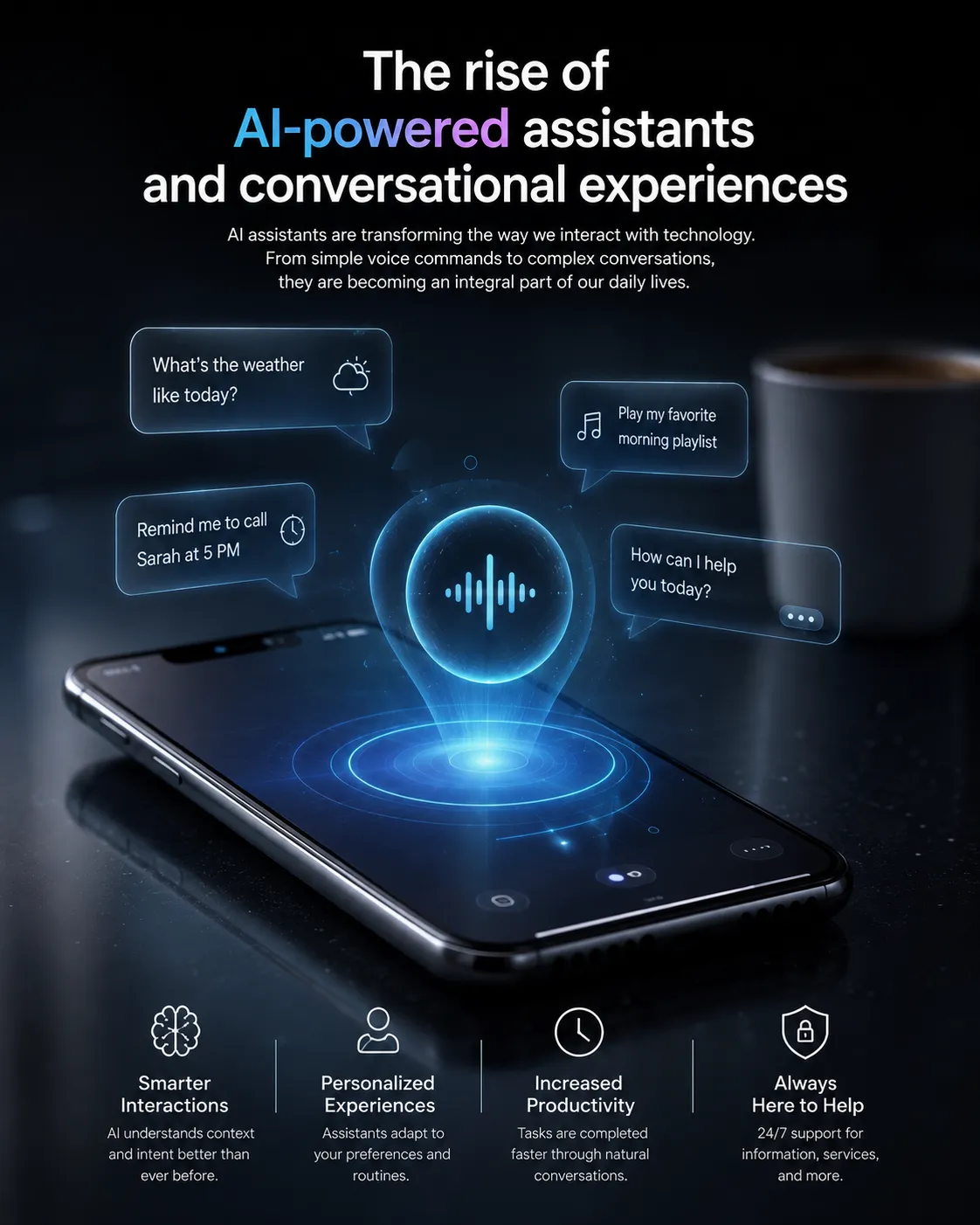
Voice assistants have existed for many years, but recent advances in generative AI have dramatically expanded their capabilities. Earlier assistants could perform simple commands such as setting alarms, playing music, or checking the weather. Modern AI systems can understand context, maintain conversations, summarize information, generate content, solve problems, and interact with increasingly complex digital workflows.
This represents a significant shift from command-based interaction to collaborative assistance. Users are no longer limited to predefined commands but can communicate naturally, refine requests, and receive personalized responses.
Large language models are also becoming capable of acting rather than merely answering questions. Instead of simply recommending restaurants, an AI assistant may compare reviews, make reservations, update calendars, and notify participants. Instead of suggesting productivity strategies, it may organize schedules, draft emails, prioritize tasks, and coordinate multiple services simultaneously.
Voice interaction is also becoming more practical. Improvements in speech recognition, multilingual support, and conversational memory make speaking to AI feel increasingly natural. For many situations—particularly while driving, cooking, or multitasking—voice may become the preferred interface over typing or tapping screens.
Another important trend is multimodal AI. Modern systems can combine text, images, voice, video, and documents within a single conversation. A user might photograph a broken appliance, ask for repair advice, order replacement parts, and schedule a technician without switching between multiple apps.
Despite these advances, conversational interfaces still face limitations. Some tasks require visual precision, detailed controls, or extensive customization that graphical interfaces handle more effectively. Complex photo editing, professional design software, financial trading platforms, and engineering applications often benefit from visual workflows that AI conversations alone cannot fully replace.
Why traditional mobile apps remain important
Although artificial intelligence is advancing rapidly, traditional applications continue to offer strengths that are difficult to replace completely.
One of the most significant advantages is reliability. Mobile apps provide carefully tested interfaces designed for specific tasks. Banking applications, healthcare platforms, enterprise software, and professional creative tools require predictable behavior, clear navigation, and compliance with strict security standards. Users often prefer explicit controls when handling sensitive financial information, medical records, or confidential business data.
Performance is another consideration. Native mobile applications can optimize hardware usage, provide offline functionality, deliver high-performance graphics, and interact directly with device components such as cameras, sensors, or biometric authentication systems. AI assistants frequently depend on cloud processing, which introduces latency and requires reliable internet connectivity.
User experience also matters. Applications are designed with visual layouts that help people compare options, monitor progress, and perform complex workflows efficiently. While conversational AI excels at answering questions and coordinating actions, visual interfaces remain valuable for activities involving dashboards, editing tools, maps, timelines, and interactive controls.
Privacy presents another important challenge. AI systems often require access to multiple services, user preferences, and personal data to function effectively. Many individuals and organizations remain cautious about granting broad permissions to a single intelligent assistant capable of accessing numerous aspects of their digital lives.
Businesses also have strategic reasons for maintaining dedicated applications. Mobile apps strengthen brand identity, enable direct customer engagement, collect valuable usage insights, and support loyalty programs. Companies may hesitate to surrender customer relationships to third-party AI platforms that become the primary interface between businesses and consumers.
For these reasons, traditional applications are unlikely to disappear overnight. Instead, they will increasingly incorporate AI capabilities while preserving the specialized experiences users expect.
How AI could transform the app ecosystem
Rather than eliminating mobile applications, artificial intelligence is more likely to change their role within the broader digital ecosystem.
Many developers are already embedding AI directly into existing apps. Productivity software now summarizes documents automatically. Photo editors remove unwanted objects with a single prompt. Shopping applications provide personalized recommendations based on conversational input. Customer support increasingly relies on intelligent chat systems capable of resolving complex issues without human intervention.
This integration allows applications to remain relevant while reducing the effort required from users. Instead of navigating numerous settings, individuals simply describe what they want to accomplish.
Another emerging trend involves AI agents capable of interacting with multiple applications simultaneously. Rather than replacing apps, these agents function as intelligent coordinators. A single request might involve checking calendars, booking transportation, sending confirmation emails, updating project management software, and generating expense reports across several different platforms.
This model changes the relationship between users and applications. Instead of interacting directly with every service, users increasingly communicate with AI, while the AI communicates with specialized software behind the scenes.
Application developers may therefore shift their priorities. Instead of focusing exclusively on graphical interfaces, they will also design systems that AI agents can understand and control. Well-documented APIs, secure authentication, structured data, and interoperable services become increasingly valuable.
The app itself becomes part of a larger intelligent ecosystem rather than the only point of interaction.
This transformation could also reduce "app fatigue." Many smartphone users already have dozens of installed applications but regularly use only a small percentage of them. AI assistants capable of accessing multiple services through a unified conversational interface may simplify digital experiences while reducing the need to manually organize countless applications.
However, this evolution requires significant collaboration among technology companies, developers, regulators, and platform providers to ensure interoperability, privacy, and user control.
Predictions for the next five years
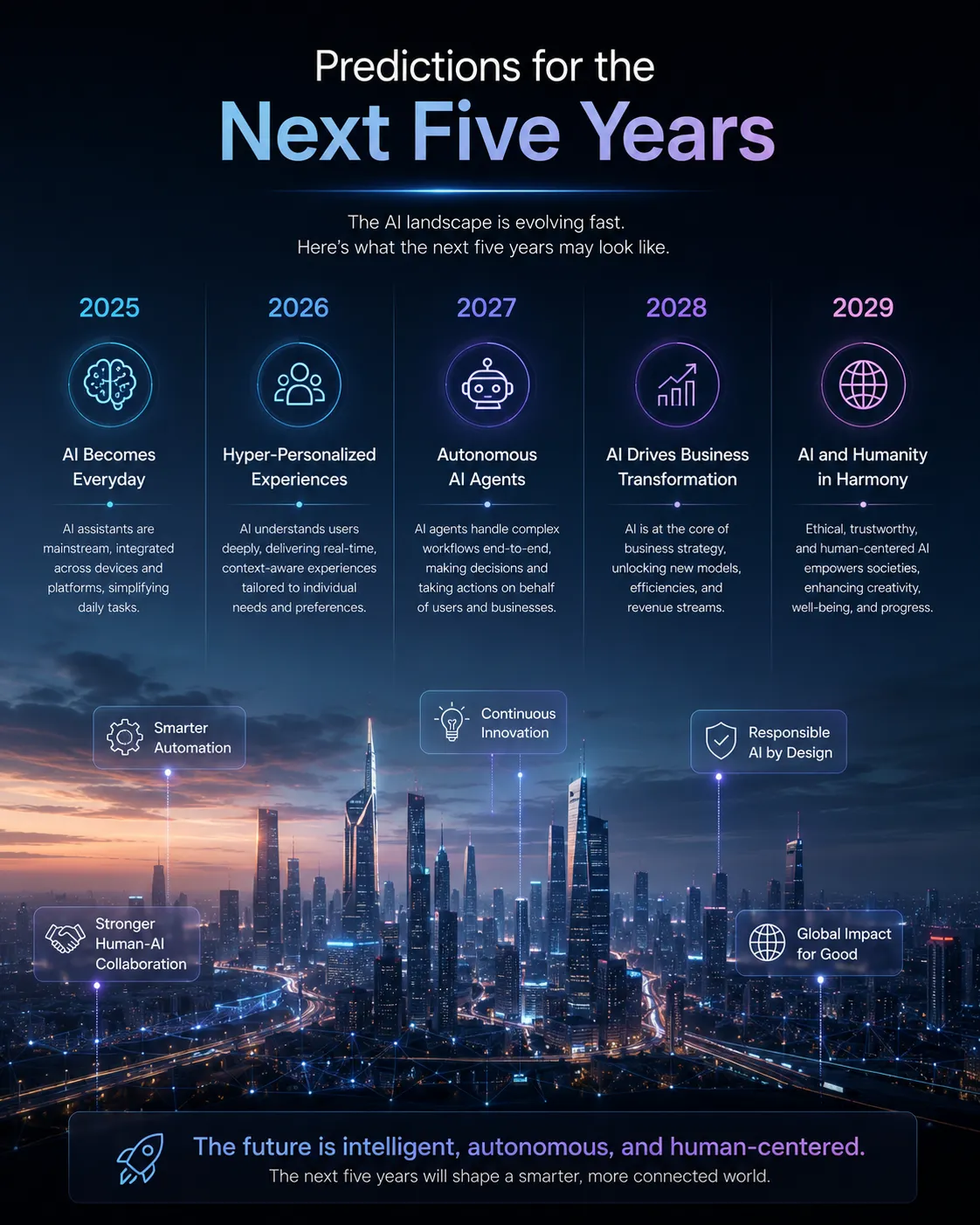
Looking ahead, the next five years are likely to bring substantial changes without completely replacing traditional mobile applications.
The first major development will probably be the expansion of AI-first interfaces. More users will begin interactions by asking an assistant rather than opening a specific application. Search, scheduling, shopping, customer service, and productivity tasks are especially well suited to conversational interaction.
Second, AI agents capable of completing multi-step workflows will become increasingly common. Rather than answering isolated questions, they will coordinate tasks across multiple services while requesting confirmation only for important decisions or sensitive transactions.
Third, voice interaction will become significantly more natural. Continuous improvements in speech recognition, contextual understanding, and emotional awareness will allow conversations with AI to resemble human dialogue more closely. Voice interfaces may become particularly important for wearable devices, smart vehicles, augmented reality glasses, and smart home ecosystems.
Fourth, applications themselves will become increasingly intelligent. Instead of merely responding to user commands, software will proactively anticipate needs, recommend actions, detect potential problems, and automate repetitive tasks while keeping users informed and in control.
At the same time, regulatory frameworks will continue evolving. Governments around the world are introducing new rules governing AI transparency, data privacy, accountability, and algorithmic decision-making. These regulations will influence how quickly AI assistants gain permission to access sensitive personal information and execute important actions autonomously.
Consumer trust will also play a decisive role. Users must feel confident that AI systems protect their privacy, make accurate decisions, and provide sufficient transparency about how information is collected and used. Widespread adoption depends not only on technical capability but also on public confidence.
Finally, rather than witnessing the disappearance of mobile apps, society will likely experience a hybrid digital environment. Traditional applications will continue serving specialized, visually intensive, or highly regulated functions, while AI assistants become the primary gateway for routine tasks, information retrieval, and everyday digital interactions.
Conclusion
Artificial intelligence is fundamentally changing how people interact with technology, but replacing traditional mobile applications entirely remains unlikely in the near future. Instead, AI is redefining software interfaces by shifting attention away from navigating individual apps and toward communicating goals through natural conversation.
Traditional applications still offer advantages in performance, security, specialized functionality, and visual interaction. At the same time, AI assistants excel at simplifying workflows, coordinating multiple services, and reducing the complexity of everyday digital tasks.
The most realistic future is one where artificial intelligence and mobile applications complement rather than replace each other. Apps will become smarter, AI assistants will become more capable, and users will increasingly move between conversational interfaces and specialized software depending on the task at hand.
Over the next five years, the distinction between "using an app" and "using AI" may gradually fade. Instead of choosing between the two, users will interact with intelligent ecosystems where AI serves as the primary guide while applications provide the specialized capabilities operating behind the scenes. This balanced evolution promises greater convenience and efficiency without sacrificing the precision, reliability, and control that traditional mobile software continues to deliver.
More from ArticlePaid
Revolutionary Inventions Shaping the Future of Technology an
Technology is evolving at an unprecedented pace, creating inventions that are transforming how we live, work, and interact with the world. From artificial

Why AI Stocks Are Falling Despite Record Investments
Artificial intelligence has become one of the defining investment themes of the decade. Governments are committing billions to AI ...

Climate Change and Geoengineering: How Can Technology Help and Why It's Crucial for Our Planet
This article explores the potential of geoengineering technologies to combat climate change, examining how they work, their risks, and why they may be crucial in our fight to save the planet.
The Rise of Agentic AI in Finance – 2026 Guide for CFOs
Agentic AI represents the next evolution beyond generative tools like ChatGPT. These autonomous systems can reason, plan, adapt to...
10 Skills That Could Become More Valuable Because of AI
Artificial intelligence is changing the way people work, learn, and build careers. As AI tools become more capable, many people as...

AI Revolution: A Wake-Up Call to The Global Workforce
The AI revolution is here, as evidenced by the massive AI-powered technologies taking the universe by storm. At least every corner of the globe is awakenin
Build an AI Team That Works Together For You
In my last article, I shared how to build one custom AI that writes your tasks for you. You set up the five-field brief once, you ...

All you need to know about shengjia zhao
Discover everything you need to know about Shengjia Zhao, the ChatGPT co-creator and newly appointed Chief Scientist of Meta’s Superintelligence Lab
How AI Agents Are Replacing Freelancers—And Why That's Not A
In 2025, the freelance economy is facing its most significant disruption yet: AI agents. Once considered tools to speed up a task here and there, today’s A
Weekly Top Articles

8 Methods to Write the Next Short Story After a Successful Hit
When Your Success Becomes Your Next ChallengeYou have published your first short story, and you feel proud to receive positive rev...

9 Ways to Stop Overthinking & Free Yourself From Mental Drain
Mental drain, or internal friction, quietly eats away at our energy. We waste countless hours tangled in self-criticism, anxious p...

Why Saving Money Won't Make You Rich: 7 Ways to Wealth
Introduction: Will Saving Make You Richer?Everybody wants to leave school and enter a bright financial future. Most people think t...

Classic Caprese Salad: The Ultimate Healthy Dish Coursework
Introduction to Classic Caprese SaladClassic Caprese Salad is a traditional Italian dish made of fresh tomatoes, mozzarella cheese...

Healthy soup for cold& cough- comforting Ginger Garlic soup
IntroductionWarm up with this easy, healthy and tasty homemade Ginger Garlic Soup. This soup has been made using fresh ingredients...

Perimenopause Symptoms: What Really Happens in Your 40s and How to Cope
A clear, evidence-based guide to the years before menopauseYou are waking up at 3 a.m. for no reason. Your period came early last ...








Responses (0)
Sign in to share your thoughts.
Sign in