
Artificial intelligence has evolved from an emerging technology into one of the most competitive industries in the world. In 2026, the race is no longer about building the smartest chatbot. Instead, it is about creating complete AI ecosystems that power businesses, automate workflows, assist developers, and reshape how billions of people interact with technology every day.
Three companies dominate the conversation: OpenAI, Google, and Anthropic. Each approaches AI from a different perspective. OpenAI focuses on product usability and broad adoption. Google leverages decades of research and an unmatched ecosystem of products. Anthropic has positioned itself as the leader in AI safety, reliability, and enterprise-grade reasoning.
Rather than declaring a single winner, it is more useful to examine where each company excels, where it struggles, and which trends will likely shape the next phase of artificial intelligence. This comparison provides an objective overview based on technology, market position, innovation, enterprise adoption, and future potential.
OpenAI: The company that transformed mainstream AI
Few companies have influenced artificial intelligence as dramatically as OpenAI. The release of ChatGPT changed public perception of AI almost overnight, turning generative AI into a mainstream technology used by consumers, businesses, developers, educators, and governments.
By 2026, OpenAI has evolved beyond being simply the creator of ChatGPT. Its ecosystem includes advanced reasoning models, coding assistants, multimodal capabilities, enterprise platforms, and AI agents capable of completing increasingly complex tasks.
One of OpenAI's greatest strengths is product design. While competitors often showcase impressive research, OpenAI consistently delivers intuitive user experiences that appeal to both technical and non-technical audiences. This accessibility has helped establish ChatGPT as one of the most recognized AI products in the world.
The company also benefits from a thriving developer ecosystem. APIs allow businesses to integrate advanced AI into customer support, software development, document analysis, marketing automation, and countless other workflows.
However, OpenAI also faces significant challenges. Rapid growth has increased infrastructure costs, competition continues to intensify, and enterprise customers increasingly demand greater transparency regarding privacy, governance, and model behavior. Additionally, maintaining leadership requires continuous innovation as rivals narrow the technological gap.
Despite these challenges, OpenAI remains one of the strongest competitors because of its combination of cutting-edge research, practical applications, and widespread adoption.
Google: Combining world-class research with a massive ecosystem
Google has been investing in artificial intelligence for well over a decade. Many of today's foundational AI breakthroughs originated from Google's research teams, making the company uniquely positioned for long-term leadership.
Unlike OpenAI, Google does not rely on a single flagship product. Instead, AI is integrated across nearly every part of its ecosystem, including Search, Workspace, Android, Cloud Platform, YouTube, Maps, and enterprise productivity tools.
This integration represents Google's greatest competitive advantage. Rather than convincing users to adopt an entirely new platform, Google enhances products that billions of people already use daily.
Google also benefits from enormous computational resources, specialized AI hardware, extensive datasets, and one of the world's largest cloud infrastructures. These assets enable rapid model development and large-scale deployment.
Another major strength lies in enterprise AI. Organizations using Google Cloud can deploy sophisticated machine learning solutions while benefiting from security, scalability, and seamless integration with existing cloud services.
Nevertheless, Google faces its own obstacles. Product launches have occasionally appeared fragmented, with overlapping branding and multiple AI offerings creating confusion among users. The company also faces increasing scrutiny regarding privacy, regulation, and the responsible deployment of AI technologies.
Even so, Google's combination of research excellence, infrastructure, and ecosystem integration ensures that it remains one of the most influential players in artificial intelligence.
Anthropic: Prioritizing safety, reasoning, and enterprise trust
Although Anthropic entered the market later than some competitors, it has established an impressive reputation in a relatively short period. Founded by former OpenAI researchers, the company emphasizes AI alignment, safety, transparency, and reliable reasoning.
Its Claude family of models has become particularly popular among professionals who require long-context document analysis, legal research, technical writing, programming assistance, and enterprise knowledge management.
One distinguishing characteristic of Anthropic is its focus on producing thoughtful, well-structured responses rather than maximizing conversational creativity. Many enterprise customers value consistency, predictability, and reduced hallucinations more than flashy demonstrations.
Anthropic has also invested heavily in constitutional AI, an approach designed to improve model behavior through explicit principles rather than relying solely on human feedback. This methodology has attracted organizations operating in regulated industries where reliability is essential.
However, Anthropic faces certain limitations. Compared with OpenAI and Google, its consumer ecosystem remains relatively small. Brand recognition outside enterprise and developer communities is also lower, and it lacks the extensive product ecosystem enjoyed by Google.
Nevertheless, Anthropic continues to strengthen its position by focusing on enterprise customers, responsible AI development, and advanced reasoning capabilities. Rather than competing across every market simultaneously, it concentrates on areas where trust and reliability matter most.
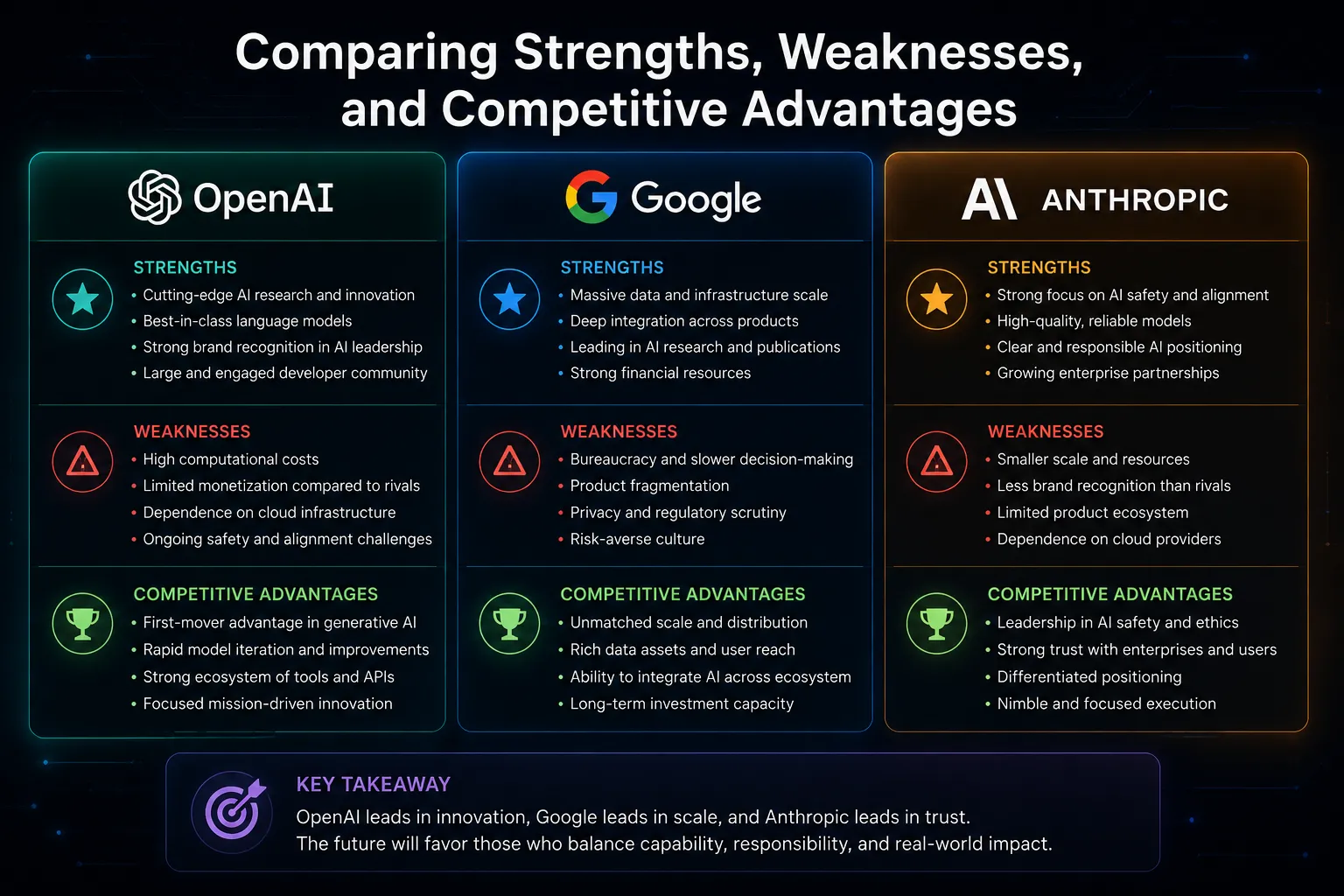
Comparing strengths, weaknesses, and competitive advantages
The AI race cannot be judged using a single metric. Different users value different capabilities, and each company has developed distinct competitive advantages.
OpenAI excels in usability, innovation speed, developer engagement, and consumer adoption. Businesses seeking flexible AI integrations often choose OpenAI because of its mature APIs and rapidly evolving product portfolio.
Google's primary strength lies in scale. Its AI technologies enhance products already used by billions of people worldwide. Combined with world-class infrastructure and extensive research capabilities, Google possesses resources that few competitors can match.
Anthropic differentiates itself through dependable reasoning, AI safety, and enterprise trust. Organizations handling sensitive information frequently prioritize reliability over experimental features, making Anthropic particularly attractive in sectors such as finance, healthcare, law, and government.
Each company also faces notable weaknesses.
OpenAI must continue balancing innovation with responsible deployment while managing growing infrastructure demands.
Google occasionally struggles to communicate a unified AI strategy, despite possessing exceptional technology.
Anthropic must expand market awareness without compromising the careful, safety-focused philosophy that defines its brand.
Ultimately, success depends on user priorities. Developers may prefer one platform, enterprises another, and everyday consumers yet another. The AI landscape has become diverse enough that multiple leaders can coexist.
Future trends that will define the AI race beyond 2026
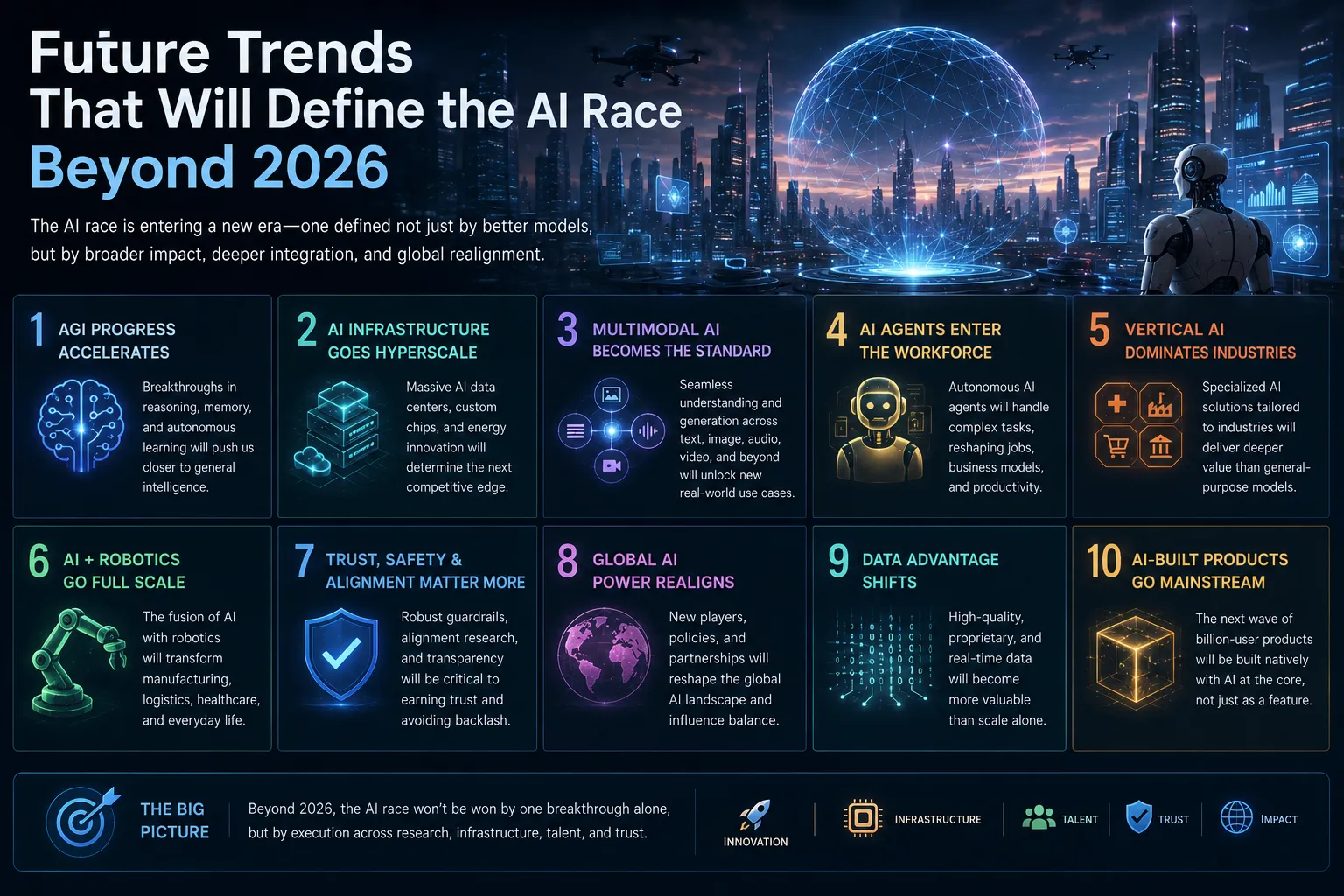
The next stage of artificial intelligence will extend far beyond chatbots. Several emerging trends are likely to determine which companies lead the industry over the coming years.
The first trend is the rise of autonomous AI agents. Instead of answering isolated questions, AI systems will increasingly perform multi-step tasks independently, including research, scheduling, coding, purchasing, analysis, and workflow automation.
A second trend involves deeper multimodal intelligence. Future AI models will seamlessly understand text, images, audio, video, documents, and real-world environments within a single interaction. This capability will significantly expand business applications.
Enterprise adoption will also accelerate. Companies increasingly seek AI solutions that integrate securely with internal knowledge bases, customer data, compliance frameworks, and proprietary software systems.
Cost efficiency represents another critical battleground. As AI usage grows exponentially, organizations will prioritize models that deliver high-quality performance while minimizing computational expense.
Regulation will become increasingly important as governments establish standards for transparency, copyright, privacy, security, and accountability. Companies that proactively address governance concerns may gain competitive advantages among enterprise customers.
Finally, AI search is reshaping digital marketing. Search engines are evolving from displaying lists of links toward generating direct answers synthesized from multiple sources. This shift increases the importance of publishing authoritative, well-structured, trustworthy content optimized for both traditional search engines and AI-powered assistants.
Businesses investing in semantic SEO, topical authority, structured content, and strong EEAT signals will likely achieve greater visibility across both Google Search and AI-generated responses.
Conclusion
Declaring a single winner in the AI race of 2026 oversimplifies a rapidly evolving industry. Each company leads in different areas, reflecting unique priorities and strategic strengths.
OpenAI continues to define consumer AI through rapid innovation, accessible products, and an extensive developer ecosystem.
Google leverages unparalleled infrastructure, decades of AI research, and deep integration across its global technology ecosystem.
Anthropic has emerged as a trusted leader in safety, enterprise reasoning, and responsible AI development, earning growing recognition among organizations that value consistency and governance.
Rather than replacing one another, these companies are collectively accelerating the future of artificial intelligence. Their competition drives faster innovation, higher-quality products, and broader adoption across industries worldwide.
For businesses, developers, and consumers, the real winner is not necessarily one company but the expanding ecosystem of AI technologies that continues to transform productivity, creativity, decision-making, and digital experiences. As AI capabilities mature, success will increasingly depend not only on model intelligence but also on trust, usability, scalability, and the ability to solve real-world problems effectively.

















Responses (0)
Sign in to share your thoughts.
Sign in