
Updated 28 October 2026. Figures are provisional and may change as rescue work continues.

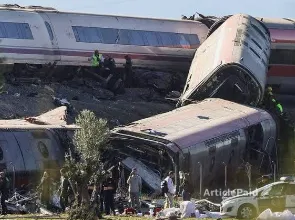
At least 64 people have died and around 80 have been injured after two high-speed trains collided near Urda, in Spain's Toledo province, on Wednesday morning. It is one of the deadliest rail accidents in the country's history and the second fatal high-speed collision in Spain this year.
What happened
The collision took place shortly before 9 a.m. local time on the Madrid–Seville high-speed line, roughly 130 kilometres south of Madrid. Reports describe a straight stretch of track with good visibility.
According to the operator Iryo, its Madrid–Seville service 6076 left Madrid at 7:54 a.m. and was struck from behind by a Renfe train near Urda, at kilometre point 118, "for reasons that remain unknown". The impact derailed the two rear carriages of the Iryo train, and some carriages came to rest down an embankment.
Regional authorities say about 544 passengers were aboard the two trains: roughly 397 on the Renfe service and 147 on the Iryo service.
Casualties and rescue operation
Castilla-La Mancha president Emiliano García-Page said about 80 people were hurt, around 50 of them seriously and 15 critically. He warned that some of the most badly injured might not survive, so the death toll could still rise. Injured passengers are being treated at several hospitals in the area, and temporary medical facilities were set up near the scene.
The regional emergency plan has been activated. Firefighters, police and medical teams are working among the wreckage, which has made the search of the affected carriages difficult.
What caused the crash?
The cause has not been officially established. Transport Minister Óscar Puente told reporters that the control system at Urda failed and that six trains were held. One was then allowed to restart and travelled about 25 kilometres before hitting a stopped train at high speed. Puente called it "inexplicable" how this had happened.
That is the minister's initial account, not the result of the investigation. The Civil Guard has sent a disaster investigation team to the site. Investigators are expected to examine signalling and control-centre records, communications between operators, onboard train data and the physical evidence.
Service disruption
The infrastructure manager Adif has suspended high-speed services between Madrid and Andalusia. Travellers should check Renfe, Iryo and Adif announcements before setting out.
Reaction
Prime Minister Pedro Sánchez said he was shocked by the accident and offered his "affection, solidarity and support" to the victims and their families.
Second deadly crash this year
In January 2026, an Iryo train derailed near Adamuz, in Córdoba province, and was hit by an oncoming Renfe train. More than 40 people died. Until then, no accident on Spain's high-speed network, which opened in 1992, had caused deaths. The two cases are being investigated separately, and the Urda crash does not on its own show a wider systemic failure. It will, however, increase scrutiny of railway safety and signalling in Spain.
What happens next
The priorities now are caring for the injured, identifying the dead and supporting their families. Answers about how two trains came to occupy the same section of track are likely to take weeks.


















Responses (0)
Sign in to share your thoughts.
Sign in