The Unsolved Mystery of Why We Yawn (And Why It’s Contagious)Did you just yawn?

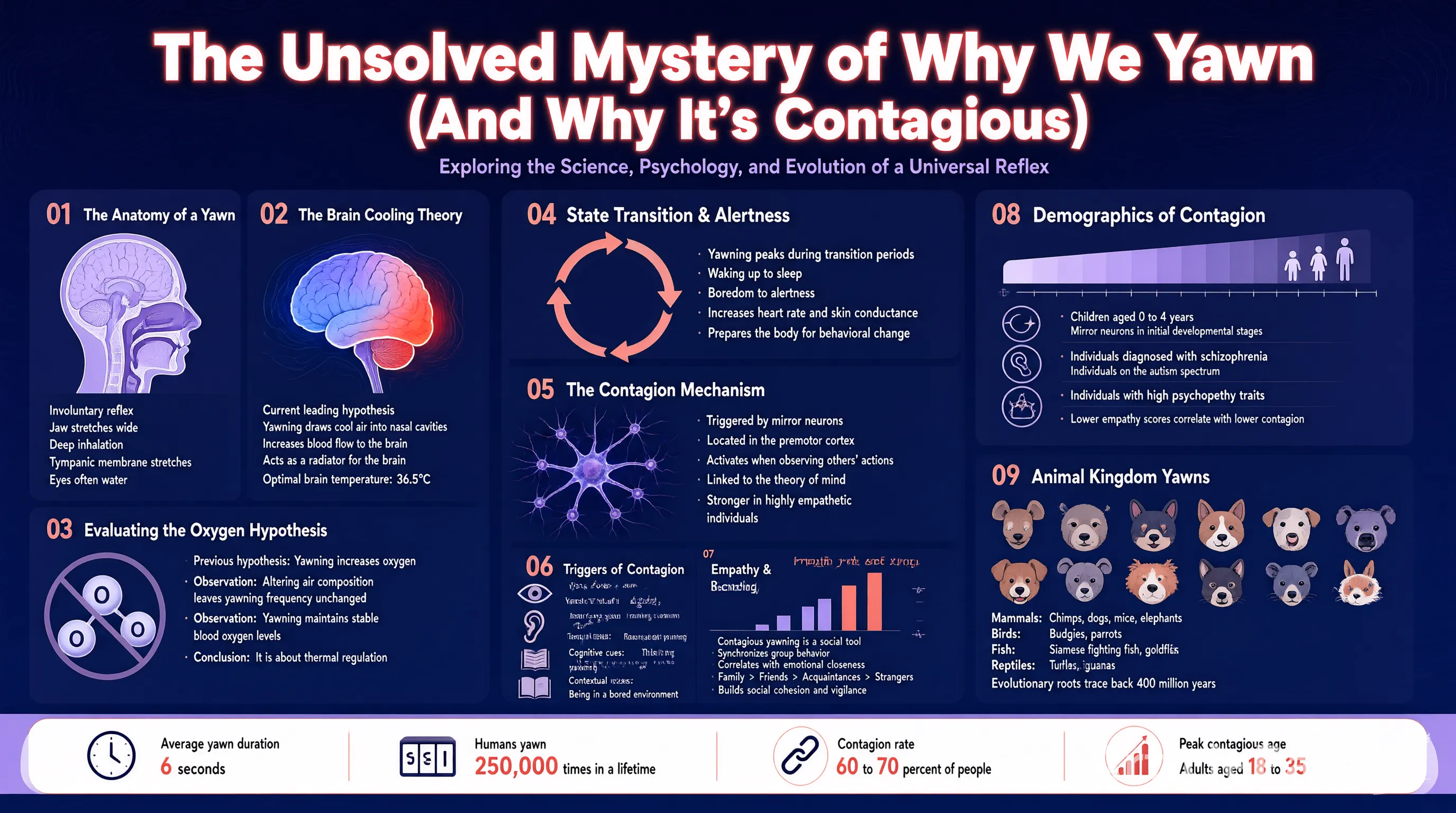

Did you just yawn? Don’t worry, you aren’t tired. You’re just experiencing one of biology’s most baffling quirks. Yawning is universal among humans and many animals, yet scientists still can’t agree on exactly why we do it.
For decades, the prevailing theory was that we yawn to draw in extra oxygen when our brains get sluggish. However, modern research has largely debunked this. Today, the leading hypothesis is thermoregulation. Just as a computer needs a fan to keep its processor cool, a yawn might act as a biological cooling system. It draws cool air into the sinus cavities to lower brain temperature and keep us alert. Yet, this doesn't fully explain the involuntary mechanics.
Then there’s the bizarre phenomenon of contagious yawning. Seeing, hearing, or even just reading about a yawn can trigger one in you. Why? Researchers believe it’s deeply tied to empathy and social bonding. Contagious yawning activates the same brain regions involved in processing emotions and social cues. It’s thought to be an evolutionary tool that helped early humans synchronize their behavior, ensuring the tribe stayed alert or rested together. Interestingly, children don't develop contagious yawning until around age four, further linking it to developed social awareness.
Despite these fascinating new clues, the exact neurological triggers remain elusive. Until science finally cracks the code, we’ll just have to accept the mystery and embrace the strange, involuntary reflex. Or did I just make you yawn again, proving that some biological puzzles are best left up to the imagination?
Beyond Brain Cooling: Alternative Theories
While thermoregulation leads the pack, other theories persist. Some researchers suggest yawning acts as a "state changer," helping us transition between sleep and wakefulness by stretching lung tissues and increasing heart rate. Others point to the surfactant theory, proposing that yawning coats the alveoli with a lubricating film, preventing them from collapsing during deep breaths and ensuring optimal oxygen exchange.
The Empathy Connection and Mirror Neurons
The contagious aspect of yawning offers a fascinating window into human psychology. Neuroscientists point to "mirror neurons"—brain cells that fire both when we perform an action and when we observe someone else doing it. When you see a yawn, these neurons simulate the act, triggering the reflex. Studies show contagious yawning is stronger among close friends than strangers, reinforcing its role in social cohesion. Furthermore, individuals with conditions affecting empathy, like severe autism, often show reduced susceptibility to contagious yawning. This neurological mirroring proves a simple jaw-stretch is actually a complex social interaction, linking our physical reflexes directly to our emotional intelligence.
An Evolutionary Survival Tool
From an evolutionary standpoint, this shared reflex might have been crucial for survival. Early humans needed to coordinate their daily rhythms. A contagious yawn could silently signal to the tribe that it was time to sleep, or help a drowsy watchman snap back to alertness. Even our pets catch the bug; studies reveal dogs can "catch" yawns from their owners, suggesting this empathetic reflex transcends species and is hardwired into social mammals. Ultimately, the yawn remains a beautiful reminder of our interconnected biology, bridging the gap between individual physiology and collective behavior, reminding us we are never truly alone.
Ahh I also yawn while writing this article.Do you have the same feeling then Comment












Responses (0)