
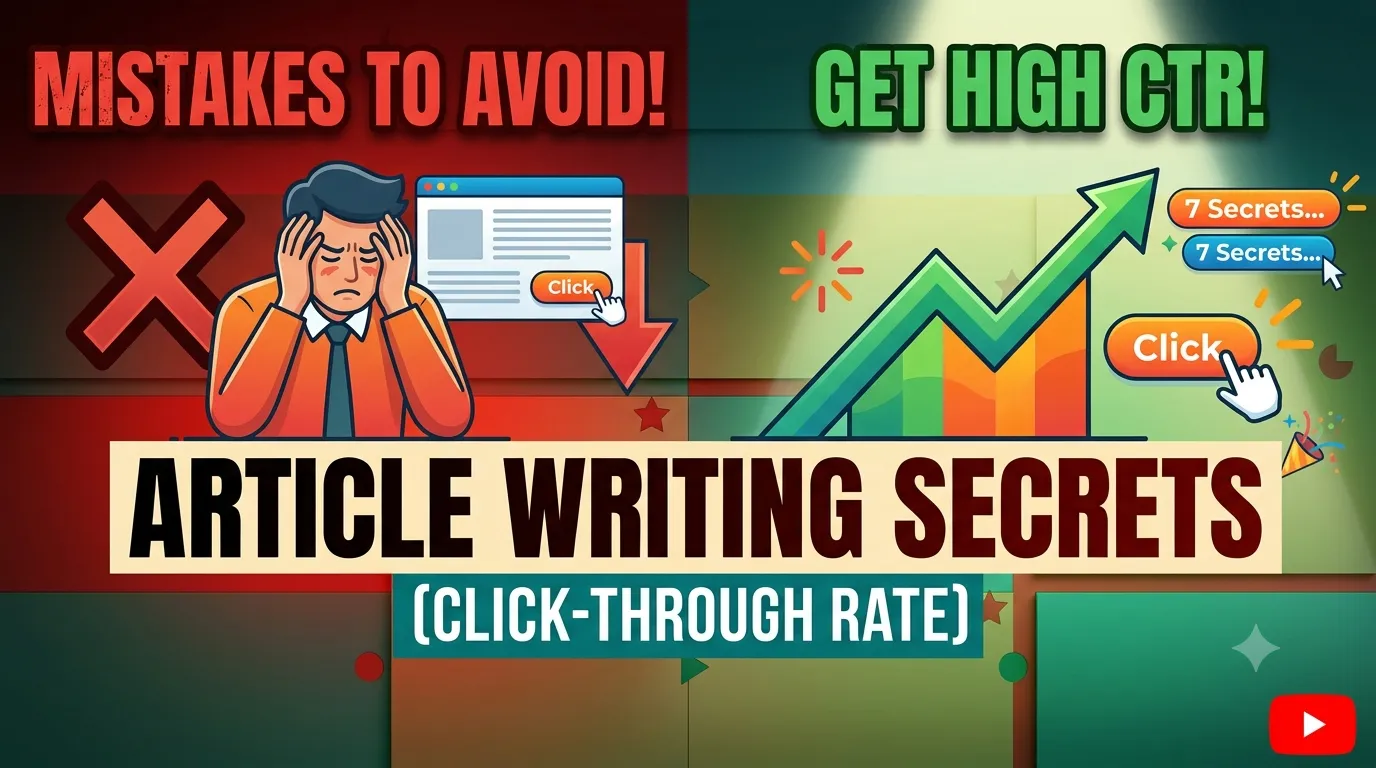
Whether you are writing for high-traffic content platforms, client blogs, or your own digital brand, avoiding common writing traps is what separates amateur content from high-paying, professional work.
Here are the 10 critical mistakes to cut from your article writing process to keep your readers hooked and search engines happy:
1. The "Wall of Text" (Poor Formatting)
Online readers don't read; they scan. Heavy, unbroken paragraphs of 6+ lines will cause readers to bounce immediately.
The Fix: Keep paragraphs to 2–3 sentence. Use bullet points, bold key terms, and utilize and subheadings to create visual breathing room.
2. Vague, Fluffy Intros
Starting an article with "Since the dawn of time..." or "In today's modern world, everyone likes..." wastes the reader’s time. If your intro doesn't promise a clear benefit within the first three sentences, you've lost them.
The Fix: Lead with a striking statistic, a relatable pain point, or a direct answer to the user's search intent.
3. Lack of Subheadings (or Weak Ones)
Subheadings shouldn't just be decorative labels like "Introduction" or "Conclusion." They need to tell a story on their own so a scanning reader can grab the core value of your piece in five seconds.
The Fix: Make your subheadings descriptive and actionable (e.g., instead of "Diet", use "The 98% Bamboo Diet").
4. Keyword Stuffing
Writing for search engine optimization (SEO) is important, but repeating your target keyword in every single paragraph reads robotically and can actually get your article penalized by modern search algorithms.
The Fix: Write for the human first. Use natural variations and synonyms (LSI keywords) instead of forcing the exact same phrase over and over.
5. Weak or Missing Data (Vague Generalities)
Saying "Exercise has many health benefits" feels empty. Readers and editors want proof.
The Fix: Anchor your claims with concrete data, expert quotes, or specific case studies. For example: "150 minutes a week of moderate cardio reduces cardiovascular risk by 30–40% (AHA)."
6. Ignoring the Target Audience's Skill Level
If you write a highly technical article full of industry jargon for a beginner audience, they will get confused. Conversely, if you explain basic terms to an expert crowd, they will get bored.
The Fix: Define technical terms inline on their first use if writing for general audiences, or skip the basics entirely if your readers are seasoned pros.
7. Neglecting the "So What?" Test
Every section of your article needs to serve a purpose. If you include a fact, a backstory, or a tip simply to pad your word count without explaining *why* it matters to the reader, it’s filler.
The Fix: After writing a section, ask yourself: "So what? How does this help the reader solve their problem?" If it doesn't, cut it.
8. Passive Voice Overload
Passive voice makes your writing sound distant, academic, and slow (e.g."The article was written by the creator").
The Fix: Use active voice to drive energy and momentum (e.g., "The creator wrote the article"). It cuts down word count and feels much more direct.
9. Forgetting the Call to Action (CTA)
An article shouldn't just end on a random concluding thought. You need to guide your reader on what to do next with the information they just consumed.
The direct Wrap up with a clear next step—whether that's leaving a comment, checking out a related resource, or signing up for a newsletter.
10. Editing While Writing
Trying to fix typos, tweak sentences, and rewrite paragraphs while you are still drafting kills your creative momentum. It results in disjointed articles that take twice as long to finish.
The Fix: Separate the processes entirely. Write the first draft as fast as you can without looking back. Then, step away for an hour before returning with a strict editor’s eye to polish the structure and grammar.






















Responses (0)
Sign in to share your thoughts.
Sign in