
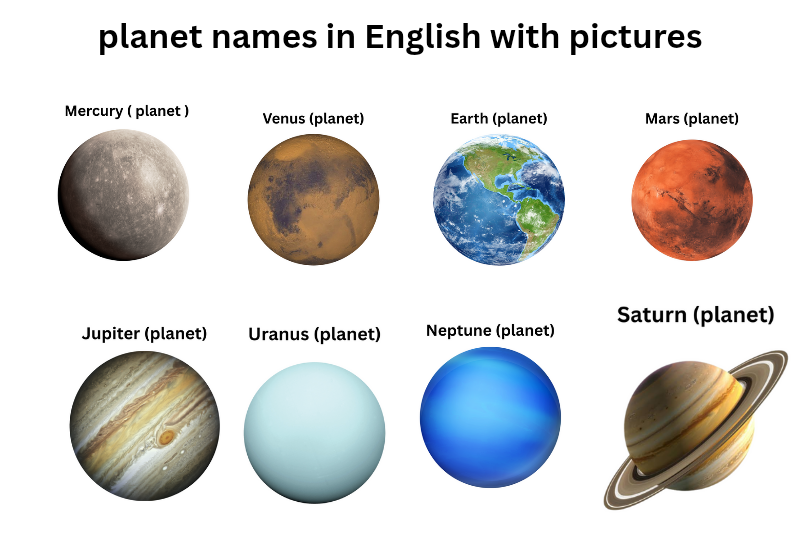
Planet Names in English with Pictures is a helpful guide for anyone curious about our solar system. This post features all eight planets—Mercury, Venus, Earth, Mars, Jupiter, Saturn, Uranus, and Neptune—presented with their names in English and eye-catching images. Each planet includes a short, easy-to-understand description that explains its unique features. Whether you're a student, teacher, or just love learning about space, this post makes it simple and fun to explore the planets. The pictures help with memory and make learning more visual and engaging. A great starting point for space lovers of all ages.

No .1 Mercury
Mercury is the closest planet to the Sun and also the smallest in our solar system. It has a rocky surface filled with craters, much like our Moon. With no atmosphere to trap heat, Mercury faces extreme temperatures—scorching hot during the day and freezing at night. It orbits the Sun in just 88 Earth days. Despite its closeness to the Sun, Mercury isn’t the hottest planet. Because of its thin atmosphere and rapid orbit, scientists study Mercury to understand how planets form and survive so close to their stars.

No. 2 Venus
Venus is often called Earth’s “sister planet” because of its similar size and composition. However, it’s far from friendly—its thick atmosphere traps heat, making it the hottest planet in the solar system. The surface is rocky and hidden beneath clouds of toxic gas, mainly carbon dioxide and sulfuric acid. Venus rotates very slowly and in the opposite direction to most planets. Despite its harsh environment, Venus is a focus of exploration because it may once have had water and Earth-like conditions long ago.

No. 3 Earth
Earth is the only known planet that supports life. It has a balanced mix of land, water, and atmosphere, which creates ideal conditions for plants, animals, and humans. About 71% of Earth is covered by oceans, and its atmosphere protects us from harmful solar radiation. Earth orbits the Sun once every 365 days and rotates on its axis every 24 hours, giving us day and night. With diverse climates and ecosystems, Earth is unique in its ability to sustain life, making it the focus of environmental care and study..

No. 4 Mars
Mars, known as the “Red Planet,” gets its color from iron oxide (rust) on its surface. It’s a cold, desert-like planet with massive volcanoes, deep valleys, and polar ice caps. Though its atmosphere is thin and mostly carbon dioxide, scientists believe Mars once had water and possibly supported life. Several rovers and orbiters are studying Mars to understand its past and prepare for future human missions. Its similarities to early Earth make it a key target in the search for life beyond our planet.

No. 5 Jupiter
Jupiter is the largest planet in our solar system, more than 11 times wider than Earth. It’s a gas giant made mostly of hydrogen and helium, with no solid surface. Jupiter is famous for its Great Red Spot, a giant storm larger than Earth that has been raging for centuries. It has at least 79 moons, including Ganymede—the largest moon in the solar system. Jupiter's strong magnetic field and massive size play a big role in protecting the inner planets from asteroid impacts.

No. 6 Saturn
Saturn is best known for its stunning ring system, made up of ice and rock particles. Like Jupiter, Saturn is a gas giant mainly composed of hydrogen and helium. It’s the second-largest planet in the solar system and has over 80 moons, including Titan, which has a thick atmosphere. Despite its size, Saturn is very light and could float in water if a big enough ocean existed. Scientists continue to study Saturn’s rings and moons for clues about the solar system’s formation.

No. 8 Uranus
Uranus is a unique planet that orbits the Sun on its side, giving it extreme seasonal changes. It's an ice giant with a pale blue color caused by methane gas in its atmosphere. Unlike Jupiter and Saturn, Uranus has a rocky core surrounded by icy materials and gas. It has a faint ring system and at least 27 moons. Temperatures on Uranus are some of the coldest in the solar system. Its odd tilt and distant location make it a fascinating target for future exploration.

No. 8 Neptune
Neptune is the eighth and farthest planet from the Sun. It's an ice giant, similar to Uranus, with a deep blue color due to methane in its atmosphere. Neptune is known for its fast winds and violent storms, including the Great Dark Spot—a storm similar to Jupiter’s Red Spot. It takes 165 Earth years to complete one orbit around the Sun. Neptune has 14 known moons, with Triton being the largest. Its distant, cold environment holds many secrets about the outer solar system.






















Responses (0)
Sign in to share your thoughts.
Sign in