

Artificial intelligence has already transformed the way people search for information, write content, summarize documents, and interact with technology. Yet the next stage of this evolution is moving beyond systems that simply answer questions. Increasingly, AI is becoming capable of completing tasks, making decisions within defined limits, coordinating multiple tools, and working toward specific goals with minimal human intervention. These systems are commonly referred to as AI agents.
The idea of having a digital assistant is hardly new. For years, voice assistants and chatbots promised to simplify everyday life, but their abilities were often limited to responding to commands or retrieving information. AI agents represent a significant step forward because they are designed to act rather than merely react. Instead of waiting for every instruction, they can plan sequences of actions, adapt to changing circumstances, and interact with software, databases, and online services to accomplish objectives.
Despite the excitement surrounding AI agents, it is important to separate realistic expectations from speculation. While these systems are becoming increasingly capable, they are not independent thinkers or replacements for human judgment. Their value lies in automation, coordination, and assistance—not in making critical decisions without oversight. Understanding what AI agents are, where they are already making an impact, and how they differ from traditional chatbots provides a clearer picture of how digital assistants may reshape both work and everyday life.
What AI agents actually are
An AI agent is a software system that can pursue a defined goal by observing information, reasoning about possible actions, and carrying out tasks through available tools or applications. Rather than responding with a single answer, an AI agent often follows a workflow that may involve multiple steps before reaching the desired outcome.
For example, imagine asking an AI system to organize a business trip. A traditional chatbot might suggest destinations, recommend hotels, or answer questions about flights. An AI agent, however, could compare schedules, search for transportation options, reserve accommodations through connected services, update your calendar, prepare an expense estimate, and notify colleagues about your travel plans. Instead of handling one request at a time, it manages an entire process.
This ability comes from combining language models with planning capabilities, memory, external tools, and decision-making rules. AI agents can interact with email systems, project management platforms, spreadsheets, customer databases, cloud storage, and countless other digital services. Depending on their permissions, they can retrieve information, generate reports, update records, schedule appointments, or execute repetitive workflows.
Importantly, AI agents operate within boundaries established by developers or users. They do not possess unlimited autonomy. Their actions are constrained by permissions, business rules, security policies, and human approval where necessary. In many professional environments, the most effective AI agents are those that collaborate with people rather than attempting to replace them entirely.
How AI agents differ from traditional chatbots
Although both AI agents and chatbots rely on artificial intelligence, their purposes and capabilities differ significantly.
Traditional chatbots are primarily conversational interfaces. They receive an input, generate a response, and wait for the next prompt. Their strength lies in answering questions, providing customer support, explaining concepts, or generating text. Even highly advanced conversational models generally require users to guide each step of a task.
AI agents extend beyond conversation. Instead of focusing solely on dialogue, they are designed to achieve objectives through action. They can break a large goal into smaller tasks, monitor progress, decide which tools to use next, and continue working until the objective is completed or human input becomes necessary.
Consider a customer service example. A chatbot may answer questions about a refund policy or explain return procedures. An AI agent could verify an order, determine whether the purchase qualifies for a refund, generate shipping labels, notify warehouse staff, update the customer's account, and prepare confirmation emails—all while following company policies.
Another major distinction is persistence. Chatbots typically treat each conversation as a sequence of exchanges. AI agents can maintain ongoing projects, revisit unfinished work, monitor changing conditions, and continue operating over longer periods. For instance, an agent might watch inventory levels throughout the week and automatically notify purchasing teams when supplies fall below a defined threshold.
This greater autonomy does not eliminate the need for human oversight. Instead, it shifts human involvement toward supervision, approval, and exception handling rather than manual execution of every individual task.
Where AI agents are already making an impact
AI agents are no longer experimental concepts confined to research laboratories. Businesses across multiple industries are already deploying them to automate workflows, improve productivity, and reduce repetitive administrative work.
Customer support is among the most visible applications. Instead of simply answering frequently asked questions, AI agents can access customer records, retrieve previous conversations, recommend solutions, create support tickets, and escalate complex issues to human representatives when necessary. This shortens response times while allowing human staff to focus on more complicated cases.
In software development, AI agents assist programmers by reviewing code, suggesting improvements, identifying bugs, generating documentation, and even testing applications. Rather than replacing developers, these systems often function as collaborative assistants that accelerate routine programming tasks.
Marketing teams increasingly use AI agents to coordinate campaigns across multiple channels. An agent may collect performance data, prepare analytics reports, recommend advertising adjustments, schedule social media posts, and generate content variations tailored to different audiences.
Within finance departments, AI agents can automate invoice processing, reconcile transactions, detect unusual spending patterns, generate financial summaries, and assist with compliance documentation. Because financial operations require high accuracy, these systems usually operate under strict approval rules.
Healthcare organizations are also exploring AI agents for administrative purposes. They can help schedule appointments, organize medical records, summarize documentation, assist with insurance paperwork, and support clinical staff by reducing administrative workloads. Decisions related to diagnosis or treatment, however, remain under the responsibility of qualified healthcare professionals.
Manufacturing companies use AI agents to monitor equipment performance, predict maintenance requirements, optimize production schedules, and coordinate supply chains. These capabilities help reduce downtime and improve operational efficiency.
Even small businesses are beginning to benefit. Entrepreneurs may rely on AI agents to organize emails, track invoices, prepare meeting summaries, update customer relationship management systems, or generate recurring reports that previously required hours of manual work each week.
How AI agents may transform work and everyday life
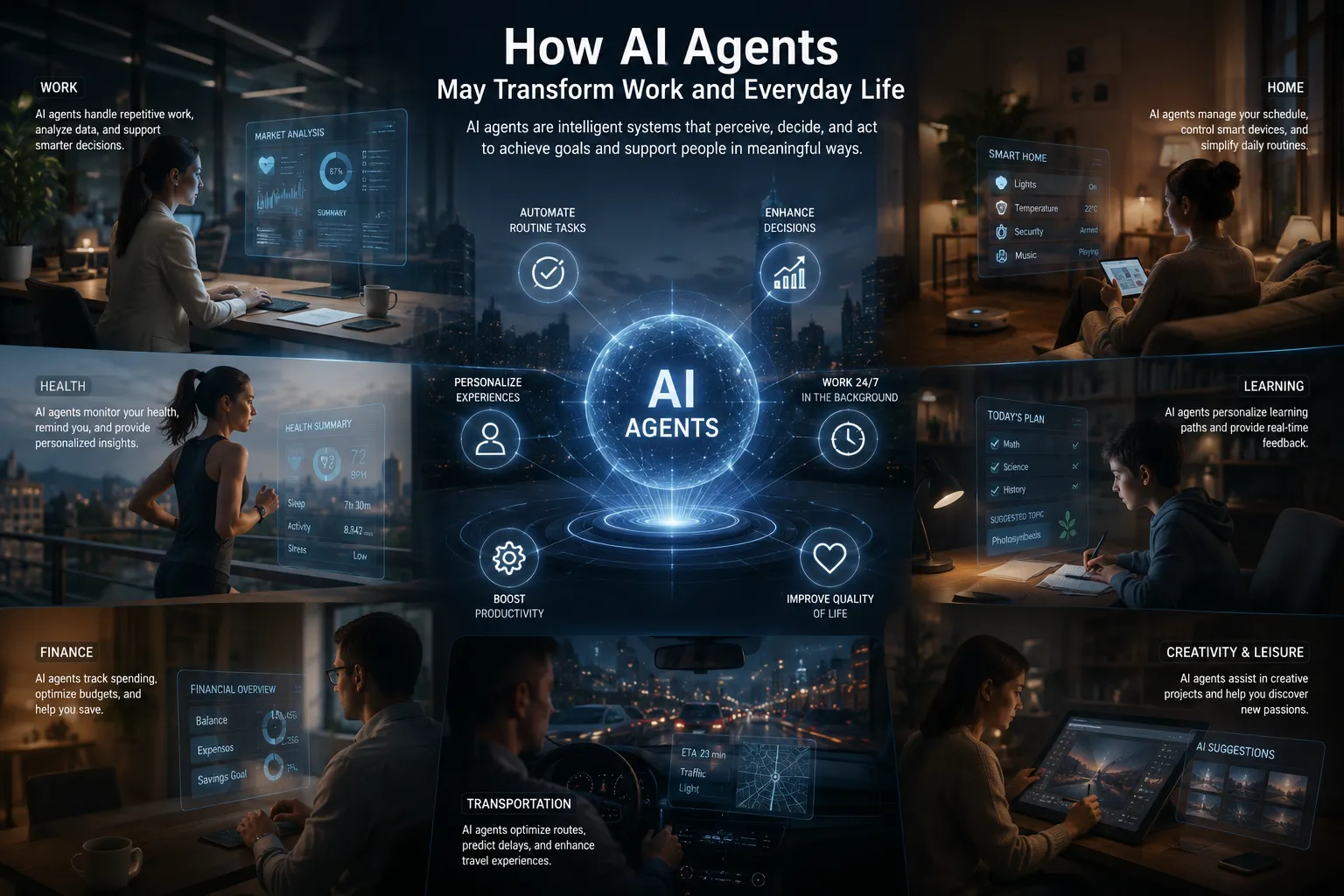
The long-term significance of AI agents lies less in replacing individual jobs and more in changing how work is organized. Many professions include numerous repetitive activities that consume valuable time without requiring deep expertise. AI agents have the potential to automate these routine processes while allowing people to focus on judgment, creativity, collaboration, and problem-solving.
Knowledge workers may increasingly delegate administrative responsibilities to digital assistants. Instead of manually organizing meetings, preparing reports, collecting research, or updating databases, professionals could assign these activities to AI agents that operate across multiple software platforms.
Managers may benefit from agents that summarize project progress, identify risks, prepare presentations, monitor deadlines, and coordinate communication between teams. Rather than replacing leadership, these systems could reduce administrative burdens and improve access to timely information.
Students may eventually use AI agents as personalized learning assistants that create study plans, monitor learning progress, organize research materials, and adapt educational resources according to individual needs. Teachers could use similar systems to assist with lesson preparation, grading support, and administrative work while maintaining responsibility for educational decisions.
In everyday life, digital assistants could become considerably more proactive. Instead of simply responding to voice commands, future AI agents might monitor household calendars, compare utility bills, suggest grocery purchases based on inventory, coordinate family schedules, manage subscriptions, and remind users about important deadlines or appointments.
Travel planning could become far more seamless. An AI agent may automatically monitor flight prices, adjust reservations after schedule changes, arrange transportation, update calendars, and provide real-time travel recommendations during the trip.
As these systems become more integrated into daily routines, the emphasis will likely shift from interacting with dozens of separate applications toward delegating broader objectives to intelligent assistants capable of coordinating multiple services simultaneously.
Challenges, limitations, and a balanced outlook
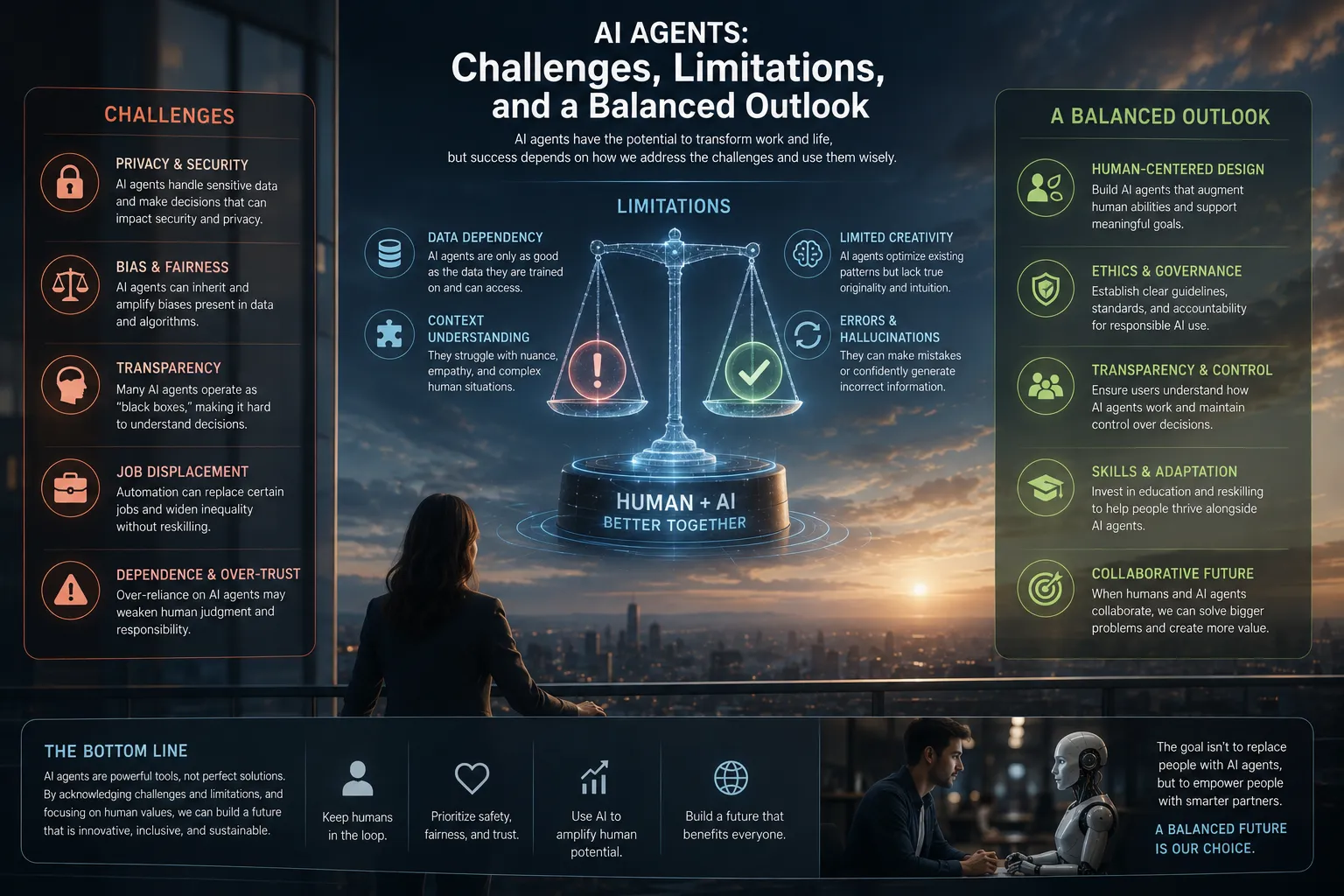
While AI agents offer impressive possibilities, they also introduce important challenges that deserve careful consideration.
Reliability remains a significant concern. AI systems can misunderstand instructions, produce incorrect information, or make flawed decisions when presented with incomplete or ambiguous data. Even sophisticated agents require validation mechanisms, especially when handling financial, legal, medical, or safety-related tasks.
Privacy and security are equally important. AI agents often require access to emails, calendars, documents, databases, or internal business systems. Organizations must establish strict permission controls, encryption standards, audit logs, and oversight procedures to ensure sensitive information remains protected.
Transparency also matters. Users should understand what actions an AI agent has taken, why certain decisions were made, and when human approval is required. Systems that operate as "black boxes" may reduce trust, particularly in industries where accountability is essential.
Workforce transformation represents another important consideration. Automation will likely reduce demand for some repetitive administrative tasks while increasing demand for skills involving supervision, critical thinking, system design, communication, and strategic decision-making. Rather than eliminating all forms of work, AI agents are expected to reshape job responsibilities across many industries.
There is also the risk of unrealistic expectations. Marketing materials sometimes portray AI agents as fully autonomous digital employees capable of replacing entire teams. In reality, successful implementations usually involve collaboration between humans and AI. People define objectives, establish rules, verify outcomes, and intervene when unusual situations arise.
Regulation will also influence adoption. Governments and industry organizations are developing standards related to transparency, accountability, data protection, and responsible AI deployment. These frameworks will likely become increasingly important as AI agents gain access to more sensitive systems and perform more consequential tasks.
Looking ahead, AI agents are likely to become a common layer between people and the digital tools they already use. Much like smartphones gradually unified communication, navigation, photography, and entertainment into a single device, AI agents may unify numerous digital workflows into a single intelligent assistant capable of coordinating actions across multiple applications.
Their success, however, will depend not only on technological advances but also on thoughtful implementation, human oversight, and realistic expectations. The most valuable AI agents will not be those that attempt to replace people entirely, but those that help individuals and organizations work more efficiently while leaving critical judgment, creativity, ethics, and responsibility firmly in human hands.























Responses (0)
Sign in to share your thoughts.
Sign in