
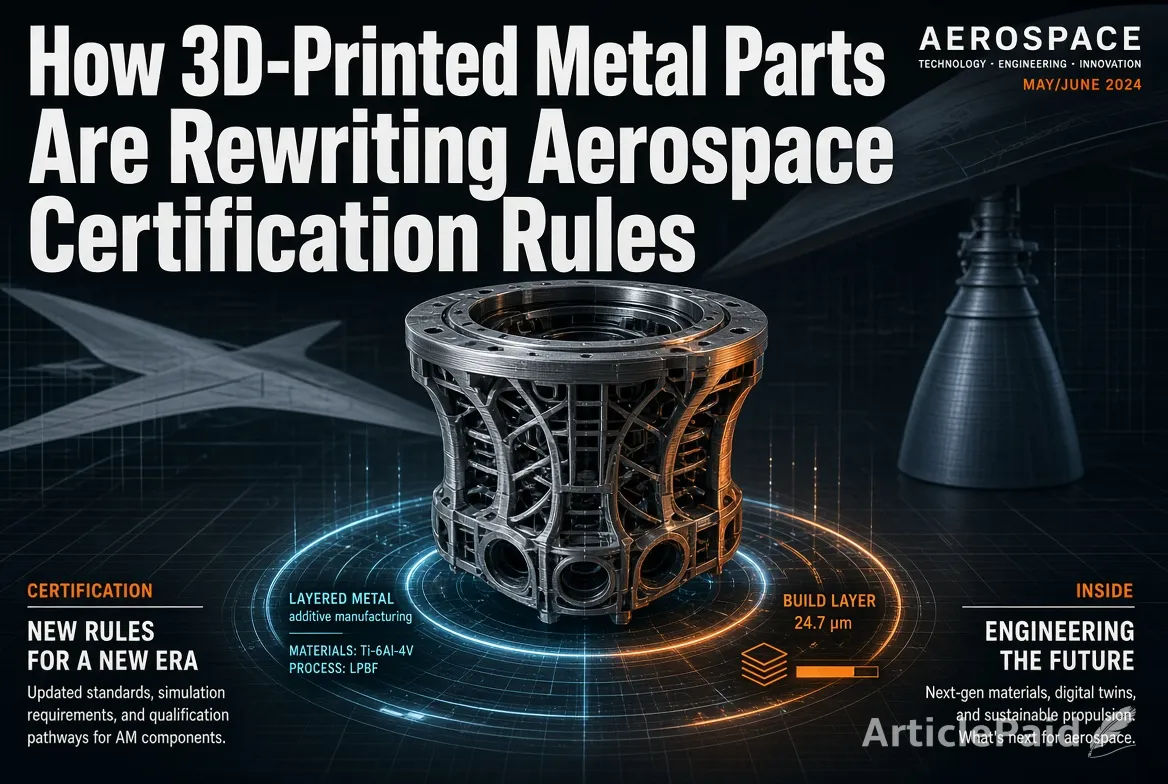
How 3D-Printed Metal Parts Are Rewriting Aerospace Certification Rules
For decades, aerospace certification rested on a simple foundation: materials made by forging, casting, or machining had predictable properties.
Engineers could rely on extensive databases of tensile strength, fatigue life, and crack-growth rates. A part was certified once the material, process, and design were proven through rigorous testing. Additive manufacturing of metals has broken that model.
Metal 3D printing—primarily laser powder-bed fusion and electron-beam melting—builds components layer by layer from fine powder. The resulting parts can be lighter, more complex, and produced faster than traditional equivalents.
GE Aviation’s fuel nozzles for the LEAP engine, now flying on thousands of aircraft, reduced 20 separate pieces into a single printed component and cut weight by 25 percent. Similar successes appear in rocket engines, turbine blades, and structural brackets. Yet the same process that enables these gains creates new certification headaches.
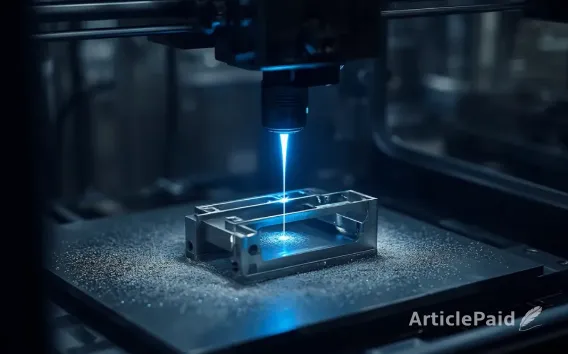
Unlike wrought metal, a printed part’s microstructure is highly sensitive to laser power, scan speed, powder quality, and even the machine’s location in the factory.
Tiny variations produce differences in porosity, residual stress, and grain orientation. These defects are often internal and difficult to detect with conventional non-destructive inspection.
Fatigue performance can vary significantly between builds, and anisotropy means strength in the build direction may differ from strength in the horizontal plane. Traditional “material allowables” simply do not exist for most printed alloys at the required confidence levels.
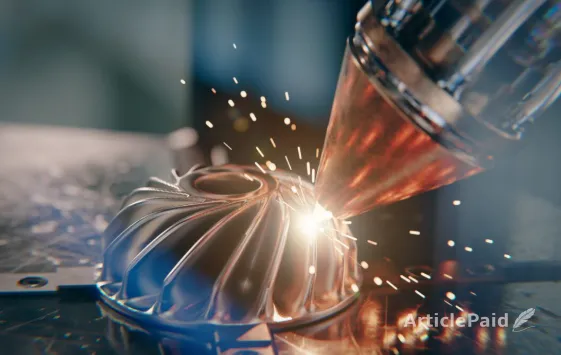
Regulators and industry have responded by shifting the certification philosophy. Instead of certifying a static material specification, authorities now emphasize process control and real-time monitoring.
The FAA and EASA have issued guidance that treats the entire additive manufacturing chain—powder feedstock, machine parameters, post-processing, and inspection—as a single qualified process.
Companies must demonstrate statistical process control across multiple builds and machines. In-situ sensors that track melt-pool temperature and acoustic signatures are becoming mandatory for critical parts.
Digital twins and machine-learning models help predict when a build is drifting out of tolerance before the part is even finished.
Post-processing has also gained new importance. Hot isostatic pressing is routinely used to close internal porosity, while heat treatments are carefully tailored to relieve residual stresses without degrading the desired microstructure.
Surface finishing and machining of critical interfaces remain essential, because as-printed surfaces often act as fatigue initiation sites.
The result is a hybrid certification framework.
For lower-criticality components, equivalence to existing materials can sometimes be shown with reduced testing. For flight-critical parts, full-scale component testing, fracture-mechanics analysis, and extensive process documentation are still required—yet the path is now clearer and more repeatable.
Standards organizations such as ASTM and SAE continue to publish new specifications for powder quality, process parameters, and mechanical testing of additively manufactured metals.
This evolution is rewriting more than paperwork. It is changing how aerospace companies design and produce hardware.
Engineers no longer design around the limitations of machining or casting; they design for the printer.
Part counts drop, lead times shrink from months to weeks, and on-demand production of spares becomes realistic.
The certification system that once lagged behind the technology is catching up—not by forcing additive manufacturing into old rules, but by creating new ones that match the physics of layer-by-layer construction.
The transformation is still incomplete. Full certification of large structural airframe components remains challenging, and supply-chain qualification of powder producers and machine manufacturers is ongoing.
Yet the direction is clear.
Metal 3D printing is no longer an experimental technique seeking special exceptions.
It is becoming a mainstream manufacturing route whose rules are being rewritten in real time by the parts already flying.





















Responses (0)
Sign in to share your thoughts.
Sign in