
For decades, if you wanted to talk about UFOs, you had to be prepared for a specific kind of reaction: a polite smile, a rolled eye, or a joke about tinfoil hats. The subject belonged firmly to sci-fi conventions, late-night radio shows, and blurry photographs taken in rural cornfields.
But over the last few years, a quiet revolution has taken place. The tinfoil hats have been traded for military flight helmets. Today, the people driving the conversation aren't conspiracy theorists in basements; they are commercial airline captains, Navy radar operators, and members of the United States Congress.
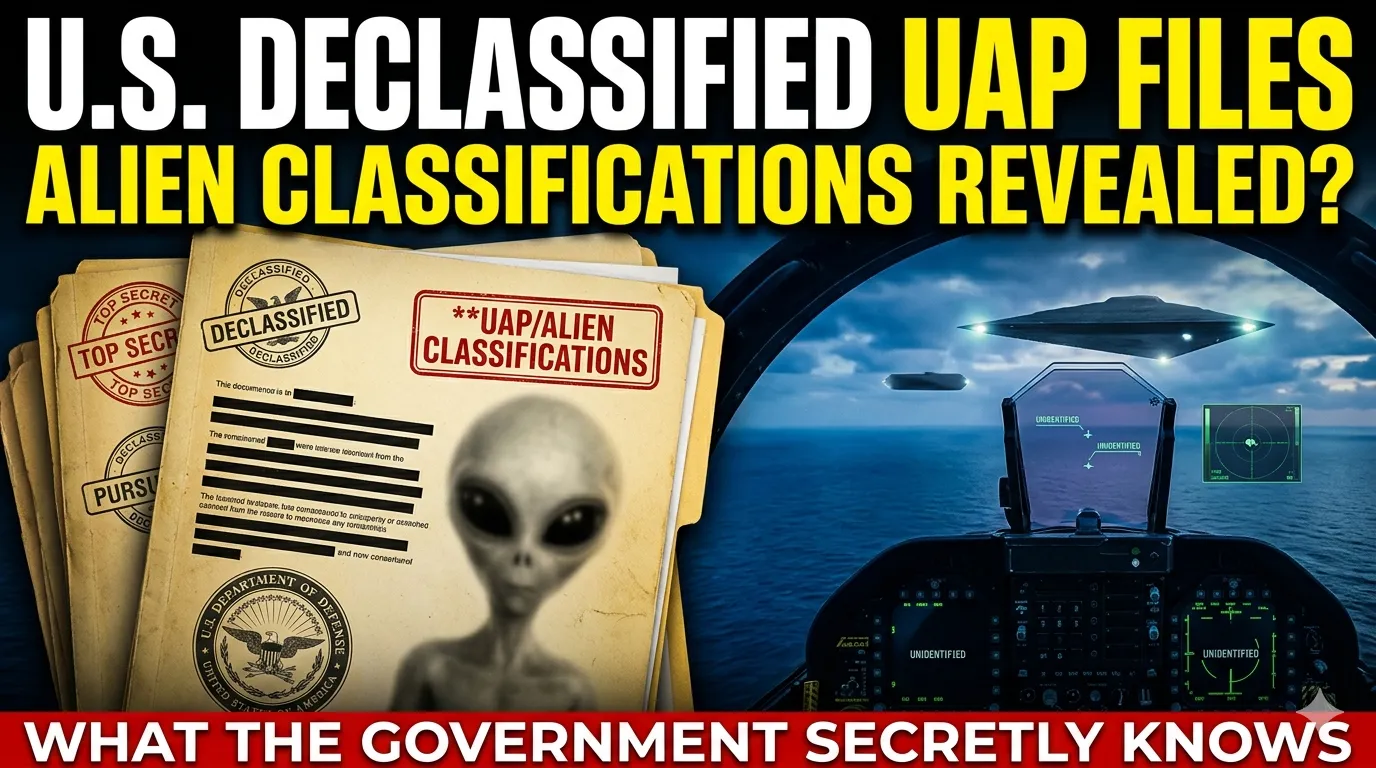
The U.S. government even gave the phenomenon a new, less stigmatized name: UAPs (Unidentified Anomalous Phenomena). Under the recent PURSUE declassification initiative, the government has been unsealing millions of pages of military records. When you look through these files, the reality that emerges isn't a Hollywood movie script—it is something far more grounded, and in many ways, far more mysterious.
What the Pilots Are Actually Seeing
When we think of aliens, pop culture tells us to look for giant flying saucers or massive city-destroying motherships. But the actual declassified military logs paint a very different, highly geometric picture. Pilots aren’t reporting cinematic space battles; they are logging bizarre, quiet disruptions to standard aviation.
The most common encounter filed with the military’s All-domain Anomaly Resolution Office (AARO) doesn’t look like a craft at all. It is the Metallic Orb. Pilots across the globe have captured footage of small, silver or translucent spheres zipping through the sky. They don’t have wings, they don’t leave exhaust trails, and they seem completely indifferent to the jet wash of a multi-million dollar fighter wing.
Then there is the infamous "Tic Tac." When Navy Commander David Fravor flew out to investigate a radar anomaly off the coast of California in 2004, he didn't find a classic saucer. He saw a smooth, solid white, forty-foot oblong object hovering just above the water. It had no windows and no visible seams. When he tried to get closer, the object didn't just fly away—it accelerated so fast it seemed to vanish, reappearing seconds later on radar miles away.
These aren't isolated stories. The files are full of descriptions of massive, silent Black Triangles moving slowly over suburban areas, and shifting, ovaloid shapes that seem to move effortlessly between the vacuum of space, the air, and the deep ocean.
The "Alien" Mythology vs. The Cold Reality
It is impossible to talk about these objects without addressing the question everyone wants answered: Who is flying them?
Over the last half-century, a massive mythology has built up around extraterrestrial types. We all know The Greys—the small, large-headed beings with oversized black eyes that dominate movies and abduction lore. We hear stories of "Tall Whites" or "Nordics" whispered about in military base folklore.
But if you open the actual declassified folders released by the government, you find a massive disconnect. The files are intensely focused on hardware, national security, and radar data. You will find thousands of pages analyzing thermal signatures, atmospheric anomalies, and foreign drone capabilities. What you will not find is a verified autopsy report, a captured alien blueprint, or a jar containing a biological specimen.
This doesn't mean the government is or isn't hiding something in a secret bunker. It means that from a public, scientific standpoint, we are still stuck at square one. The lore is vast, but the physical ledger remains empty.
The True Confession Inside the Files
The real takeaway from the U.S. government's transparency push isn't a dramatic confession that we have made contact with an interstellar empire. The true confession is much more vulnerable: the world's most powerful military is openly admitting it doesn't know what is in its own skies.
Historical archives from Project Blue Book in the 1950s and 60s show that Uncle Sam has been trying to solve this puzzle for a long time. While 95% of sightings back then (and now) turn out to be easily explained—weather balloons, camera glares, commercial drones, or secret military projects from adversary nations—there is a stubborn, remaining few percent that completely defy explanation.
When a declassified file concludes that an encounter is "unresolved," it means that even with multi-sensor tracking—where a physical object is seen by a pilot's eyes, tracked by a ship's radar, and recorded on a jet’s infrared camera all at the same time—the data doesn't add up. The objects move at speeds that should tear modern metals apart, without creating sonic booms, and without leaving a heat signature.
The reality behind the UAP phenomenon isn't a solved mystery; it's an ongoing investigation. We may not have proof of visitors from another planet, but the declassified files prove that the sky is far stranger, and far less understood, than we ever cared to admit.























Responses (1)
Sign in to share your thoughts.
Sign in