

Artificial intelligence has become one of the defining investment themes of the decade. Governments are committing billions to AI infrastructure, technology giants are expanding data centers at an unprecedented pace, and venture capital continues to pour into AI startups. On paper, the industry has never looked stronger.
Yet investors have noticed a surprising contradiction. While spending on AI continues to reach record levels, many AI-related stocks periodically experience significant corrections. Companies once considered unstoppable have seen their share prices fall despite reporting strong revenue growth and announcing ambitious expansion plans.
This apparent disconnect raises an important question: Why are AI stocks falling despite record investments?
The answer lies in how financial markets work. Stock prices are influenced by expectations rather than current achievements. Investor psychology, valuation concerns, macroeconomic conditions, and uncertainty surrounding future profitability all contribute to market fluctuations. A growing industry does not automatically guarantee rising stock prices, especially when expectations become excessively optimistic.
Understanding these dynamics is essential for both experienced investors and newcomers interested in the AI revolution. While artificial intelligence is expected to reshape countless industries over the coming decade, the path for AI-related stocks is unlikely to be smooth.
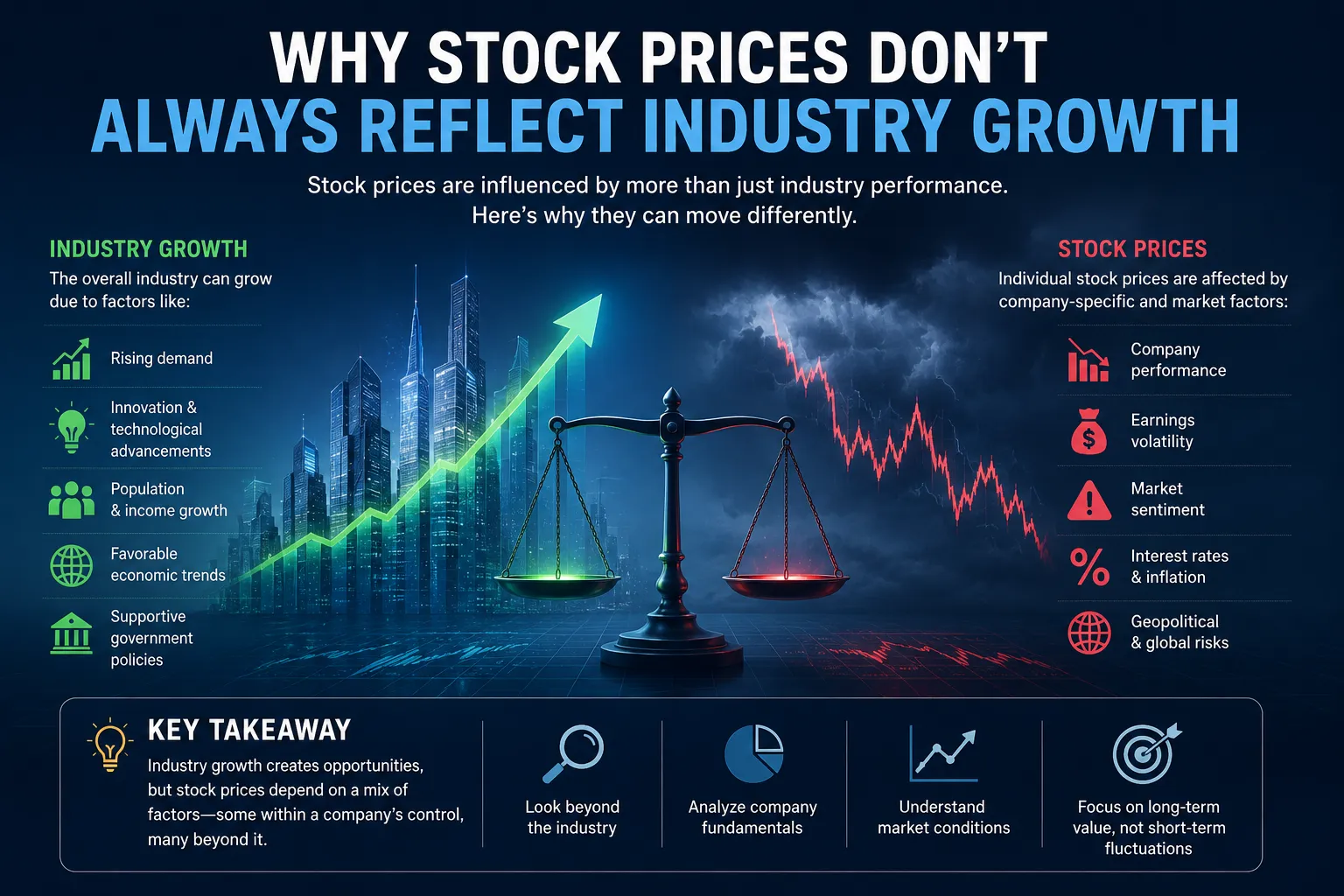
Why stock prices don't always reflect industry growth
One of the biggest misconceptions among investors is that a rapidly growing industry should always produce rising stock prices. In reality, markets are far more complex.
Stock prices represent expectations about future earnings rather than current business performance. When investors become extremely optimistic, those expectations often become difficult to satisfy.
Many leading AI companies experienced enormous rallies as investors anticipated explosive long-term growth. Valuations climbed well beyond historical averages because markets priced in years of future success before that success actually materialized.
As a result, even positive earnings reports can disappoint investors if they fail to exceed already elevated expectations.
Another important factor is the timing of profitability. Building AI infrastructure requires enormous capital expenditures. Companies are investing billions in:
- Data centers
- Advanced semiconductors
- Cloud infrastructure
- Energy capacity
- AI research
- Specialized engineering talent
Although these investments may generate substantial profits in the future, they often reduce current earnings.
Public companies face constant pressure from quarterly earnings reports. Investors frequently react negatively when rising expenses reduce short-term profit margins, even if those expenditures strengthen long-term competitiveness.
This explains why record AI investment can coincide with falling stock prices.
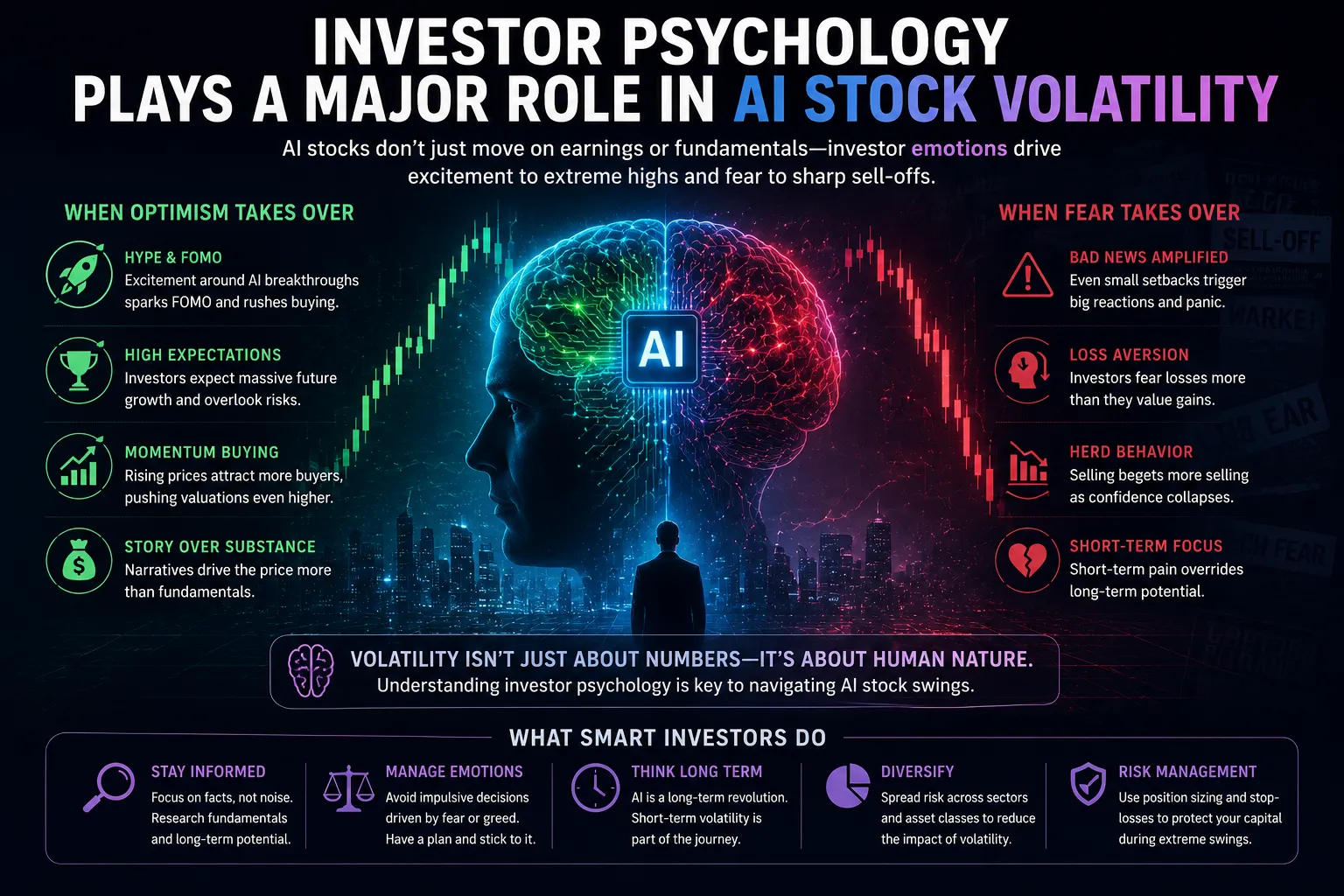
Investor psychology plays a major role in AI stock volatility
Financial markets are driven by emotions as much as by financial data. Investor psychology is especially important during periods of technological transformation.
Artificial intelligence has generated tremendous excitement comparable to previous technology revolutions such as the internet boom and the early smartphone era.
During periods of enthusiasm, investors often exhibit Fear of Missing Out (FOMO). Capital flows rapidly into companies associated with AI, sometimes regardless of their actual financial performance.
This creates inflated valuations.
Eventually, reality catches up. When investors realize that commercial adoption will take longer than expected, profit-taking begins. Selling pressure increases, triggering broader market declines.
Several psychological factors contribute to these movements:
- Overconfidence during bull markets
- Panic selling during corrections
- Short-term focus instead of long-term investing
- Media-driven sentiment swings
- Momentum trading by institutional funds
Many investors also struggle with uncertainty.
Although artificial intelligence promises enormous productivity gains, no one knows exactly which companies will dominate the industry over the next decade.
Some firms currently viewed as AI leaders may lose their competitive advantage as technology evolves.
This uncertainty causes investors to frequently reassess company valuations, leading to substantial price volatility even when industry fundamentals remain positive.
Rising interest rates and economic conditions are affecting AI valuations
Macroeconomic conditions have become another major factor influencing AI stock performance.
Technology companies are generally valued based on future cash flows. When interest rates rise, future earnings become less valuable in today's dollars.
This mathematical relationship often leads to lower valuations for high-growth companies, including AI businesses.
Higher interest rates also increase borrowing costs.
Many AI companies require significant financing to expand infrastructure, build data centers, and develop increasingly sophisticated models.
As financing becomes more expensive, investors begin questioning whether future returns will justify today's investment levels.
Economic uncertainty also encourages investors to rotate capital toward more defensive sectors such as healthcare, utilities, consumer staples, or dividend-paying companies.
Even if AI remains an attractive long-term opportunity, institutional investors often reduce exposure during periods of market volatility.
Additional macroeconomic concerns include:
- Inflation
- Geopolitical tensions
- Supply chain disruptions
- Energy costs
- Regulatory uncertainty
- Global economic slowdown
These factors influence the broader market and often affect AI stocks more dramatically because growth companies tend to exhibit higher volatility.
Consequently, AI-related declines do not necessarily indicate weakness within artificial intelligence itself but rather reflect changing financial conditions.
The AI industry outlook remains exceptionally strong
Despite periodic stock market corrections, the long-term outlook for artificial intelligence remains remarkably positive.
Businesses across nearly every industry continue increasing AI adoption.
Applications now extend far beyond chatbots and image generation.
Organizations are integrating AI into:
- Healthcare diagnostics
- Financial analysis
- Manufacturing automation
- Logistics optimization
- Customer service
- Software development
- Cybersecurity
- Scientific research
Governments are also investing heavily in AI capabilities, recognizing artificial intelligence as both an economic opportunity and a strategic priority.
Meanwhile, major cloud providers continue expanding infrastructure to meet growing demand for AI computing power.
The semiconductor industry remains another critical growth engine.
Demand for advanced GPUs, specialized AI chips, networking equipment, and high-performance memory continues to increase as organizations deploy larger and more sophisticated AI models.
Analysts also expect enterprise AI spending to accelerate over the next several years as companies move from experimentation toward large-scale implementation.
The key distinction investors should recognize is that industry growth does not necessarily occur in a straight line.
Technological revolutions typically experience periods of rapid optimism followed by corrections before entering more sustainable phases of expansion.
Historical examples include:
- The internet revolution
- Cloud computing
- Smartphones
- E-commerce
- Electric vehicles
Artificial intelligence appears to be following a similar pattern.
What investors should expect from AI stocks in the coming years
Looking ahead, AI stocks are likely to remain among the market's most volatile investment categories.
Competition within the industry is intensifying rapidly.
Large technology companies continue investing aggressively while startups introduce innovative solutions across numerous specialized markets.
This competition benefits innovation but also creates uncertainty regarding future market leaders.
Investors should expect continued fluctuations driven by:
- Quarterly earnings
- Product launches
- Regulatory developments
- Interest rate decisions
- Semiconductor supply
- Corporate AI adoption rates
Rather than focusing exclusively on short-term price movements, many long-term investors evaluate broader indicators such as revenue growth, recurring software income, infrastructure expansion, customer adoption, and sustainable competitive advantages.
Another important trend is market differentiation.
In the early stages of the AI boom, nearly every company mentioning artificial intelligence experienced rising valuations.
Today, investors increasingly distinguish between businesses with genuine AI capabilities and those merely using AI as a marketing narrative.
This shift may ultimately strengthen the market by rewarding companies capable of generating sustainable profits rather than speculative excitement.
As AI matures, investors are likely to place greater emphasis on profitability, execution, and measurable business outcomes instead of future promises alone.
Conclusion
The decline of AI stocks despite record investments may appear contradictory, but it reflects the way financial markets evaluate expectations rather than headlines.
Artificial intelligence remains one of the fastest-growing technological sectors in the global economy. Companies continue investing billions in infrastructure, research, semiconductor manufacturing, and enterprise applications. However, elevated valuations, investor psychology, macroeconomic pressures, and uncertainty surrounding future profitability have created periods of significant stock market volatility.
These corrections do not necessarily signal weakness within the AI industry. Instead, they illustrate the normal evolution of transformative technologies as markets transition from early enthusiasm toward more realistic expectations.
For long-term investors, understanding this distinction is crucial. While short-term fluctuations are likely to continue, artificial intelligence still possesses enormous potential to reshape industries, improve productivity, and generate substantial economic value over the coming decade. Investors who focus on business fundamentals rather than temporary market sentiment may be better positioned to navigate the volatility that accompanies one of history's most significant technological revolutions.






















Responses (0)
Sign in to share your thoughts.
Sign in