
5 Bizarre Evolution "Hacks" That Make Zero Sense in the Modern World
Evolution is an incredible engineer, but it doesn't build from scratch. Instead, it works like a frantic programmer patching old software code. It tweaks what already exists, leaves in obsolete features, and occasionally copies and pastes code from millions of years ago.
While these evolutionary "hacks" kept our ancestors alive, they have become completely useless—and occasionally infuriating—glitches in the modern world. Here are five of the most bizarre biological carryovers we are still stuck with.
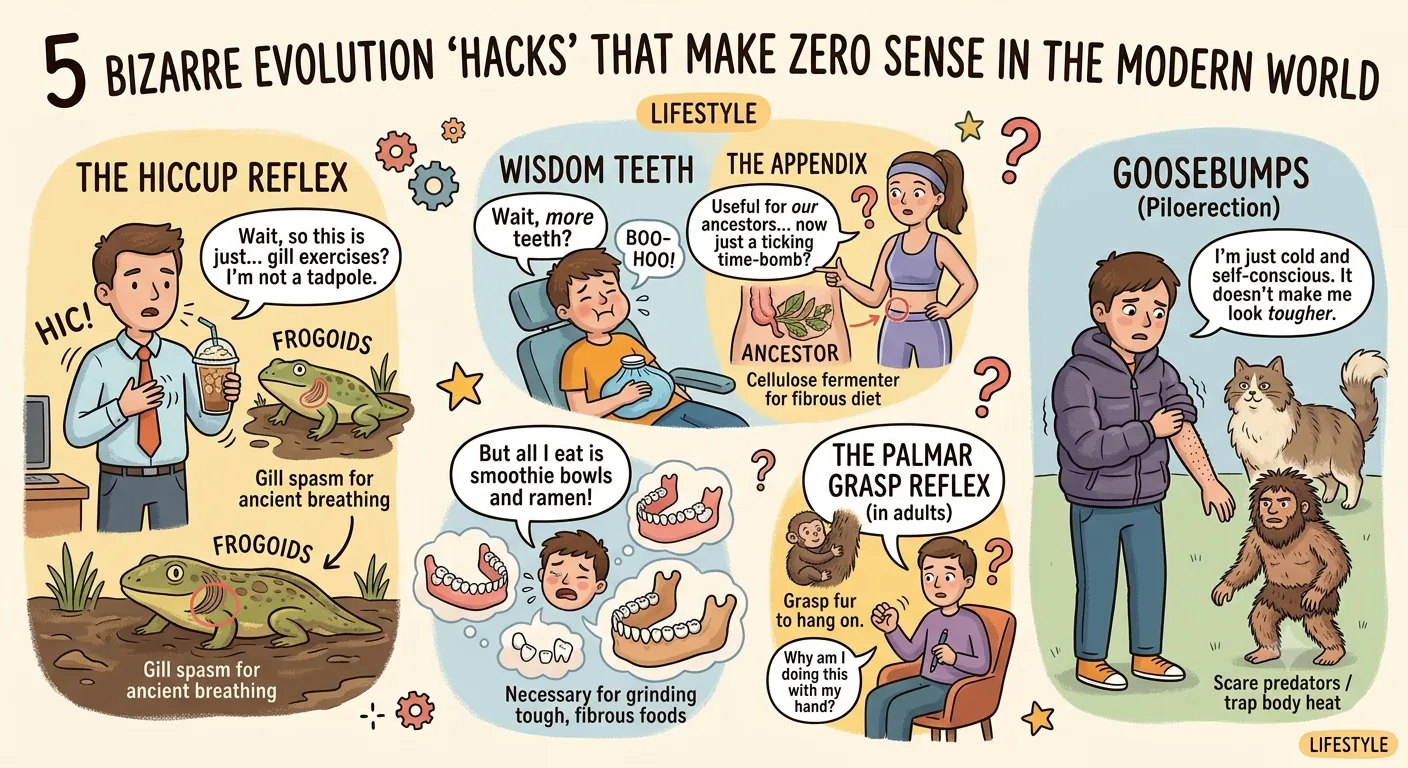
1. The Hiccup Reflex
The Glitch: An annoying, chest-spasming contraction that serves no modern purpose.
If you have ever gotten a violent case of the hiccups after drinking a carbonated beverage or eating too fast, you can thank your ancient amphibian ancestors.
Scientists believe hiccups are a leftover neural circuit from the days when our evolutionary predecessors transitioned from water to land. Specifically, it heavily mirrors how tadpoles and lungfish breathing mechanisms function. A tadpole needs to pump water across its gills while closing its glottis to prevent that water from entering its lungs.
In humans, this spasm of the diaphragm followed by the sudden slamming shut of the vocal cords is identical to that ancient gill-breathing reflex. Today, it serves absolutely zero purpose other than making you look ridiculous in meetings.
2. Goosebumps
The Glitch: Your skin turns into a bumpy chicken texture when you hear a scary noise or feel a draft.
When you get cold or experience a sudden rush of adrenaline (like hearing a strange noise at night), tiny muscles at the base of your hair follicles contract. This causes your hair to stand on end, creating goosebumps (scientifically known as piloerection).
For a furry mammal like a chimpanzee or a cat, this is a brilliant survival hack:
Insulation: Standing hair traps air, creating a layer of warmth against the cold.
Intimidation: Fluffing up makes the animal look significantly larger and more dangerous to predators.
Because humans have lost the vast majority of our dense body hair over the last few million years, this reflex is completely broken. When you get scared today, your body tries to fluff up to intimidate a threat, but you just end up looking slightly chilly.
3. The Appendix
The Glitch: A tiny, ticking time-bomb in your gut that can randomly try to kill you.
For generations, the appendix was labeled the ultimate evolutionary mistake—a useless, dead-end pouch attached to the large intestine that seemed to exist solely to get inflamed and require emergency surgery.
Historically, the appendix was a much larger organ used by our distant, plant-eating ancestors to digest massive amounts of tough, fibrous cellulose (like bark and raw leaves). As our diets shifted toward cooked food and meat, we no longer needed that massive fermentation chamber, and it shrank down over millennia.
The Modern Saving Grace: Recent research shows the appendix actually isn't completely useless anymore; it acts as a "safe house" for good gut bacteria during severe bouts of illness. However, given that it can still randomly rupture and become life-threatening, its risk-to-reward ratio in the 21st century is incredibly poor.
4. Wisdom Teeth
The Glitch: Painful, crowded extra molars that modern jaws don't have room for.
Most people view the extraction of wisdom teeth as a painful rite of passage in young adulthood. But why do we grow teeth that our mouths physically cannot accommodate?
Our early ancestors had much larger, wider jaws and an incredibly tough diet consisting of raw roots, nuts, and fibrous meats. They needed a third set of molars—the wisdom teeth—to act as heavy-duty grinders. Furthermore, without modern dentistry, early humans frequently lost teeth to decay, meaning the extra room at the back of the mouth was actually quite useful.
Once humans discovered fire and began cooking, our food became vastly softer. Over time, our brains grew larger and our jaws shrank significantly to accommodate our changing skull structures. The problem? Our DNA didn't completely get the memo, and it still insists on forcing those final four heavy-duty grinders into a jaw that ran out of space thousands of years ago.
5. The Palmar Grasp Reflex
The Glitch: A newborn baby clinging tightly to anything placed in their palm.
If you place your finger into the palm of a newborn baby, their tiny fingers will instantly curl around it with an incredibly strong grip. In fact, this reflex is so powerful that many newborns can support their own body weight for a few seconds.
While it makes for a heartwarming photo, this is actually a raw survival instinct called the palmar grasp reflex.
Millions of years ago, primates traveled by swinging through trees or migrating long distances. A newborn baby primate had to immediately cling to its mother's thick body fur to avoid falling to the forest floor while she climbed or fled from predators. Because modern human parents generally don't sport a full coat of thick fur, the reflex is obsolete—leaving babies grasping at nothing but loose air, blankets, or your hair.




















Responses (2)
Sign in to share your thoughts.
Sign in