
5 Fascinating Facts About the Human Psyche That Explain Why We Act the Way We Do
The human psyche is a complex, beautifully flawed masterpiece. While we like to think of ourselves as entirely rational creatures who make logical choices, modern psychology proves that much of our behavior is driven by hidden subconscious patterns.
Understanding these psychological quirks doesn't just give you a fascinating look into the human mind—it also gives you a massive advantage in everyday communication, marketing, and self-awareness. Here are five incredible facts about the human psyche that you can observe in daily life.
1. The "Primacy and Recency" Effect Dictates What We Remember
If you are giving a presentation, going to a job interview, or writing an article, timing is everything. The human brain naturally remembers the beginning and the end of an event much more clearly than the middle.
Known as the Serial Position Effect, your psyche uses the primacy effect to easily store the first pieces of information in your long-term memory. Meanwhile, the recency effect keeps the very last things you heard fresh in your short-term memory. If you want to make a lasting impression, put your most powerful points at the very start or the absolute end.
2. We Experience "Cognitive Dissonance" When Our Beliefs Are Challenged
The human brain craves internal harmony. When you hold a strong belief, but are suddenly confronted with new evidence that contradicts it, your brain experiences acute psychological discomfort known as cognitive dissonance.
Instead of changing their minds, most people will subconsciously rationalize, make excuses, or completely ignore the new facts just to eliminate the mental discomfort. This is why arguing about deeply rooted topics on the internet rarely changes anyone's perspective; the psyche prefers comfort over being corrected.
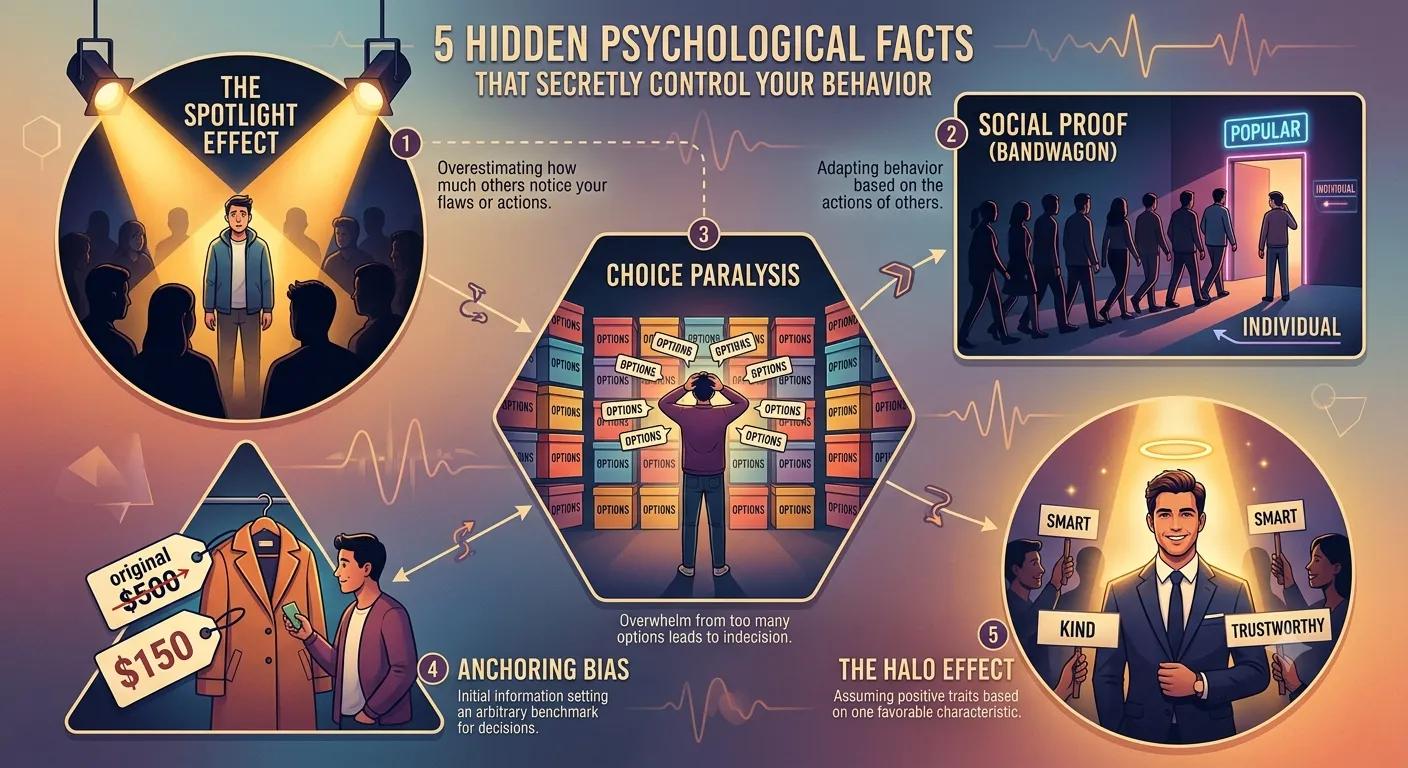
3. The "Spotlight Effect" Makes Us Overestimate How Much People Notice Us
Have you ever spilled a tiny drop of coffee on your shirt or had a minor bad hair day and felt like the entire world was staring at you? That is the Spotlight Effect in action.
Psychologists have proven that we center our entire world around our own experiences, causing us to drastically overestimate how much other people notice our appearance, mistakes, or behavior. In reality, most people are far too wrapped up in their own "spotlight" to pay close attention to yours. Realizing this is one of the quickest ways to reduce social anxiety.
4. Choice Paralysis: Less Options Actually Equal More Happiness
We live in a culture that praises infinite choices, from streaming platforms to restaurant menus. However, the human psyche suffers from a phenomenon called the Paradox of Choice.
When presented with too many options, the brain experiences "decision fatigue" and choice paralysis. Furthermore, even after making a choice from a massive list, individuals report lower satisfaction and higher regret, constantly wondering if one of the alternatives would have been better. Limiting your options consistently leads to greater mental peace.
5. The "In-Group Bias" Explains Our Tribal Nature
From sports teams to political parties and brand loyalty, humans are hardwired to form groups. The In-Group Bias is a psychological mechanism where we automatically view members of our own group as more trustworthy, intelligent, and kind, while viewing "outsiders" with skepticism.
This tribal mentality is an evolutionary leftover from thousands of years ago when sticking with a immediate tribe meant the difference between survival and death. Today, it still secretly influences our social circles and buying habits.




















Responses (0)
Sign in to share your thoughts.
Sign in