

Search has entered a new era. For more than two decades, Google has primarily functioned as a gateway, connecting users with websites that contain the information they need. Ranking on the first page meant visibility, traffic, and business opportunities. Today, however, the landscape is changing faster than ever. Artificial intelligence is transforming how people search, how Google delivers answers, and how businesses should approach online visibility.
Instead of presenting only a list of blue links, Google increasingly provides AI-generated summaries, contextual answers, personalized recommendations, and conversational experiences. Users no longer need to visit multiple websites to piece together information. Google's AI-powered search aims to provide direct, comprehensive responses within the search results themselves.
This shift has significant implications for website owners, marketers, publishers, and SEO professionals. Traditional ranking factors still matter, but success increasingly depends on creating trustworthy, helpful, and semantically rich content that AI systems can understand, reference, and recommend.
Whether you manage a business website, publish content regularly, or simply want to understand where search is heading, it's essential to know how AI search works and how Google's evolution affects both users and content creators.
What AI Search Really Means
AI search goes far beyond matching keywords with web pages. Traditional search engines relied heavily on identifying relevant words and ranking pages based on hundreds of signals, including backlinks, page authority, freshness, and user experience. While these factors remain important, artificial intelligence introduces a deeper understanding of language and user intent.
Modern AI search attempts to understand what a person is truly asking rather than simply matching exact phrases. It considers context, previous interactions, related concepts, and the overall meaning behind a query.
For example, someone searching for "best laptop for remote work" is not simply looking for pages containing those exact words. Google's AI understands that the user likely wants recommendations based on battery life, video conferencing performance, portability, price, reliability, and productivity.
Instead of forcing users to refine searches repeatedly, AI systems generate comprehensive answers that synthesize information from multiple authoritative sources.
This evolution is powered by advances in machine learning, natural language processing, large language models, and semantic understanding. These technologies allow search engines to interpret relationships between topics, entities, and concepts in ways that were previously impossible.
AI search also encourages conversational interactions. Rather than starting a new search every time, users can ask follow-up questions naturally, creating an experience similar to speaking with a knowledgeable assistant.
For businesses, this means optimizing for topics and user intent rather than relying solely on keyword density or exact-match phrases.
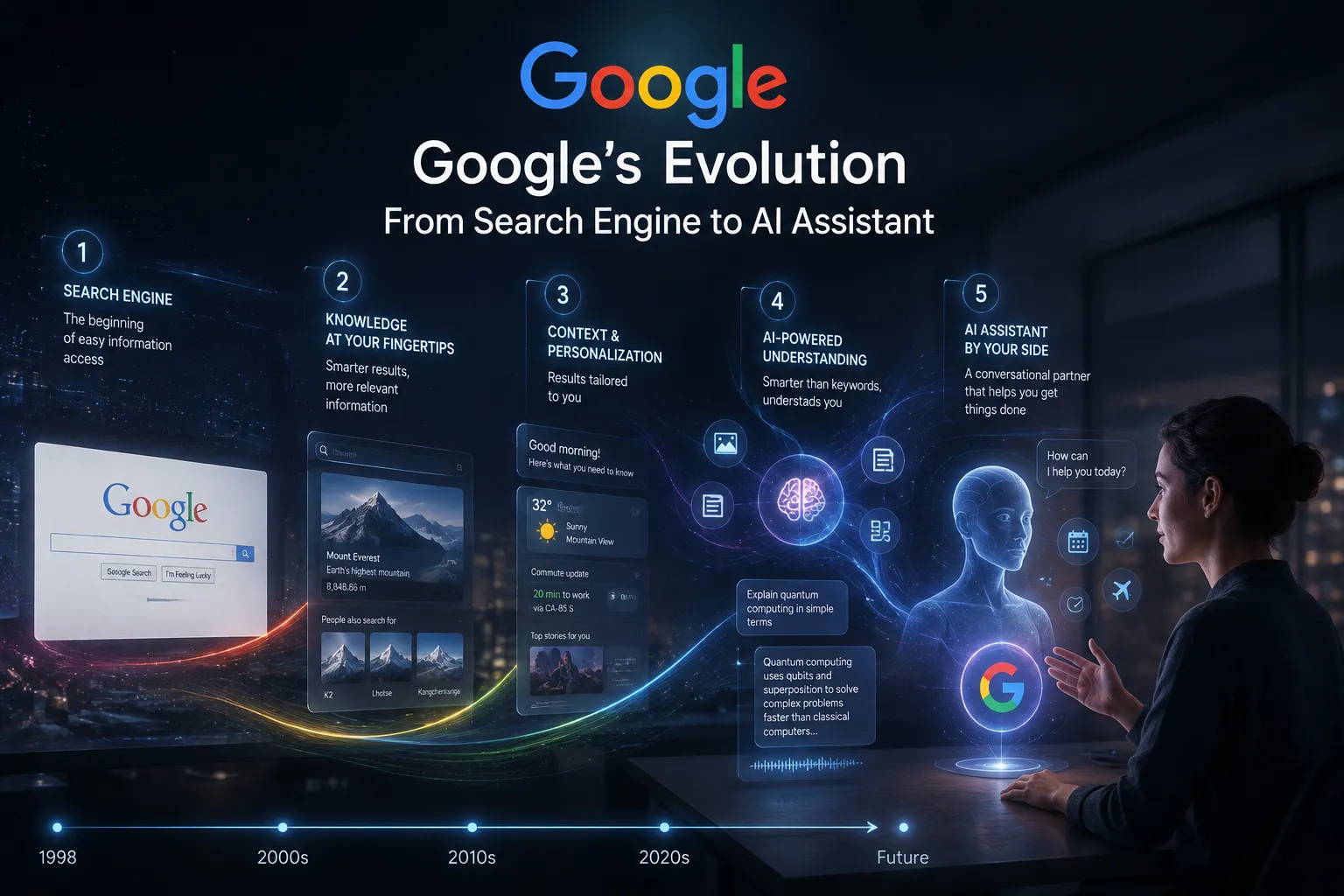
Google's Evolution From Search Engine to AI Assistant
Google's transformation has been gradual rather than sudden. Over the years, the company introduced features such as Knowledge Panels, Featured Snippets, People Also Ask, local packs, and rich results. Each innovation aimed to answer user questions more efficiently within the search results.
Artificial intelligence accelerates this strategy significantly.
Today, Google's AI-generated overviews can summarize complex topics before users even click a website. Instead of presenting ten links and asking users to compare them manually, AI creates concise responses supported by information gathered from multiple trusted sources.
This represents one of the biggest changes in search history.
Google is moving toward becoming an intelligent information assistant rather than simply an index of websites.
Several developments have contributed to this evolution:
- Advanced language models capable of understanding nuanced questions.
- Semantic search that identifies relationships between concepts.
- Context-aware ranking systems.
- Personalized search experiences.
- Multimodal AI capable of interpreting text, images, voice, and video together.
The result is a more natural search experience that feels increasingly conversational.
Users can now ask lengthy questions, compare products, request explanations, or continue conversations without repeatedly reformulating their searches.
For businesses, visibility is no longer limited to ranking first for a keyword. Instead, content may be cited, summarized, or referenced by Google's AI when generating answers.
That makes content quality, expertise, credibility, and topical authority more valuable than ever.
How AI Search Changes the User Experience
The average internet user is already experiencing AI search, even if they don't realize it.
Search results have become faster, smarter, and more informative. Instead of opening multiple tabs to compare information, users increasingly receive summarized answers immediately.
This creates several noticeable changes.
First, search becomes more conversational. People naturally ask complete questions instead of typing fragmented keyword phrases.
Instead of searching:
"SEO AI Google"
Users increasingly ask:
"How does Google's AI search affect SEO for small businesses?"
AI understands both approaches, but conversational queries often produce more helpful responses.
Second, search sessions become shorter yet more productive.
Users spend less time clicking between websites because AI provides an overview before presenting supporting resources.
Third, follow-up questions become seamless.
Someone researching electric vehicles can ask about battery life, charging infrastructure, maintenance costs, and government incentives without restarting the search process.
This conversational experience mirrors interactions with AI assistants like ChatGPT and other large language models.
However, there are also challenges.
Users may click fewer websites because AI-generated summaries answer many informational questions directly.
Publishers therefore face declining organic traffic for certain query types, particularly informational searches with straightforward answers.
On the other hand, users who do click through often have stronger intent because they seek deeper expertise, original research, products, or detailed guidance beyond the AI overview.
This means quality traffic may become more valuable than sheer visitor volume.
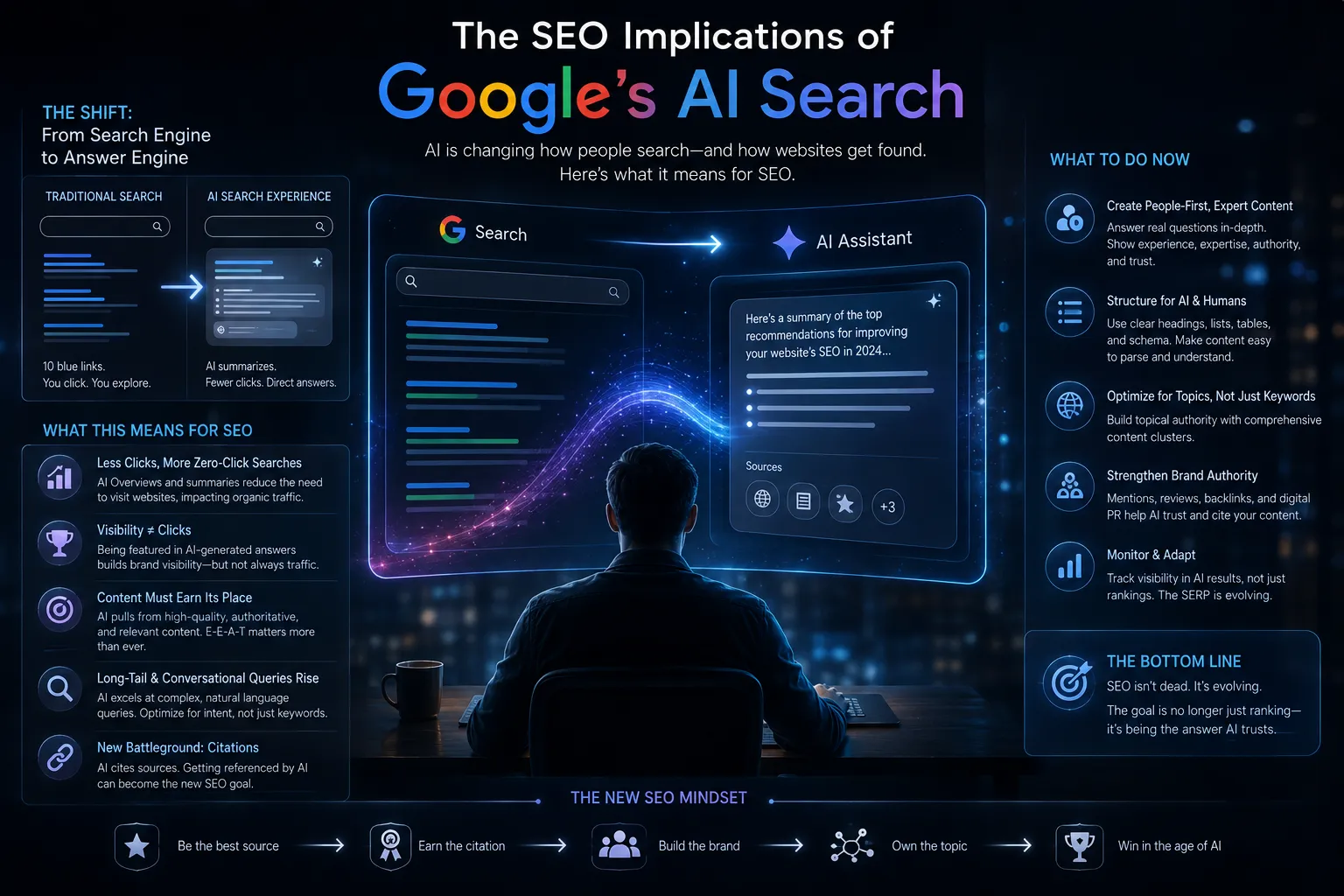
The SEO Implications of Google's AI Search
Perhaps the biggest question for marketers is whether SEO still matters.
The answer is yes—but SEO is evolving.
Ranking pages remains important because Google's AI still relies on trustworthy web content to generate responses. Without high-quality websites, AI has no reliable information to reference.
However, optimization priorities are changing.
Modern SEO increasingly focuses on semantic search rather than isolated keywords.
Instead of targeting a single phrase repeatedly, successful content comprehensively covers an entire topic while answering related questions users are likely to ask.
Topical authority becomes essential.
A website demonstrating deep expertise across an entire subject area is more likely to be trusted by both Google's ranking systems and AI-generated responses.
Content should also demonstrate:
- Clear expertise.
- Original insights.
- Accurate information.
- Strong internal linking.
- Structured headings.
- Helpful examples.
- Comprehensive topic coverage.
Google's emphasis on helpful, people-first content aligns perfectly with AI search.
Thin articles written only to rank keywords are becoming less effective.
Instead, AI systems reward content that genuinely solves problems.
Technical SEO remains highly relevant as well.
Fast-loading pages, mobile optimization, structured data, crawlability, accessibility, and logical site architecture help search engines understand content more efficiently.
Another growing consideration is entity optimization.
Rather than focusing exclusively on keywords, Google increasingly understands people, organizations, products, locations, and concepts as interconnected entities.
Building authority around identifiable entities strengthens semantic relevance.
Businesses should also pay attention to branded search.
As AI systems become more selective about trusted sources, strong brand recognition can significantly improve visibility within AI-generated answers.
How to Optimize Content for Google SEO, Semantic Search, and AI Engines
Preparing for AI search requires a broader content strategy than traditional keyword optimization alone.
Start by understanding user intent.
Every piece of content should answer genuine questions, solve real problems, and provide value beyond what an AI summary can easily generate.
Long-form, comprehensive articles often perform well because they cover topics in sufficient depth while addressing related subtopics naturally.
Semantic search optimization means including relevant concepts, synonyms, entities, and contextual information instead of repeating identical keywords.
For example, an article about AI search should naturally discuss machine learning, search intent, large language models, Google's algorithms, conversational search, user experience, and content quality.
This creates richer topical relevance.
Content structure also matters.
Clear H2 and H3 headings help both users and AI systems understand information hierarchy.
Short paragraphs improve readability across devices.
Bullet points and numbered lists make information easier to scan.
Answering frequently asked questions within content also increases the likelihood of appearing in AI-generated summaries.
Originality is becoming a major competitive advantage.
AI can summarize existing information easily, but firsthand experience, expert opinions, proprietary research, case studies, and unique data remain highly valuable.
Businesses should invest in creating content that contributes new knowledge rather than simply rewriting what already exists online.
Trust signals are equally important.
Author expertise, citations where appropriate, transparent business information, customer reviews, and consistent branding all contribute to perceived credibility.
From a technical perspective, structured data continues to play an important role by helping search engines understand page content more accurately.
Internal linking strengthens topical authority while guiding both users and crawlers through related information.
Finally, remember that AI engines increasingly evaluate overall content quality rather than isolated optimization tactics.
The best-performing websites are those that consistently publish valuable, accurate, and user-focused content.
Conclusion
Google Search is no longer just a search engine—it is steadily evolving into an AI-powered information platform. Rather than simply directing users to websites, Google increasingly generates intelligent answers that interpret intent, summarize trusted information, and provide conversational experiences.
For users, this means faster, more relevant, and more intuitive search experiences.
For businesses, publishers, and marketers, it represents both a challenge and an opportunity.
Organic visibility is no longer determined solely by keyword rankings. Success depends on creating authoritative, trustworthy, and comprehensive content that serves both human readers and AI-powered search systems.
The fundamentals of Google SEO remain important, but they now work alongside semantic search, topical authority, structured content, entity optimization, and user-first experiences.
Organizations that adapt early will be better positioned as AI continues reshaping search.
Rather than viewing AI as a threat to SEO, businesses should see it as the next evolution of search optimization. High-quality content, genuine expertise, and a strong understanding of user intent have never been more valuable. As Google's AI capabilities continue to advance, the websites that consistently educate, solve problems, and build trust will remain the ones most likely to earn visibility, authority, and long-term organic success.

















Responses (0)
Sign in to share your thoughts.
Sign in