
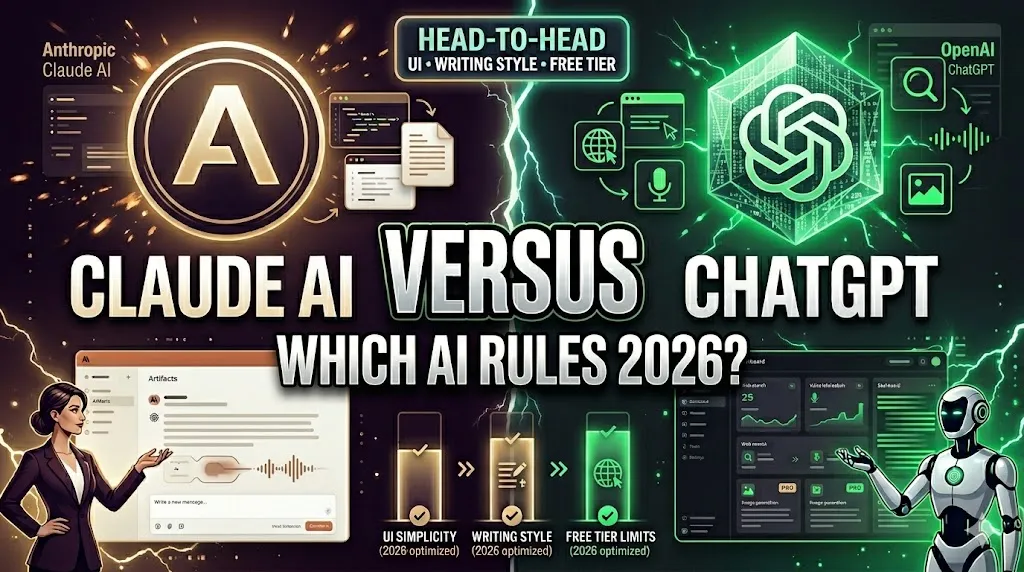
Series 1: Claude AI vs. ChatGPT: Which Should You Use in 2026?
'CLAUDE vs CHATGPT' accented by a glowing '2026' banner. Style: High-contrast, clean corporate-tech digital illustration, distraction-free background.
The landscape of consumer Artificial Intelligence has entered a mature, highly nuanced era in 2026. Long gone are the days when AI chatbots were quirky novelties prone to immediate hallucination. Today, the choice between Anthropic’s Claude and OpenAI’s ChatGPT is a foundational decision that impacts personal workflows, software engineering output, and corporate productivity pipelines. While both ecosystems offer exceptional processing capabilities, their design philosophies, output architectures, and commercial limitations have diverged sharply.
1. User Interface and Workspace Philosophy
The physical and cognitive layout of an AI interface determines how naturally it integrates into a human user's daily habits. In 2026, the contrast between Claude and ChatGPT's interface frameworks highlights their fundamentally different user strategies.
Claude’s Clean Canvas: Anthropic has doubled down on a deeply minimalist, document-first philosophy. Claude’s workspace feels less like a chat terminal and more like an executive text editor. The interface is highly spacious, leveraging warm off-white tones and elegant typography that minimizes visual fatigue during deep-focus work sessions. The defining architectural marvel is its secondary window system, which keeps conversations separate from interactive collateral.
ChatGPT’s Action Hub: OpenAI has optimized ChatGPT to serve as a fast-paced command center. It relies on a dense, utilitarian dashboard designed to quickly switch between voice modes, active plugins, and custom GPT extensions. ChatGPT's interface is built around high-speed interactive tools, presenting a more technical, multi-modal layout suited for rapid multi-tasking.
2. Writing Style and Cognitive Nuance
When assessing the pure text output of these LLM engines, the differences in their core optimization objectives become immediately apparent. The selection of one tool over the other often hinges entirely on the desired tone and structural depth of the generated text.
The Anthropic Literary Polish: Claude is widely recognized for its superior human-like prose, elegant syntax variations, and conversational self-awareness. It routinely avoids the generic linguistic traps that plague machine learning outputs—such as starting paragraphs with 'In today's fast-paced world' or overusing terms like 'testament' and 'delve.' Claude is highly capable of subtle tonal shifts, making it the preferred choice for screenwriters, technical essayists, and branding experts who require an authoritative, natural voice.
The OpenAI Analytical Execution: ChatGPT approaches writing with absolute precision, structural rigidity, and data-dense efficiency. It excels at highly structured corporate briefs, bulleted operational summaries, and strict compliance manuals. While its output can occasionally read as slightly clinical or formulaic without aggressive custom instructions, its structural predictability makes it exceptionally reliable for institutional workflows that prize consistency over literary flair.
3. Free-Tier Limitations and Commercial Accessibility
For the casual or cost-conscious operator, the structural constraints placed on the unpaid tiers of these platforms are often the deciding factor. Both organizations have implemented starkly contrasting monetization throttles in 2026.
Feature Dimension
Anthropic Claude (Free Tier)
OpenAI ChatGPT (Free Tier)
Message Volume Throttling
Strict dynamic context-based limits. Cuts off rapidly under heavy text load.
Generous, predictable caps on base models; temporary access to high-tier models.
File Analysis & Context Window
Massive document acceptance, but consumes user message budget very quickly.
Smaller individual prompt windows, but includes native internet search capabilities.
Advanced Feature Access
Basic artifact display allowed; Custom Project environments locked.
Advanced Data Analysis and Custom GPT access included with lower priority rates.
Conclusion: The Strategic Verdict
In 2026, choose Claude if your primary operations revolve around sophisticated long-form writing, parsing deep legal or research documents, or collaborative coding where clean UI isolation matters. Choose ChatGPT if you require an omnivorous operational assistant with uninterrupted web access, real-time voice tools, and a reliable free tier that doesn't restrict casual, multi-hour query sessions.





















Responses (0)
Sign in to share your thoughts.
Sign in