
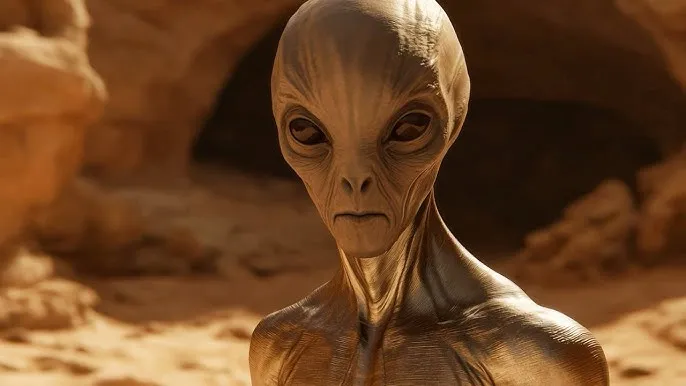
We’ve all stared up at the night sky and wondered. Are we alone? For decades, scientists have scanned the stars with radio telescopes, sent probes to Mars, and debated the Fermi Paradox: if the universe is so vast and old, where is everybody? But what if the answer isn’t silence — what if they’re already here, or on their way, and they’re not just visiting? What if they’re vastly more intelligent than humans?
Let’s play out that scenario. Not the Hollywood version with laser battles and Independence Day fireworks, but the quieter, more unsettling reality of encountering beings whose minds operate on a level we can barely comprehend.
The Discovery Moment
Imagine the announcement. Not a blurry video of lights in the sky, but something undeniable: a signal decoded from deep space that contains mathematics too elegant for human minds to have invented, or a probe that lands gently in the desert and begins communicating in perfect, anticipatory English (and every other language). Or perhaps we simply detect their megastructures — Dyson spheres dimming distant stars, or artifacts already embedded in our solar system that we’ve been mistaking for natural phenomena.
The first shock wouldn’t be their existence. It would be the gap. Their technology wouldn’t be “a few centuries ahead.” It might be thousands or millions of years ahead. They could manipulate gravity like we flip a light switch, engineer biology at the atomic level, or think in dimensions our brains literally can’t perceive.
What Intelligence That Superior Looks Like
Human intelligence is impressive — we went from stone tools to smartphones in a geological blink. But we’re still limited by biology: our brains are energy-hungry, prone to bias, and evolved for savanna survival, not cosmic puzzles. A species millions of years further along the evolutionary or technological curve might treat quantum mechanics as basic arithmetic. They could solve problems like dark energy or the hard problem of consciousness the way we solve crossword puzzles.
Communication with them might feel like a toddler trying to debate philosophy with a panel of Nobel laureates — except the laureates are also telepathic, or use some form of direct mind-linking we don’t even have words for. Misunderstandings wouldn’t be cute cultural differences. They could be existential.
Would they see us as charming primitives? Potential students? Or pests? History isn’t reassuring here — when technologically superior humans encountered less advanced societies on Earth, the results were rarely equal partnerships.
The Ripple Effects on Earth
Science and Technology: Overnight, fields like physics and biology could leap forward centuries. Cures for diseases that seem impossible today. Clean energy that makes fossil fuels look like rubbing sticks together. But there’s a catch: dependency. If we rely on alien knowledge, do we stagnate as a species? Would we become the cosmic equivalent of a cargo cult, waiting for the next download from the sky?
Society and Politics: World governments would scramble. Some leaders might try to weaponize the contact, others to monopolize it. Religions would fracture or adapt — some seeing saviors, others demons. Conspiracy theorists would say “I told you so,” while millions experience a profound existential vertigo. What happens to human ambition when we know there are minds that dwarf ours?
Economy and Daily Life: AI that we built might suddenly look embarrassingly primitive. Jobs in every sector could transform or vanish. Art, music, and culture might explode with new inspiration — or feel small in comparison. Imagine trying to write a novel knowing that somewhere out there, aliens have perfected storytelling in ways that make Shakespeare look like a child’s scribble.
The Philosophical Gut Punch: This would be the biggest shift. For most of human history, we placed ourselves at the center of the story — created in God’s image, the pinnacle of evolution. Meeting superior aliens forces a humbling rewrite. Are we a stepping stone? An experiment? Just one average species among millions?
Some philosophers argue this could be liberating. If we’re not the smartest, we don’t have to carry the unbearable pressure of being the universe’s main character. We could focus on being better humans — kinder, more curious, more cooperative — rather than dominant.
Risks and Opportunities
The dangers are obvious. An intelligence gap this large could lead to accidental harm. They might not even notice us at first, like we don’t notice ants when building a highway. Or they could view us through a lens of cold utility: resources to harvest, DNA to study, a planet to “improve.”
But optimism isn’t foolish either. A truly advanced civilization might have moved past scarcity, conquest, and ego. They could be post-biological — minds uploaded or distributed across machines — and see sharing knowledge as natural as breathing. They might help us avoid self-destruction from climate change, nuclear weapons, or rogue AI.
The key variable is their values. Intelligence doesn’t guarantee benevolence. A superintelligent species could be compassionate, indifferent, or malevolent in ways we can’t predict. We might need to grow up fast as a species to even have a meaningful conversation.
Facing the Cosmos
In the end, discovering superior aliens wouldn’t just answer the question “Are we alone?” It would force us to answer “Who are we, really?”
We might feel small. That’s okay. The universe was always bigger than us. The real test would be our response: Do we panic, divide, and regress? Or do we get curious, humble, and reach higher than we ever thought possible?
Maybe that’s the real gift they’d bring — not their technology, but the mirror they hold up to humanity. A chance to evolve, not because we’re the smartest, but because we refuse to stay limited.
For now, it’s still speculation. But the next time you look at the stars, consider this: the silence might not be empty. It might just be polite. And when it breaks, we’d better be ready — not with weapons, but with wonder.
What do you think? Would meeting smarter aliens be the best or worst thing to ever happen to us?




















Responses (1)
Sign in to share your thoughts.
Sign in